

Welcome to the latest edition of Corgi Diecast Diaries, your regular blog review of all the news, updates and topical stories from the captivating world of Corgi die-cast model collecting.
We know that our readers like nothing more than finding out about a new Corgi model exclusive and we are pleased to inform you that this is exactly what we have for you in this latest edition and more than that, it’s at the double! Coming direct to you from the computer of our product design engineers, we will be taking an exclusive first early design look at screenshots from both the new Spitfire Mk.IX and Spitfire T.9 tooling projects, whilst at the same time discussing why these represent a significant addition to the ever popular Aviation Archive range. Not wanting to forget about some beautiful new models which have just been, or are about to be released, this Aviation Archive centric edition of the blog will also include signed sample pictures of two fantastic impending additions to the range, with the fascinating stories behind each one making these models so attractive to Corgi collectors.
Before we get started, could we please take a moment to address some reader catalogue concerns. Since the launch of the January - April Corgi model range earlier this month, we have received several messages from collectors expressing their disappointment that a printed version of the catalogue has not been produced, something they also value collecting. The original range announcement did include details of the availability of a downloadable catalogue pdf, something we thought would make the catalogue instantly available to millions of people the world over and take the general paper strain away from most people, but there is more. A printed catalogue was produced and circulated amongst our retail partners, so it should be possible to obtain one from your usual model supplier should you so wish. In addition to this, all orders placed via the Corgi website will be sent a copy of the printed catalogue with their latest in stock order, although this has to be accompanied by the caveat that this is only whilst we still have stocks of the catalogue available. The good news is that there will be a new catalogue and range of models to look forward to this coming May.
Arguably the most instantly recognisable aircraft to ever take to the skies, is it any wonder that people would do almost anything for the opportunity to fly in a Spitfire?
Since the first model appeared back in 1998, the Aviation Archive range has been producing representations of the world’s most iconic aircraft as scale diecast models and as such, arguably the world’s most famous aircraft has been very much on our radar. The Supermarine Spitfire may have the reputation of being Britain’s wartime savour in the nation’s hour of greatest need, but this magnificent aircraft is much more than that and is as familiar to as many people today as it was during the dark days of the Second World War. With its beautifully crafted elliptical wing and long standing association with the Rolls Royce Merlin engine, the Spitfire is an aviation masterpiece, beautiful to look at and ruthlessly effective in the role for which it was intended, the domination of the skies. To most people, the Spitfire is far too handsome to be a fighting machine, which probably goes some way to explaining why it has always been viewed with such affection - flown by heroes and admired by the rest of us.
With the Spitfire being such a famous aviation subject, the Aviation Archive range has been able to boast the inclusion of a Spitfire since 1999, with this first model appearing in 1/144th scale and as part of a multi-model set. This tooling was followed by an altogether more ambitious and it has to be said, more popular 1/72nd scale model the following year, but we will look at this in a little more detail in a second. The next new Spitfire tooling from Corgi arrived in 2002 and was something pretty special at that time, a diecast Supermarine Spitfire Mk.I in 1/32nd scale - in the eyes of the diecast collector, the Spitfire could do no wrong.
By far and away the most popular series of Spitfire models to appear in the Aviation Archive range were produced in 1/72nd scale, the scale which many collectors regard as the main collecting scale. These early models showed that scale diecast models were here to stay and that we now had access to a range of hugely collectable metal models which were proving to be rather addictive - it is likely that many of our readers will have several of these classic Corgi models in their collections.
The current Corgi Spitfire project is the first and only time a restored example of the aircraft has been the subject of a development LIDAR scan prior to work starting.
If we are being perfectly honest, this first Spitfire tooling, whilst being extremely welcome, was perhaps a little over ambitious and included tooling slides to allow several different marks of the aircraft to be modelled, from the Mk.I through to the Mk.IX. Since the appearance of this original 1/72nd scale tooling, our design teams have returned to this famous subject and produced updated representations of the Spitfire, concentrating on earlier marks to this point, but things are about to change.
The Mk.IX variant of the Spitfire was arguably the most important mark of the aircraft, due to the fact that it was something of a stop-gap arrangement introduced to counter the threat of the Luftwaffe’s Focke Wulf Fw190 and although our 1/72nd scale diecast representation of the aircraft was really nice and met with significant collector support, the fact that it was a hybrid development of the original tooling meant that it was perhaps not as accurate as it could have been. With the aircraft’s stellar reputation and the advent of more advanced design and manufacturing techniques, the current Corgi team felt that it was about time we addressed this Spitfire situation.
An exclusive first look at the resultant scan data image following our hugely enjoyable visit to the Biggin Hill Heritage Hangar.
With the announcement of our January - April range, we were also allowed to inform Corgi collectors that we were working on three new Aviation Archive tooling projects for the coming year, including not one, but two new Spitfire models. We are now in a position to bring you a little more detail about these projects, including an exclusive first look at several design screengrabs, produced during the early development stages of both new models. Looking at both separately, let’s begin by looking at the Spitfire Mk.IX and our fitting tribute to this most capable variant of the Merlin powered Spitfires.
New Corgi Spitfire Mk.IX
An exclusive first look at a CAD design screenshot from our new Supermarine Spitfire Mk.IX tooling project, but one which already highlights the impressive level of detail the new model will feature.
Making its maiden flight from Eastleigh Aerodrome on 5th March 1936, the Spitfire would not only go on to earn the reputation as Britain’s most famous fighting aeroplane, but would also prove adaptable enough to undergo constant modification and upgrade, to maintain its position as one of the most capable fighter, fighter bomber and reconnaissance aircraft of the war. With constant wartime production and over 22,000 Spitfires and Seafires eventually built, the later marks of machines were capable of attaining speeds approaching 100 mph faster than the first Spitfires to enter service, even though they still maintained much design commonality with their predecessors.
It could be argued that the Spitfire Mk.IX was the most important mark of Spitfire in the aircraft’s entire production run and as a result, it is somewhat surprising to learn that it was actually something of a stop-gap development. The arrival of the Luftwaffe’s new Focke Wulf 190 fighter over the Western Front in August 1941 saw RAF Spitfire Mk.Vs operating over the Channel falling victim to the ‘Butcher Bird’ in ever increasing numbers and something had to be done. A major Spitfire upgrade was in progress, but the Mk.VIII was still some way off, as manufacturing facilities prepared their tooling jigs for the new aircraft, but there was a temporary solution. One of the major features of the new Spitfire was its use of a powerful new version of the Rolls Royce Merlin engine and it was proposed that fitting this new engine to a Spitfire Mk.V airframe would give the fighter a welcome performance boost.
The first 100 Spitfire Mk.IX fighters were actually Mk.Vc airframes adapted to take the new Merlin 61 two stage, two speed supercharged engine, with this combination producing a thoroughbred fighting aeroplane, one which was more than capable of challenging the FW190 and the latest ‘F’ variant of the Messerschmitt Bf 109. In fact, the new Spitfire was considered so successful that this would become the second most heavily produced variant in the entire production run and if including the aircraft powered by the licence built Packard Merlin 266 (Spitfire Mk.XVI) even eclipsed the Mk.V in production numbers. With further powerplant refinement taking place throughout the production life of this variant, the first Mk.IX Spitfires began joining RAF Squadrons from July 1942, with this famous mark of Spitfire going on to see service past D-Day and into the post war era. The last major Merlin engine powered variant of the Spitfire, this ‘emergency stop-gap fighter’ would actually go on to be considered something of an aviation classic.
Another trio of development images from our new Spitfire Mk.IX tooling and what’s that lurking under the wings?
Our new 1/72nd scale Spitfire Mk.IX tooling will produce our most accurate model of this mark of Spitfire we have ever produced, leaving collectors to judge where it sits in the history of diecast Spitfire models. We have been fortunate enough to be allowed access to Airfix research and design information during this early phase of development, something we believe will set this model apart when it comes to detail and accuracy. We firmly believe that Airfix have access to the most robust collection of Spitfire research material in the world and as they have been producing Spitfire model kits since 1955, we are certain that access to this information will be of huge benefit to our exciting new tooling project. They just happen to have introduced their own spectacular new 1/24th scale superkit of the Spitfire Mk.IX to their recently announced 2022 range, a development which proved rather fortuitous for us.
The images we are showing here are an exclusive first look at CAD screenshots produced during the design phase of this new model tooling and whilst far from being the finished article, they do show how we have managed to capture impressive levels of detail and that the project is advancing nicely. The model will be taking its place in a range announcement later this year, when we have a clear idea of production and availability schedules and at that point, the model will have its own webpage and will be available for pre-order. We look forward to bringing you many more Spitfire blog updates in the weeks to come - oh, by the way, do you notice anything unusual under the wings?
Corgi Supermarine Spitfire T.9
100% Spitfire, but one made for two! This beautifully clear LIDAR scan image of the Biggin Hill Heritage Hangar’s TE308 will give our designers a head start when working on our new Spitfire T.9 tooling.
As one of the most heavily produced fighter aircraft of all time, you would be forgiven for thinking that a two seat training variant of the Spitfire would have been high on the list of Air Ministry requirements during WWII, as they explored every possible way to have more combat prepared Spitfire pilots available to front line squadrons as they possibly could. In fact, even though the Supermarine company seriously discussed the production of a two seat Spitfire as far back as 1941, the Air Ministry showed no interest in the proposal, presumably down to the fact that there was a shortage of new Spitfires at that time and they couldn’t risk the possibility of increasing this shortage. In any case, they saw no need to make changes to a pilot training programme which appeared to be working so well.
The first ‘two seat’ Spitfires were unofficial modifications, made by individual overseas Spitfire squadrons, or more notably, by the Soviet Air Force. Supplied with over 1000 Spitfires, the Russians converted several Spitfires to two seat configuration, but rather than moving the front cockpit slightly forward as Supermarine would later do, the Russians simply added their second cockpit behind the existing one, in a narrower section of the fuselage and making these aircraft rather distinctive.
The next three images show CAD design screenshots of the new Spitfire T.9 tooling at different angles, a beautiful new model which will grace Aviation Archive collections later in the year.
Once aware of the Russian Spitfire conversions, Vickers Supermarine revived their interest in a two seat Spitfire as a private project in 1946, selecting a Spitfire Mk.VIII airframe as their donor aircraft. In fact, one of the most interesting facts about the two seat Spitfire variant is that there is no such thing as a new-build Spitfire trainer, as every single example was originally manufactured as a single seat fighter.
Something of a post war phenomenon, the two seat Spitfire did attract several military operators over the years, however, it is during the warbird restoration era and possibly even as recent as just the past decade that the popularity of ‘Spitfires made for two’ has really taken hold. As arguably the most famous aircraft of all time, the ability to boast that you had flown in a Spitfire used to be the preserve of talented and extremely fortunate pilots, however, as they now had the opportunity to carry a passenger, the Spitfire flying floodgates had opened and there was seemingly no end of people queueing to get Spitfire experience in their bucket list log books.
Over recent years, offering Spitfire experience flights has become an extremely lucrative business, to the point that only a few years ago, almost every Spitfire under restoration was being converted to T.9 or two seat Spitfire standard. These aircraft are now much loved in their own right, regularly appearing at Airshows and operating in all but the poorest weather conditions, offering Spitfire flights to their latest lucky recipients. If you are ever fortunate enough to take a flight in one of these magnificent aircraft, you will surely never forget the experience, with yourself and your loved ones going on to have a close affinity with the actual Spitfire you flew in, or the one which was flying next to you. These Spitfires made for two are maintaining and even enhancing the legacy of this magnificent aeroplane, bringing R.J Mitchell’s classic design to the hearts of a new generation of Spitfire converts.
The undoubted popularity of the Spitfire T.9 was the deciding factor in our decision to make our new Spitfire tooling project something of a dual undertaking, even though the initial design phase for each model could hardly be more different. We have arrived at Corgi interesting fact time again now, as we confirm that no Corgi (or for that matter Airfix) Spitfire model design project has utilised a LIDAR scan of this famous aircraft as the basis of their initial design - until now! With an impressive library of Spitfire reference material to call upon, all these projects had previously relied on existing design methods and accurate drawings to obtain their Spitfire references, however, for our new Spitfire Mk.9 project, we moved in an exciting new direction.
A 1/72nd scale model representation of the real thing below. If you are lucky enough to have taken an experience flight in a two seat Spitfire, could there possibly be a better way to commemorate your good fortune than with one of our stunning new models?
With grateful thanks to our friends down at the Biggin Hill Heritage Hangar, we were given the opportunity to scan their beautiful Spitfire T.9 TE308 in its stunning ‘Grey Nurse’ squadron markings, undoubtedly one of the world’s most distinctive Spitfires. This was the first time that a LIDAR Spitfire scan will have been used in the production of a Corgi Spitfire model, another first for this exciting project. The images we are showing here feature several of the cleaned up scan images of TE308 and a selection of design screenshots showing details of the new Spitfire T.9. Please note that these are development images and are subject to change, however, we were desperate to share them with you, as our Spitfire twins are a further indication of continued investment in the Aviation Archive range and two stunning new models for us all to look forward to.
Watch this space for more Spitfire exclusives soon.
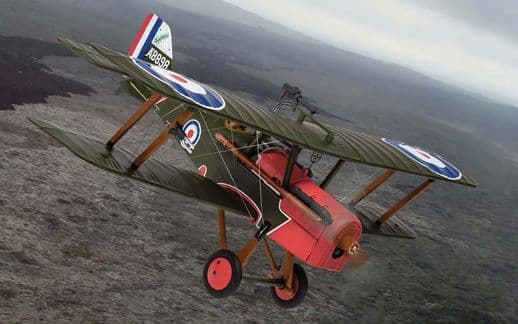
The latest Royal Aircraft Factory SE5a release commemorates one of the greatest British airmen of the First World War and his particularly distinctive fighter.
Although we are recognised for producing some of the finest diecast models the hobby has ever seen, each one of our Aviation Archive releases is in its own way a little piece of history, a model which is a scale representation of a famous aircraft or one which was flown by a significant airman. That is most certainly the case with our latest 1/48th scale Great War aviation release, as we commemorate an aircraft flown by one of Britain’s most celebrated aviator, a man who was referred to as ‘The English Richthofen’ and who was described by the Red Baron himself on hearing of his death as ‘By far the best English flying man’, Albert Ball. Before we go on to look at the story behind this stunning new release, could we just let people know that this model is now available and selling out fast - if you have a pre-order in place and have not received it yet, it might be a good idea to chase it up now.
At a time when Britain was suffering horrendous losses on the Western Front and the nation was in desperate need of a hero, they found what they needed in a handsome young fighter pilot from Nottingham named Albert Ball. Fiercely patriotic and desperate to do his duty, Ball had displayed both bravery and real flying skill in amassing an impressive victory tally in a relatively short period of combat and by September 1916, he had at least 31 victories to his name, making him Britain’s most successful flying ace. The majority of his victories were scored whilst flying the nimble Nieuport Scout and when he was forced to exchange this for the new, but heavier Royal Aircraft Factory SE5 on joining the elite No.56 Squadron RFC, he was initially less than impressed.
He soon came to appreciate the rugged and heavily armed new fighter, as it was more than a match for the latest German Albatros D.IIIs he was now facing in combat. During a period of combat inactivity due to bad weather, 56 Squadron ground crews painted several of their SE5 fighters in flamboyant schemes, reportedly in response to the colourful German aircraft which were opposing their pilots. This unusual embellishment would prove to be relatively short lived, as higher authority took a dim view of the practice and ordered the markings removed immediately.
In the early evening of 7th May 1917, Albert Ball led a flight of thirteen SE5 fighters from Vert Galant airfield on a hunting mission, hoping to clear the skies of any German fighters they encountered. By this second mission of the day for Ball, the weather had started to deteriorate and with the skies darkening and rain in the air, the long patrol eventually resulted in a savage dogfight with Albatros fighters of Jasta 11. Selecting a red painted Albatros as his target, Ball relentlessly pursued the German fighter, which was piloted by ace Lothar von Richthofen, younger brother of the famous Red Baron. Unable to shake off his British attacker and clearly fearing for his life, von Richthofen put his aircraft down in the first suitable field he saw, unharmed, but out of the fight.
What happened next is shrouded in mystery. With light fading fast and the weather deteriorating still further, Albert Ball’s SE5 fighter was seen to emerge from the low cloud base at around 500 feet, inverted, with its engine seized and trailing smoke. It crashed, still inverted on nearby farmland, where the young airman was pulled from the wreckage by local girl, who cradled him during his final moments. His death was caused by injuries sustained in the crash and not as a result of combat, but that didn’t stop Lothar von Richthofen from claiming the victory – unfortunately for him, his official report stated he had been in combat with a British triplane, before he had been brought down.
The loss of Britain’s leading fighter ace was not only a tragedy for squadron personnel back at Vert Gallant aerodrome, but also for the entire nation. Albert Ball was a reluctant inspiration to millions of people, with official plaudits and civil receptions being something which really made him really quite uncomfortable, but something he had to get used to. By his own admission, he was much more at home in the cockpit of his fighter, doing ‘his bit’ for King and Country, away from all the fuss. In the month following his death, the London Gazette published the announcement that Albert Ball had been posthumously awarded the Victoria Cross, Britain’s highest award for valour in the presence of the enemy.
It has since been reported that Ball was being considered for this significant award weeks before his final combat, as the legend of ‘The English Richthofen’ was already proving to be an inspiration for troops fighting on the Western Front and to the British public back home. Tragically, this quiet young man for whom duty and honour meant so much, would never have the opportunity to receive this recognition in person.
This stunning new model marks the story of one of the most talented airmen to have ever flown in the markings of a British aircraft.
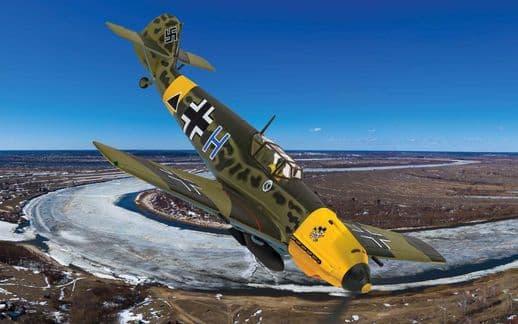
During the Eastern Front campaign, a special unit of Messerschmitt Bf109 fighters were used in a close air support role, with its pilots becoming adept at dive bombing Soviet positions.
Last but certainly not least in this latest edition of our blog is the final release in our Barbarossa/Strike East collection, a scale example of the famous Messerschmitt Bf 109E fighter, but one which was unusually operated in a dive bombing/close air support role. As production on this latest blog got underway, this model had still not arrived in our warehouse, but there is nothing like a Breaking News feature and we are pleased to report that pre-orders are now being processed.
Even as the Luftwaffe were mounting some of their heaviest bombing raids of the Second World War against London, other units were secretly being moved to airfields close to the border with the Soviet Union, in preparation for what would be the most powerful invasion force ever assembled in the history of warfare - Operation Barbarossa, the strike against the Soviet Union. Hitler’s plan was to seize vast swathes of Soviet territory, effectively ending the threat of the Soviet Union as a military force, whilst at the same time affording the Third Reich huge supplies of natural resources for their continued war effort. Conquered cities and their populations would be pressed into service as slave labour for German industry and much needed living room for his own population could be secured.
Military planners were convinced that the Soviets were in no position to withstand an onslaught of this ferocity and with the professionalism of their combined and cohesive invasion forces, they expected to defeat their enemy in possibly as little as three months of fighting. The elements of strategic surprise and tactical effectiveness were crucial if the plan was to succeed, with the Luftwaffe playing a central role in not only the initial air strikes, but also as Wehrmacht forces continued to push deeper into Soviet territory. In support of Barbarossa, the Luftwaffe would commit 65% of its entire strength to the operation, in full knowledge that they would be facing the largest air force in the world at that time.
Messerschmitt image selection, this latest Bf 109 release is the last in our Barbarossa/Strike East collection.
As one of the most famous fighting aeroplanes in the history of warfare, the Messerschmitt Bf 109 series is synonymous with Luftwaffe operations during the Second World War and indeed was both constantly upgraded and in constant production for the entirety of the conflict. In fact, the ground-breaking Bf 109 was already in service at a time when most of the world’s major air forces still had biplane designs as their front line fighters and incredibly, later variants of the aircraft were still in service at the advent of the jet age. The ‘E or Emil’ variant of the Messerschmitt Bf 109 was the second most numerous version of the fighter to be produced and the one which served extensively throughout the Battle of Britain and during the massive aerial battles of Operation Barbarossa, the German invasion of the Soviet Union.
This conflict would extend far beyond the six months of Barbarossa itself and descend into a bloody attractional war over vast areas of territory and become a significant turning point in the outcome of the Second World War. During the savage fighting around Stalingrad in late 1942, early 1943, some of these older variants of Bf 109 were adapted to fly close air support missions, acting like high speed dive bombers in support of ground troops who were encountering particularly stubborn areas of Soviet resistance. These ground attack Messerschmitts proved incredibly effective, even though the inexorable tide of incessant Soviet offensives had already dictated the outcome of this struggle.
That’s all we have for you in this latest edition of Die-cast Diaries, but we will be back again in two weeks’ time with more Corgi model exclusives, when this time we will be focussing on an impressive selection of new Vanguards models. We would be delighted if you could join us then.
In the meantime, we are always interested to hear your Corgi related views, so if you would like to drop us a line to comment on anything blog related or to suggest a topic you would like to see covered in a future edition of the blog, could we ask if you would use our diecastdiaries@corgi.co.uk email for all correspondence.
If you can’t wait for the next blog, you will find plenty of Corgi model collecting discussions taking place on our official social media channels, access to which can be obtained by clicking on the respective links at the foot of the Corgi website homepage.
Thank you for continuing to support our Die-cast Diaries blog.
Our next edition is scheduled for publication on Friday 11th February.

