

Welcome to the latest edition of Corgi Die-cast Diaries, your regular blog review of all the news, updates and topical stories from the captivating world of Corgi die-cast model collecting.
One of the most appealing benefits of being a Corgi Aviation Archive model collector is how we not only have beautiful scale representations of some of the world's most famous aircraft types within our collections, but also how each model plays its own small part in the preservation of aviation history. Over the past 25 years, the models introduced into this range all have fascinating stories to tell, be that the wartime role a particular aircraft performed, its involvement in a particular raid or action, or the exploits of a courageous pilot or crew, but all preserving that piece of history and all adding real interest to our collections.
In this latest edition of our Corgi development blog, we continue this proud legacy by featuring two recent additions to the Aviation Archive range, models which may well be presented in different scales, but aircraft types which span almost half a century of jet fighter development. Both aircraft are historically significant in their own right and both models make for incredibly appealing additions to any model aircraft collection.
It's time to check our weekend flight plans and strap ourselves in, because we've been cleared for our latest Aviation Archive sortie.
Something a little bit different for the enjoyment of our blog readers, our photographer Michael has let his creative juices flow unchecked and used the latest Messerschmitt Me 262 release to produce this very different image.
As the world of aviation can undoubtedly boast some of the most capable and exciting machines ever conceived by mankind within its ranks, it wouldn't take a rocket scientist to deduce that the annals of aviation would undoubtedly provide fertile subject matter for the modelling hobbyists, be that in plastic or die-cast metal, something which has been evident for the past 70 years or so. When referring specifically to the Corgi Aviation Archive range, a collection of models which initially began as something of a limited test range to gauge market opinion would soon become a major force in the brand's fortunes, with a seemingly insatiable appetite for aeroplane models leading to the rapid growth of the range.
Even though the Aviation Archive range is now firmly established, collectors continue to be passionately vocal on suggesting which aircraft types they would like to see added to the range in the years to come and even though we will all undoubtedly have our own particular favourites, we do try to work our way through this very long list with each successive range. Unfortunately, as most collectors will be fully aware, this can be an expensive exercise and we are fighting for development investment along with all the other brands in the Hornby Hobbies family. We will get through your 'wants list', but it will clearly take us a while to get there.
One aspect concerning our existing tool bank which does throw up some exciting opportunities for both us and the collector has been highlighted by the latest 1/72nd scale Messerschmitt Me 262 jet fighter release, that of utilising parts which are available for use, but as yet have not appeared on a limited edition release. Our existing tool bank is packed full of fantastic aircraft subjects and if we can uncover some of these unutilised component gems, we can bring some fantastic new models to display collector cabinets all over the world.
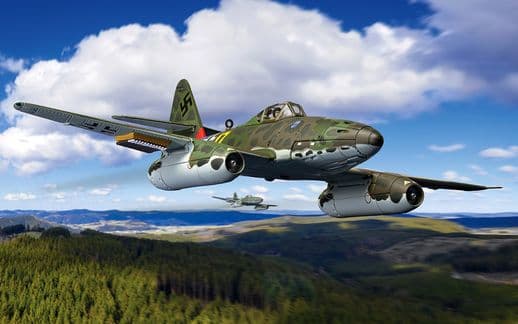
Moving on to the latest Me 262 Schwalbe release, it tells the story of the final aerial duels which took place in the skies above Europe towards the end of the Second World War, and a particular engagement which saw an Me 262 firing unguided rockets at the USAAF Mustangs it was attacking. This release was only possible after a detailed inspection of the tooling plan revealed the existence of a scale representation of the underwing mounted R4M unguided rocket projectiles these aircraft used to break up American daylight bomber formations. Let's take a closer look at the story behind this release now.
As the Second World War entered what we now know to have been its final phase, the airmen of the Allied air forces had finally managed to get the better of the Luftwaffe and whilst their enemy were still capable of inflicting significant damage on any given day, superior Allied numbers and a lack of men and replacement aircraft to shore up the crippling attrition rates being suffered, would eventually prove decisive. Hitler thought the answer to this dire situation lay in technological innovation and the introduction of new weapons which were more capable than anything the Allies had in service at that time, but whilst these reprisal weapons were nearing completion, essential resources were again being directed away from an increasingly futile war situation, which by this stage was irreversible.
As the first V-1 Doodlebugs began their indiscriminate flights towards southern England and V-2 ballistic missiles underwent the final stages of testing prior to deployment, the Luftwaffe would also be the recipient of an astonishing new weapon, the world’s first operational jet fighter. Representing a huge leap in terms of aviation technology, the Messerschmitt Me 262 was unlike any operational fighting aeroplane that had gone before it, with no propellers, swept wings and a fuselage which resembled the body of a shark, a particular analogy which was further perpetuated by the colours in which it was painted and the impressive speed at which this new fighter could launch its devastating attacks.
Potentially, this new jet aircraft posed a serious threat to Allied air operations over Europe and should it have realised its incredible potential, may have taken such a heavy toll of Allied aircraft that the progress of the war could have even been delayed by many months. Such a situation would have also allowed the Germans to introduce more of the wonder weapons they currently had in development, which made the hunting of and destruction of Hitler’s jets an absolute priority for Allied air forces.
Always a popular subject with Aviation Archive collectors, this latest Messerschmitt Me 262 is a beauty and unlike any pervious release.
Allied pilots first began reporting the appearance of a strange new aircraft in the skies above Germany during the early summer of 1944, much to the consternation of Allied military planners. The Luftwaffe’s new fighter was reported to be capable of astonishing speed, far in excess of even the latest Allied fighters and strangely, did not appear to have a propeller. As those early contacts usually ended with the strange German aircraft diving away at high speed, with their pilots forbidden from contact with the enemy at that time, the Allies immediately launched missions to investigate these reports, with reconnaissance aircraft searching for signs of unusual aircraft activity at Luftwaffe airfields deep into occupied Europe and in Germany itself.
They would not have to wait long for confirmation of this fearsome new aerial foe, as the first combat missions of the new Messerschmitt Me 262 jet fighter were mounted in August 1944 and the technological superiority of this astonishing aircraft was made clearly evident as a result. Heavily armed and capable of speeds far in excess of the latest Allied fighters and reconnaissance aircraft, military planners must have been fearful of the devastation these new aircraft could wreak on their bombing offensive and their continued air supremacy. Crucially, how many of these fighters did the Luftwaffe have and how could they be stopped?
Although the aviation history books will often describe the Messerschmitt Me 262 as the most advanced and capable fighter aircraft of the Second World War, perhaps the most reliable opinions on the aircraft should be those offered by those who actually had the opportunity to fly the jet. Eloquently described by famous British test pilot Eric ‘Winkle’ Brown as ‘the most formidable WWII aircraft he ever flew’, he went on to say that in his opinion, ‘the Me 262 represented a quantum leap in aviation performance terms and should be regarded as one of the most significant aircraft in the history of flight’. Thankfully, Captain Brown flew the Messerschmitt Me 262 after the war in Europe had ended and after the potential threat this devastating aircraft possessed had been neutralised.
Operationally, from the time this aircraft started to arrive at Luftwaffe test and evaluation units, its safe operation couldn't actually be guaranteed and the constant threat of Allied air attack saw operating airfields having to move ever deeper into Germany, in order to allow pilot conversion to this incredible new technology to take place. In addition to this, the very different flight characteristics and extremely high speed the aircraft operated at, dictated that only the most proficient fighter pilots were initially selected to fly the Messerschmitt jet and the lack of a two seat trainer variant at that time meant that pilots gaining their first experience of jet-powered flight, would be doing so during their first sortie in the aircraft.
Two more images featuring an advanced production sample of this beautiful new release, one which includes R4M rocket projectiles for the first time.
This underside angle affords us a better view of the R4M rockets and their wooden launch rails.
These highly experienced pilots would surely have been better employed flying against the huge formations of Allied bombers and their supporting fighter escorts which were pulverising German targets on a daily basis, however, this work was left to less experienced men, which only served to make the situation even more desperate for the beleaguered Luftwaffe.
In a high profile aviation case of too little, too late, fuel and material shortages would also result in shortcuts and various workarounds being a feature of Messerschmitt Me 262 production, which was already both expensive and extremely labour intensive, with the most profound impact being on the effectiveness of the ground-breaking Junkers Jumo 004 jet engines which powered the fighter. These highly advanced units were originally manufactured with something of a ‘no expense spared’ approach, but as the Me 262 finally entered full production, the cost and availability of the rare metals used throughout the engine’s construction could not be relied upon and cheaper alternatives were regularly employed.
The dramatic consequences of using lower grade materials during engine construction dictated that most of these units were unable to withstand the high temperatures generated during operation and even though the impressive design of the Messerschmitt Me 262 made it relatively easy for engineers to change an engine, they would usually be required to do so after as little as 10 hours use and certainly after no more than 25 hours at best. Indeed, it was not uncommon to find engine changes required after an aircraft had only conducted a single sortie.
Despite the difficulties of introducing completely new aviation technology during the increasingly challenging position Germany found itself in during the second half of 1944, the impact the Messerschmitt Me 262 had on the European air war and the awesome potential it possessed, posed serious challenges to Allied air superiority and their destruction either in the air or on the ground became an urgent strategic priority. With reconnaissance aircraft searching for airfields operating the new jet fighter and the bombing campaign targeting aircraft manufacturing plants, airfields and general infrastructure, swarms of roving fighter units would mercilessly hunt down the Luftwaffe jets, quickly learning that these early jet engines were relatively slow to respond to changing power settings, especially during the crucial landing and taking off phases of flight.
These unguided rocket projectiles were introduced in an attempt to allow Me 262 pilots to break up the massive USAAF daylight bomber streams, making them a little easier to target individually.
The only thing that mattered was preventing these aircraft from attacking Allied bombers in any sizeable numbers and whether their destruction took place on the ground or in the air, they had to be stopped by all means possible.
Although the Messerschmitt Me 262 jet was undoubtedly a technological marvel, the state of the war at the time of its introduction dictated that it never really stood a chance of having the impact on the air war the Germans had been hoping for. The scarcity of the rare metals required during engine construction and a constant lack of spare parts were constant frustrations to the program and there were even times when aircraft were grounded due to a lack of fuel stocks. Clearly, these were all situations which undermined the operational effectiveness of the world's first jet powered fighter and whilst the Me 262 would score combat victories, it wasn't ever in a position to show its true potential.
One of the most interesting engagements involving a Messerschmitt Me 262 jet fighter during WWII occurred on 10th April 1945, when pilot Lt Walther Hagenah and his wingman were ordered to intercept a heavy raid of USAAF bombers attacking an area north of Berlin. Knowing they would be massively outnumbered by Allied aircraft, the pair intended to attack the formation at high speed, using cannon and their underwing mounted R4M unguided rocket projectiles to break up the formation and spread confusion.
With the mighty bomber stream in sight, Hagenah noticed a flight of six American P-51D Mustangs above them, which immediately dropped their external fuel tanks as they dived in to attack. Hagenah's experience told him that if he turned to face them, or made any violent evasive manoeuvre, the speed of the Mustangs would soon bring him into their gunsights, so instead, he pushed the throttles to full power and began a gentle dive towards the ground, but crucially not changing heading. His wingman decided to take a different course of action, turning to face the Mustangs and immediately being enveloped in a hail of .50 calibre bullets.
With his own jet now at full speed, Hagenah expertly positioned his Messerschmitt for an attack on the American fighters, opening up on them with everything he had, including ripple-firing his R4M rockets at the enemy fighter formation. In his memoirs, he later recalled how two of the Mustangs were hit by rockets and immediately fell out of the sky, but having made his defiant gesture, he now needed to find the nearest Luftwaffe airfield, as he was dangerously low on fuel. Unfortunately, the airfield at Lärz was under attack by swarms of strafing USAAF fighters, but with his fuel situation now critical, he had no option but to land the jet with American fighters still in the overhead.
Combat record keeping at this stage of the war has proved notoriously difficult to corroborate historically, particularly when it came to those submitted by Luftwaffe pilots and despite the availability of Hagenah's personal recollection in this case, he would only be credited with a single Mustang victory during this engagement. Corresponding USAAF records did little to help corroborate his claims, even though reports filed from the American bombers they were ordered to attack did confirm the presence of rocket carrying Messerschmitt Me 262 jets on the day in question.
In fact, even the individual aircraft Hagenah used for this sortie cannot be definitively corroborated, however 'Yellow 17' was one of the jets on the airfield that day and was also one of the machines equipped with the R4M rocket projectiles. One of the most unusual combat engagements of the Second World War, it is thought that this was the only time a USAAF fighter was brought down during an operational sortie using an unguided rocket projectile fired from a Messerschmitt Me 262 jet. If Lt. Hagenah’s account is to be believed, the 10th April 1945 witnessed a truly unique combat engagement in the skies above Berlin.
This latest addition to the Aviation Archive range helps tell the story of this amazing aerial combat encounter from the latter stages of the Second World War and as such, is already proving a hit with collectors all over the world.
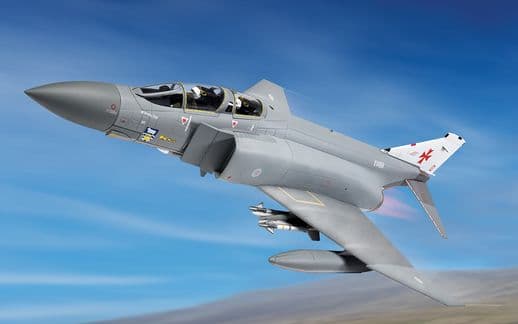
With its distinctive white tail, Phantom XV466 has to be considered one of the most attractive RAF aircraft of the post war era.
Although it could be argued that 1/72nd scale has long been the traditional scale for model aircraft collecting, recent years have witnessed the emergence of a serious scale contender to rival its popularity, with the larger 1/48th scale definitely gaining some significant collector support over that time. Even though their larger size will clearly rule out some larger aircraft subjects from inclusion in any die-cast range, amongst the many benefits these models possess are the ability to include much finer detail across their larger surface area, they make for much more impressive display pieces and arguably present us with much more pleasing representations of the subject aircraft covered.
The announcement of our new 1/48th scale English Electric Lightning F.6 tooling in 2017 heralded an exciting new era for the Aviation Archive range, a high quality collection of Cold War jets in this impressive larger scale and when the Lightning was eventually released, it certainly didn't disappoint. This beautiful new model only left us wanting more, but what would be the ideal follow up addition to the range after the Lightning, a model which would find favour with significant numbers within our collector community? In truth, there really could only be one aircraft and that was the mighty McDonnell Douglas Phantom, but in its Anglicized variant, an aircraft operated by both the Royal Navy and the Royal Air Force and arguably one of the most exciting aircraft to see British service in the post war era.
We are delighted to confirm that just the third model produced from this magnificent tooling has just been released and it’s a cracker! Presenting a British Phantom in unquestionably one of its most attractive liveries, this release presents the Phantom in its Falklands Defender role, a responsibility the jet took on from October 1982 until relieved by Tornado F.3 fighters ten years later, and one which is still being performed by RAF Typhoons to this day.
Concerns about Argentinean aircraft mounting night raids against both the British Task Force and aircraft based on Ascension Island during the Falklands conflict led to Phantoms being deployed to Wideawake Airfield from 24th May 1982, but following the surrender of enemy forces, would temporarily withdraw back to the UK. The proposed permanent deployment of Phantoms to Stanley Airfield as a strong air defence deterrent could not take place until both the runway had been repaired and additional infrastructure works had been completed, leaving the air defence of the Island to RAF Harriers during that time.
With the arrival of the first Phantom on 17th October 1982, island residents has tangible reassurance that the horrors of earlier in the year were unlikely to happen again any time soon, with their Phantoms becoming a popular sight in skies which had been pushed into the world spotlight through conflict. The Phantoms of the Falkland Islands would go on to become some of the most popular RAF aircraft of the post war era, and were clearly subject matter of interest for induction into our Aviation Archive range. We are delighted to confirm that this happy day has now arrived!
Mike's been at it again and this is an absolute stunner! Falklands defending Phantom ready for action.
Following the end of the Falklands War in 1982, an uneasy calm settled over this remote South Atlantic archipelago, however, the Island's population and British military personnel still faced the threat of attack from Argentinean aircraft operating from bases on the South American mainland. It had always been the intention that a standing force of McDonnell Douglas Phantom FGR.2 aircraft would be based on the Falkland Islands following their recapture, however, damage to the runway at Port Stanley would have to be repaired before that could happen. With a lack of adequate early warning radar coverage and with this very real threat of attack remaining, standing patrols had to initially be carried out by Sidewinder missile equipped Harrier GR.3s operating from the rather basic facilities at the temporary airfield known as Kelly’s Garden, situated close to Port San Carlos. The aircraft would later move to RAF Stanley, where conditions were a little better, but RAF Harriers would provide this vital service for a full five months following the end of the conflict.
With the runway works at the new RAF Stanley completed, the first British Phantom jets arrived on the Falkland Islands on 17th October 1982, after undertaking a 3,800 mile flight transfer from Ascension Island, which required the support of Victor tankers for airborne refuelling. Over the course of the next week, a further eight aircraft from No. 29 (F) Squadron arrived at Stanley, immediately providing QRA support for the Islands. The arrival of the Phantoms represented a significant upgrade in the defensive capabilities of the Islands and whilst the threat posed by the Argentine Air Force was still very real, the arrival of these highly capable air defence fighters was a significant deterrent to further military action.
They would also provide reassurance for the Falkland Islanders who had been forced to endure the Argentinian invasion and a war they thought they would never see. At the end of 1983, the Falklands Phantoms of No.29 Squadron were rebadged with the markings of No.23(F) Squadron, who would now assume the role of Falklands Defenders.
For RAF pilots assigned to a rotational tour in the South Atlantic, the remote, yet beautiful Falkland Islands offered some unique benefits. In the years which followed the end of the Falklands conflict, the Islands were littered with the debris of war and for military personnel, this must have offered an interesting diversion when not on duty. Perhaps of even greater appeal was the fact that the remoteness of this location allowed the opportunity for them to enjoy something of a more enthusiastic way in which to fly their aircraft, much more so than would ever be possible in the crowded airspace over Europe.
The next three images all feature an advanced production sample of the latest 1/48th scale McDonnell Douglas Phantom FGR.2 release, a stunning addition to the Aviation Archive range.
The Falklands Phantoms of No.23(F) squadron would be operated by personnel from all the remaining UK Phantom units, with everyone typically serving a four month tour on the Island, before flying back to the UK. For ten years following their arrival, the McDonnell Douglas Phantom FGR.2 would serve the Falkland Islands faithfully, maintaining a high profile, powerful defensive deterrent in helping to prevent a repeat of the dramatic events of 1982. During this period, the Phantom force was regularly maintained at squadron strength, with as many as eleven aircraft deployed to RAF Stanley at any one time.
Although facilities at RAF Stanley did allow the RAF's Phantoms to operate effectively, the runway itself was not capable of supporting large transport and passenger jet operations, in fact, the largest aircraft able to land there was the RAF's venerable old C-130 Hercules. Work to construct a larger, more capable airport at Mount Pleasant soon began and at significant expense to the UK Government, the new facility opened in 1986, quickly followed by the arrival of the air defence Phantoms.
A significant development which would dictate the future of fighter operations in the South Atlantic occurred the following November of the same year. Following a period of ongoing political disagreement with Argentina, the British Government attempted to diffuse tension by reducing the number of Phantoms based on the Islands, down to just four aircraft. This development reduced the squadron to ‘Flight’ status and heralded its adoption of the famous ‘1435 Flight’ name and its WWII Maltese heritage.
1435 Flight – Falkland Island Defenders
Now having just four Phantoms to defend the Islands against the potential might of the entire Argentine Air Force and Navy, the pilots and crew of No.1435 Flight called upon the glorious WWII heritage of this famous unit and established a South Atlantic aviation story which continues to this day. The long association between the Falkland Islands and RAF No.1435 Flight began on 1st November 1988, when No.23(F) Squadron back in the UK started to re-equip with the new Tornado F.3 interceptor. With their Falklands based detachment now reduced to just four Phantom FGR.2 aircraft, the flight drew on its heritage from the siege of Malta during the Second World War and the defiant defence mounted by a small number of almost obsolete Gloster Sea Gladiator fighters of the Hal Far Fighter Flight.
Is this the best-looking Phantom to ever see British service?
Facing overwhelming odds, these aircraft fought off repeated raids by the Italian Air Force, until more modern fighters could be delivered to the Island. Serving as much in the role of steeling the resolve of Island folk, as they were in facing the massed formations of the Regia Aeronautica, the aircraft became enshrined in Maltese folk lore and were given the names ‘Faith, Hope and Charity’ by a Maltese newspaper, noting the heroism of their struggle against all odds. The Falklands based Phantoms would adopt this proud heritage of flying in the face of overwhelming odds, giving three of their No.1435 Flight aircraft the names Faith, Hope and Charity, but what should the fourth aircraft be called.
It was quickly decided that the fourth Phantom, an aircraft which was typically operated as a reserve, should be named ‘Desperation’, which did seem to be rather fitting under these circumstances. The Phantoms of No.1435 Flight also proudly wore the Maltese Cross in recognition of their wartime heritage, in addition to carrying the Falkland Islands coat of arms on the nose of their aircraft.
A particularly hard working Royal Air Force Phantom, XV466 would have time serving with Nos 6, 41, 14, 92, 56 and 29 Squadrons before heading to the South Atlantic, in addition to spending several periods on strength with the Phantom Operational Conversion Unit. During her time with No.1435 Flight based on the Falkland Islands, XV466 earned a reputation as one of the most attractively presented RAF jets of the post war era, with her white tail and large Maltese Cross cutting quite the figure as she helped to deter further conflict in this volatile region.
Having originally entering RAF service with No.228 OCU at Coningsby, this Phantom would end her days in the South Atlantic and after providing many years of faithful service, was unceremoniously scrapped and buried at RAF Mount Pleasant. Thankfully, this latest 1/48th scale Aviation Archive model release will serve as a fine tribute the RAF's Phantom years and immortalise one of the most attractive post war RAF aircraft schemes as a die-cast metal collectable.
A thing of beauty, it's no wonder the Aviation Archive range continues to be so popular with aviation fanatics.
As with the rocket carrying Messerschmitt Me 262 featured earlier, this stunning new 1/48th scale Falklands Phantom FGR.2 is available now and the images included in this update all show an advanced production sample of this impressive new model. For us now here at Corgi, it’s on to the fourth Phantom release and the next subject to grace this growing collection - I wonder which aircraft we will choose this time.
That's all we have for you in this latest edition, however, we will be back as usual in two weeks' time, with a further selection of model project updates to bring you. Between editions, we are always interested to hear your views on all things Corgi, so if you feel like dropping us a line to comment on anything blog, collecting or Corgi model related, or even to suggest a topic you might like to see us cover in a future edition, please do drop us a line at diecastdiaries@corgi.co.uk.
If you can’t wait for the next blog, you will find plenty of Corgi model collecting discussions taking place on our official social media channels, access to which can be obtained by clicking on the respective links at the foot of the Corgi website homepage.
Link access to Corgi social media sites.
Thank you for continuing to support our Die-cast Diaries blog. Our next edition is scheduled for publication on Friday 20th October.

