

Welcome to the latest edition of CORGI Die-cast Diaries, your regular blog review of all the news, updates and topical stories from the captivating world of CORGI die-cast model collecting.
Can you believe that we already find ourselves posting the final edition of our Die-cast Diaries blog for another year – where does the time go? As the next edition of the blog is scheduled for publication on Boxing Day, we’ll be taking this opportunity to give you a Christmas break from all the new model info we normally bring you. We will, however, be returning on Friday 2nd January 2026, which will be the first day back at work for many of our readers, when we will have news of our exciting plans for the coming twelve months, and of course, along with details of our first range launch of 2026.
Before then though, we intend to sign off in style, as we have a final selection of new model image exclusives to bring you and details of new models which will be vying for positions within our display cabinets early in the New Year. We begin with the latest release in our collection series of Vanguards models, this time featuring a beautiful quartet of stylish Ford Grand Tourer models, scale representations of some of the most desirable vehicles found on Britain’s roads from the 1970s onwards, when cars were styled like cars and not spaceships.
We haven’t forgotten about our aircraft fans, and we have a pair of crackers for your delectation this time around. Marking two of the most rugged strike aircraft to take to the skies during the Second World War, we have exclusive final production sample images of our latest Bristol Beaufighter and Republic P-47 Thunderbolt model releases, our tribute to aircraft types which were asked to perform particularly hazardous low altitude missions during their respective wartime careers.
Before we’re forced to accept our fate of mince pies and re-runs of Home Alone, we have one final appointment with some new CORGI models in this latest edition of our DCD blog.
Something interesting is coming for Vanguards collectors with a discerning Ford GT eye.
When it comes discussions regarding cars of ‘status’ from over the years, the brands and models suggestions offered will all be relative, and usually reflect the social status and/or the wealth of the respondent. If they were a person of breeding, someone who would be regarded as of a higher social standing, or particularly wealthy, then their status cars of choice might be something like a Bristol, an Aston Martin, or a Rolls Royce, but for the rest of us mortals, any Ford model wearing the GT badge would be more than acceptable for getting us noticed on the roads. One thing the Ford Motor Company have always excelled at is staying ahead of the game, when it comes to keeping their cars current, desirable and popular, with their marketing department having a particular flair for convincing us that their latest models were unquestionably the cars that everybody wanted, and how we definitely didn’t want to be the ones left behind.
Whilst most of us were happy to get behind the wheel of something new, and a car that was both reliable and relatively easy on the eye, Ford had a way of convincing every motorist in the country that it was a good idea to up-spec, and how the more luxurious models in their line up made both status and resale value sense. Whether you were looking at an Escort, or an eye-catching Consul, if your car was wearing the GT badge, not only would your driving pleasure be assured, but so would your standing against other road users.
These Collector’s sets have a reputation for luxurious presentation packaging, but the models they protect are even better!
Almost every car manufacturer has at some point applied the immortal letters GT, for Grand Touring, to one of their products to indicate that it’s more stylish, more powerful, or in some cases, built to be homologated for motor racing. Ford used the GT badge with great aplomb in the 1960s and 1970s, starting the with the 1500cc Mk1 Cortina GT in April 1963, and cemented its importance to their ‘total performance’ marketing campaign by calling their Ferrari-baiting sports racing car, GT40.
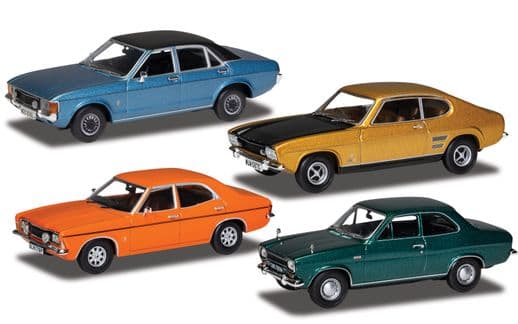
This group of GT-badged Fords brings to life a stylish, golden period in the blue oval’s history, showcasing four superb GTs in their original evocative period colours.
Our latest multi model collector’s set celebrates the long heritage of the Ford GT line, but not from the GT40 supercar perspective, from the quality family vehicle line many of us will remember being owned by our parents, friends and relatives. If you had one of these vehicles on your drive, it was certain to turn heads, as it sent the message that the adults in that particular household were definitely going places.
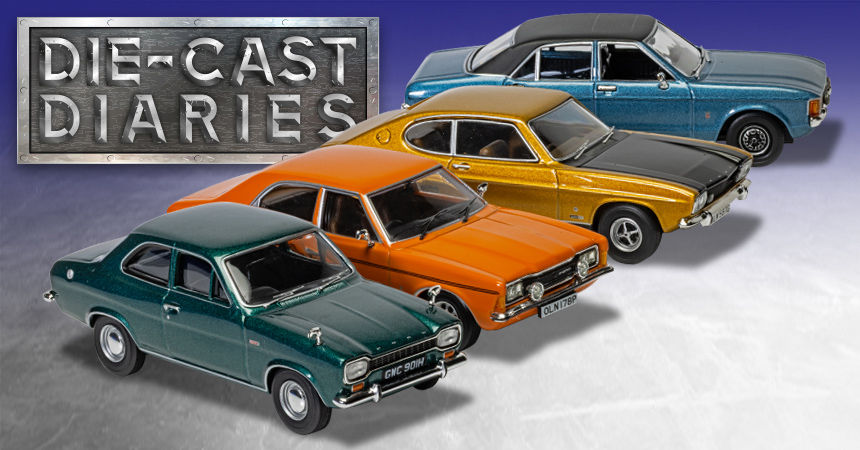
Our new Ford GT Collection set includes four Grand Touring Fords which represented some of the most desirable cars available in Britain during their time in Ford showrooms, and will no doubt bring back plenty of happy memories for hundreds of Die-cast Diaries readers.
Let’s take a closer look at each of the models featured in turn.
VA09533 - Ford Escort Mk1 1300GT in Aquatic Jade
The Escort 1300 GT was an integral part of the initial Escort range when launched in 1968, and debuted features that became performance Escort folklore such as the six-dial dashboard. Its Type 48 bodyshell housed a tuned ‘Kent’ crossflow engine, along with a modified gearbox, suspension and brakes, making it a very appealing showroom package.
The example modelled was discovered in a barn in Kent in the summer of 2008 and restored by father and son team Roy and Stephen Bryant. Sadly, Roy passed away in the autumn of 2024 but his widow, Rosemary, continues to enjoy taking it to classic car events.
VA13317 - Ford Capri Mk1 2000GT XLR in Amber Gold
The V4 Capri GT modelled was purchased new by Samuel McCarthy on the 23rd of June 1969, from the Allard Motor Company, Brixton. It cost £1151, 8s,10d and had been ordered in Light Orchid (metallic pink), but a mistake meant a gold example arrived, which Samuel decided would suffice as there were then long waiting times for Capris.
The car’s second and current owner, Lincolnshire-based Gary Adcock, got to know Samuel in 1989 and was able to purchase the car in 1993 for £450. It’s still in perfect original condition and he has a very detailed history file proving the car really has covered only 37,000 miles.
VA10321 - Ford Cortina Mk3 2000GT in Vista Orange
The Cortina GT modelled here was built at Dagenham in January 1976, meaning it benefited from the September 1973 facelift that brought in a more modern dashboard design and rectangular headlights on the higher specification models, plus numerous smaller updates made in January 1975 and January 1976. The GT specification included high-backed cloth-faced reclining seats, stiffer springs (106lb front and 140lb rear), halogen headlights and 5.5” driving lights.
The current owner of this rare unrestored survivor, which has still covered less than 78,000 miles, is Cambridgeshire-based Sam Deasy. He purchased it in June 2024 from a friend’s neighbour and loves its evocative period colour.
VA05512 - Ford Consul 3000GT in Sapphire Metallic
The Consul was top of the GT tree in the early 1970s and featured stiffer suspension, a manual gearbox and unassisted steering. Much loved by the police, it was used in both the motorway patrol and high-speed unmarked car roles all over the UK. Ford maintained that reputation by making sure all the hit TV cop shows of the era had access to Consul GTs. The example modelled was initially used for press and publicity work before Ford’s press office loaned it to the editor of Motor Sport Magazine, Bill Boddy, who wrote a glowing review of it in the July 1973 issue.
A beautiful model set which includes individual model liveries which aren’t available within the Vanguards range, this set is supplied in the high quality bespoke packaging these collection releases all benefit from, something which identifies them as desirable collector’s releases, die-cast models which will stand the test of time. You can just imagine somebody bringing a few of these to show the Antiques Roadshow team in 30 year’s time, asking for a valuation. As we’re all committed collector’s though, they’d have little chance of prizing them from our grasp.
We expect this beautiful set to be with us early in the new year now, which isn’t a bad way for Vanguards collectors to set their stalls out for 2026.
When it comes to rugged, hard-hitting and effective strike aircraft of the Second World War, the RAF’s Bristol Beaufighter stands as one of the most effective, with crews asked to undertake some of the most dangerous any Allied pilots were required to fly. The Bristol Beaufighter was originally developed as a heavy fighter variant of the company’s Beaufort bomber, an aircraft which was itself was a development of the Blenheim, and already in service with the Royal Air Force.
The first examples of the aircraft were pressed into service as nightfighters and whilst the aircraft proved to be a significant improvement over existing types in that role, there was more to come from the mighty beau from an operational perspective. As the aircraft received successive upgrades to make it ever more powerful and capable of carrying a greater array of offensive weaponry, the Beaufighter would become a successful multi-role aircraft, with a particular flair for mounting hard hitting anti-shipping strikes into the North Sea, preventing Axis shipping from moving supplies back to Germany.
Arguably, the definitive variant of the Beaufighter and certainly the most heavily produced was the TF.X, a two seat torpedo strike fighter, which was known colloquially as the Torbeau. With aircraft in a strike group package equipped with either rockets, an 18 inch mark XII torpedo or bombs, in addition to the aircraft’s cannon armament, these rugged aircraft would attack shipping at high speed and at low level, often with rocket firing Beaufighters drawing the anti-aircraft fire of the vessels to allow the torpedo equipped aircraft to make their attack runs more effectively.
Rugged and hard-hitting, the Bristol Beaufighters of RAF Strike Command flew some of the most demanding missions any crews were asked to undertake during the Second World War.
Often attacking with large numbers of aircraft wheeling about the sky in a maelstrom of fire, these savage attacks would take a heavy toll of Axis shipping in the North Sea and should Luftwaffe fighters join the action in an attempt to protect a particular convoy, they would find the heavily armed Beaufighter more than capable of looking after itself.
These highly effective coastal strike operations, launched from the exposed northern coast of Aberdeenshire, made a significant contribution to the Allied war effort in the final few months of the Second World War, further increasing the pressure on Germany’s ability to keep their war machine supplied. Knowing that Germany had to transport iron ore and other commodities of war through the North Sea to German held ports, the work of the Coastal Strike Wings was of significant strategic importance, effectively starving the German war machine into submission.
Operating in extremely harsh conditions and spending many hours flying over open water, pilots must have certainly appreciated the rugged qualities of their Beaufighters, but would have also been indebted to the often overlooked contribution of their hard working and committed ground crews who kept their aircraft serviceable, often working in harsh conditions themselves.
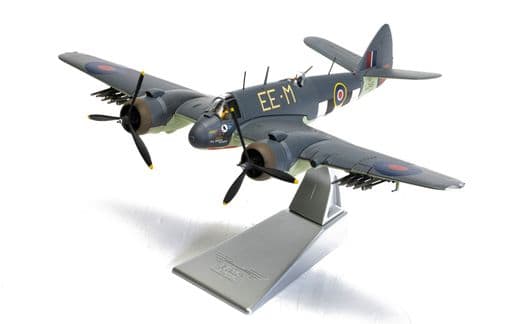
Our latest model tribute to this magnificent aircraft represents an aircraft operated by Canadian crews flying from RAF Dallachy in the weeks and months which followed D-Day. We have elected to present the model at a time after the upper surface D-Day identification markings have been painted over later in 1944, making this a particularly attractive addition to any Aviation Archive collection.
Flying some of the most dangerous strike missions of the Second World War, the Beaufighters of the Dallachy Strike Wing were charged with winning a maritime battle which simply had to be won. Denying Germany access to the valuable raw materials she needed to feed her war industries, these aircraft were sent to attack Axis shipping attempting to sail the length of the Norwegian coast to Germany, becoming so effective in their work that the ships were unable to sail during daylight hours. Instead, they would ‘fjord hop’ under the cover of darkness, and seek the protection offered by the steep sided fjord cliffs, and heavy flak batteries by day.
Once detected, however, the Dallachy Beaufighters would immediately set off to attack them, using tactics perfected to avoid the potential for collision, or aircraft suffering loss due to friendly fire during these almost frenzied attacks. Battling against hostile terrain, murderous anti-aircraft defences and vast expanses of ocean, these missions required the resolve of a special breed of airmen, and aircraft tough enough to cope with such demanding conditions.
The Beaufighter has been a popular addition to the Aviation Archive range since its introduction in 2019, and this latest model will surely only serve to enhance its growing reputation.
After providing strike cover in the run-up to and during D-Day, No.404 ‘Buffalo’ Squadron of the Royal Canadian Air Force returned to Scotland and RAF Dallachy in October 1944. Once there, they continued their fight against Axis shipping off the Norwegian coast, becoming one of the most effective anti-shipping strike units of the entire Second World War.
We were hoping to have this stunning model available to take its place underneath the Christmas trees of Aviation Archive collectors everywhere this festive season, however, it’s now looking like we’re going to have to wait until the middle of January before we can get our hands on one. Please keep an eye on our social media feeds for updated information over the holiday period.
The almost unbelievable actions and achievements of the world’s foremost fighter aces have enthralled and fascinated millions of people since the Great War brought these knights of the air to the public’s attention, a fascination which continues to this day. Airmen like von Richthofen, Ball and Rickenbacker became celebrity figures because of their daring deeds amongst the clouds, revered by the public and admired by their peers, both friend and foe.
During the Second World War, the war in the air was even more frenetic, with more aircraft contesting a superiority of the skies which spread right across the globe. With propaganda and publicity performing basically the same role, the public were crying out for heroes, and military officials were only too keen to provide them.
The latest exclusive image reveal for Die-cast Diaries readers, these images all feature advanced production samples of a release which commemorates the European air combat introduction of the famous top scoring Mustang ace of the ETO.
For a public desperate for heroes to take their minds off the horror of war, can you imagine how they might have taken to a young American pilot who was suave, handsome, but fearless and deadly behind the controls of a fighter aircraft. One such man was George E Preddy Jr, a native of Greensboro, North Carolina and a young man who joined the Aviation Cadet Program of the USAAF at the end of April 1941.
On the successful completion of his flying training, he would make his combat debut flying the Curtiss P-40 with the US 9th Pursuit Squadron in Australia. During six months of training and combat flying with the 9th Pursuit Squadron, 49th Pursuit Group, he was credited with damaging two enemy aircraft, but was also involved in a serious mid-air collision with another P-40 fighter. After a lengthy period of hospitalisation, Preddy was posted back to the US, where he converted to the twin engined Lockheed P-38 Lightning, however, fearing his future may be spent stateside and away from all the action, he enlisted the help of an influential former squadron mate, who pulled a few strings and arranged for a posting to a unit which would become the 328th Fighter Squadron.
With his historic position as the European Theatre’s leading Mustang ‘Ace’ of WWII, George E Preddy Jr. will always be associated with this exceptional fighting aeroplane, however, his combat introduction was made in two very different fighter types and initially at least, on the other side of the world. Preddy was initially posted to Australia with the 49th Fighter Group for the defence of Darwin, but suffered serious injury when his P-40 collided with another fighter during a training exercise. Following a lengthy recovery, Preddy was later sent to England and assigned to the 352nd Fighter Group, where he would fly the mighty P-47 Thunderbolt.
On 29th January 1944, Preddy would score his third aerial victory in the Thunderbolt, but would end the day floating in the English Channel, hoping to be rescued. Heading back to his home airfield at Bodney in Norfolk after scoring his latest victory, this time over a Luftwaffe Focke Wulf Fw190, Preddy’s P-47 was hit by enemy flak whilst crossing the French coastline, with his wingman reporting seeing Preddy’s fighter smoking badly, and the pilot taking to his parachute.
His wingman, Lt. William Whisner, risked running out of fuel to stay with his squadron mate, circling the position until an accurate location fix could be obtained by his controllers, and a rescue aircraft dispatched. When the amphibious Supermarine Walrus aircraft did arrive, the sea was so rough that it lost a wing float when landing, and whilst the aircraft was able to rescue Preddy, it had to be towed back to shore by an RAF rescue launch.
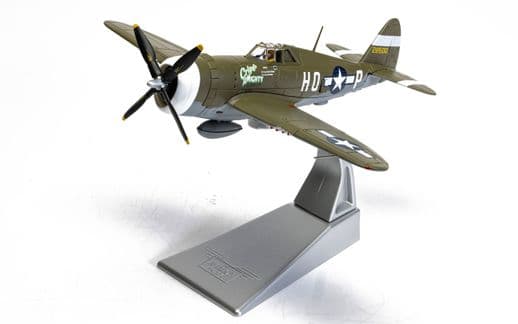
A ‘Cripes A Mighty’ fighter, but not the one we usually associate with its famous ‘Ace’ pilot.
All of George Preddy’s fighters in the European Theatre carried the name ‘Cripes A’ MIGHTY’, a term the pilot overheard people using for luck whilst playing the dice game craps. He was so taken with the saying that he had it painted on the fuselage of his Thunderbolt, and subsequently on his future Mustangs. Not long after Preddy’s North Sea soaking, the 352nd began converting from P-47s to North American P-51B Mustangs, and the rest, as they say, is the stuff of USAAF ace pilot history.
For an ‘Ace’ pilot who will be familiar to so many people, the fact that we are now telling a slightly different story relating to Preddy’s time flying in Europe is really interesting, particularly as there isn’t a Mustang in sight. The mighty Thunderbolt is a very different aeroplane to the diminutive, thoroughbred P-51 Mustang, but was rugged and hard hitting, able to bring many pilots home when their aircraft had sustained heavy combat damage.
It was also the aircraft which gave George Preddy his first taste of combat success during his time flying from bases in England, helping create the legend of the ETO’s most successful Mustang ace of the Second World War.
As is the case with the Beaufighter featured previously, we’re now expecting this really appealing addition to the Aviation Archive range to be arriving in our warehouse towards the middle of January 2026.
So that’s it, another year of blog updates in the Die-cast Diaries history books. Before we head off for a few days of festivities, we would like to thank each and every one of you for your steadfast support throughout the past year, and for continuing to collect with us – we really are incredibly grateful.
On behalf of every member of the CORGI team, could I take this opportunity to wish each and every one of you a very happy and fun-filled Christmas, with a prosperous New Year to come. We look forward to seeing you all back here again in the New Year, for more die-cast exclusives from the world of CORGI.
Well, that’s just about it for another year. After a well-earned break, we’ll be back in FOUR weeks’ time this time around, when we’ll have a further exclusive selection of the latest Corgi die-cast model updates and features. As ever, you could always drop us a line if you felt moved to do so, to comment on anything blog, collecting or Corgi model related, or even perhaps to suggest a topic you might like to see the team cover in a future edition. As always, our diecastdiaries@corgi.co.uk address is the one to use.
If you can’t wait for the next blog, you will find plenty of Corgi model collecting discussions taking place on our official social media channels, access to which can be obtained by clicking on the respective links at the foot of the Corgi website homepage.
Link access to Corgi social media sites.
Thank you for continuing to support your Corgi Die-cast Diaries blog. Our next edition is scheduled for publication on Friday 2nd January, when we look forward to seeing you all back here then.
Thank you so much for your continued support.

