

Welcome to the latest edition of Corgi Die-cast Diaries, your regular blog review of all the news, updates and topical stories from the captivating world of Corgi die-cast model collecting.
Unlike the other brands in the Hornby portfolio of companies, Corgi are unique in dividing each of their range launch announcements for any given year into four monthly sections, giving Corgi collectors three opportunities each year to get excited about welcoming a new collection of models to the range. Our latest September to December range was unveiled in all its Die-cast glory last Friday and included new model additions to most of the active sub ranges under the Corgi branding, including a couple of unexpected, if extremely welcome additions.
In line with the current release strategy adopted by the Corgi team, all of the models announced in this latest range are expected to arrive by the end of the year, meaning that nobody is going to have to wait longer than four months to add the models which appeal to them, to their collections. That isn't to say that updates will not continue to be given for some of the other exciting new tooling projects we have on the go at the moment, but these will be published as subjects within Die-cast Diaries, rather than appearing too far in advance on the Corgi website for pre-order.
It will therefore come as no surprise to hear that our new range is the only talking point in this latest edition of our blog, partly because this is being posted as a holiday edition, but also because we want to direct all Corgi fans to the new range and in particular, the release video posted by Our Brand manager. We will, however, be picking out a couple of the new models for special treatment.
To boldly go where no Corgi range has gone before, we think we have a selection which will appeal to all collector tastes in this latest range.
As any Corgi collector will happily tell you, the prospect of inspecting a new collection of model announcements is something to warm even the coldest of die-cast hearts and for the past couple of years, we have all become accustomed to this happening no fewer than three times each year. Even though we do always include updates from the new tooling projects which are currently taking up so much of our time at the moment, gone are the days when a new tooling announcement is accompanied by long and frustrating delays waiting for our pre-orders to arrive.
With this current format now being established, the clear expectation is for all the models taking their place in any range to arrive in our warehouse during the period covered by that range/catalogue publication, meaning that the models we are most looking forward to are not that far away.
As you would expect, we have new model announcements in all of the currently active ranges, including five new Aviation Archive models, if you included the fantastic new RAAF Vietnam Canberra announced at this year's Royal International Air Tattoo, and a stunning new selection of Vanguards releases to delight fans of this range. In addition to these, we also have a famous Aston Martin which features an intentionally missing driver's door, a pair of vehicles designed to keep us all free from the clutches of those devious Mysterons and a couple of heavy metal 'Rigs' which mark the welcome return of our 1/50th scale truck range.
After spending far too long away from the Corgi range, we also have stardate return for a pair of Star Trek model releases which see these attractive collector models returning to a Corgi range for the first time in almost two decades, models which boldly go where no Corgi model has gone before (well, at least for the past twenty years).
As always, Die-cast Diaries will be bringing readers all the development details behind all these new model announcements as we go at warp-speed onwards to Christmas, however for now, could we please direct everyone towards the downloadable pdf version of the current September to December catalogue using this link. In addition to this and by way of a modern and quite personal way of delivering our latest Corgi range message, could we also implore you to join our Brand Manager David Mather as he guides us all through this latest selection of models, direct from the Corgi showroom here at die-cast HQ, via the official Corgi YouTube channel.
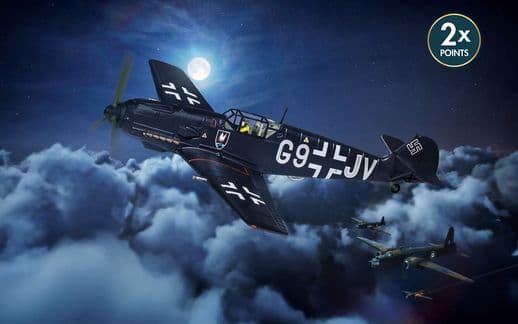
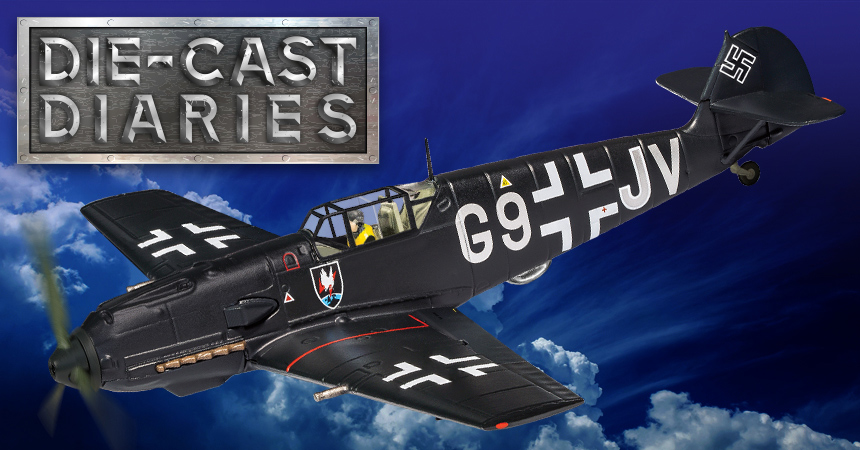
A much requested addition to our Aviation Archive range, this nocturnal Messerschmitt Bf 109E benefits from the addition of new tooling components to make this a unique addition to the range.
We are delighted to confirm that the latest selection of models earmarked to join the popular Aviation Archive range includes a model which has long been requested by collectors, one which features a small, yet rather significant tooling modification addition. Utilising our Messerschmitt Bf 109E tooling, the next model addition to this series is a black nightfighter which was engaged in attempting to stem Bomber Command's night bombing campaign during the Second World War.
The need to establish a force of fighting aeroplanes at night goes back to the Great War and Britain's need to field an effective defensive deterrent against the terrifying incursions of Germany's marauding Zeppelins, which were causing so much concern across the population of the nation. Initially, a panicked military simply diverted day fighter units to providing this cover, however, it soon became apparent that fighting at night was a specialist undertaking and how if they wanted it to produce telling results, both men and machines would have to be optimised for the task.
Moving on to the Second World War, the all-conquering Luftwaffe hadn't anticipated having to defend its own airspace against a concerted British night bombing campaign and as a consequence, initially followed very similar steps as those taken by the British in WWI. Single engined day fighter units converted to flying defensive sorties at night, but as the technology of air warfare continued to advance, so the futility of unassisted night interception of aircraft became starkly apparent.
In an attempt to increase the success of night interceptions, the Luftwaffe established several ingenious ground control systems enabling them to place their fighters in the right airspace to score night victories, however, it wouldn't be until the introduction of effective night interception radar units fitted into aircraft that night operations would be considered anything close to successful.
Although the famous Messerschmitt Bf 109E was initially pressed into service in this night-fighting role, single engined, single seat fighters were not ideally suited to this task and would actually prove quite disappointing. With its limited range and light firepower for this task, the inability to add heavy night interception technology into its diminutive airframe would always prove a major drawback and with just one pair of eyes scouring the night sky for enemy aircraft, many night sorties would end without a single enemy aircraft being sighted.
Marking an important stage in the establishment of a nightfighter force for the Luftwaffe, this nocturnal Messerschmitt Bf 109E featured the addition of LW-Zielfluggerät PeilG IV locating antenna, which was not an airborne interception radar, but more of a locating system to be used in conjunction with the Luftwaffe searchlight network. Mainly used at either dawn or dusk, it did result in an increase in night interception statistics, but only just and can only be regarded as a technological start.
Although the Messerschmitt Bf 109 fighter had already earned a fearsome reputation by the time the first skirmishes of the Battle of Britain were taking place, the fighter variant which was preparing to take on the Royal Air Force was a very different aircraft from the ones which had entered service just over three years earlier. Undoubtedly one of the most famous fighting aeroplanes in the history of flight, the Bf 109 was at the forefront of world fighter design, combining a light and diminutive airframe with a powerful engine and heavy armament, everything an aeroplane needed to dominate the skies.
The first four variants of the Messerschmitt Bf 109 were all powered by the Junkers Jumo 210 engine, an advanced unit which was Germany's first truly modern engine design, however, front line fighter aircraft are always looking to benefit from ever greater speeds and this search would lead to the first major re-design of the Bf 109 with the introduction of the 'E' or 'Emil' variant, the aircraft which was in widespread service during the Battle of Britain. This more mature version of the fighter adopted the more powerful Daimler Benz DB600 series powerplant, a 33 litre direct fuel injected inverted V12 unit which made the Luftwaffe's main fighter even more combat effective.
The adoption of this new engine did require quite extensive design modifications to be introduced, not only around the mounting frame and engine cowling area to shoehorn this larger and more powerful powerplant into what was actually a relatively small fighter aircraft, but also to add additional cooling ducting around the inner wing sections, to provide effective cooling for this beast of an engine. In fact, it's interesting to note that the development of both the Messerschmitt Bf 109 and its famous British adversary, the Spitfire, went hand in glove with engine development, ensuring that both could remain at the forefront of world fighter performance and more specifically, competitive with each other.
By the time of the Battle of Britain, there were some major differences between the engines powering the two leading fighters in the conflict which are certainly worthy of note. Although both engines were roughly the same in terms of size, weight and performance, the Merlin III had a capacity of 27 litres, whilst the Daimler Benz unit sported 33.9 litres, however, the main difference came in a combat situation. The direct fuel injection system of the German DB 601 gave the Messerschmitt fighter a distinct advantage in that fuel flow to the engine was maintained during all manner of manoeuvres, something the carburettor fed system of the Merlin could not match.
All the model images featured in this section show an advanced production sample of this beautiful new nocturnal Messerschmitt.
In either an attacking situation, or if a Messerschmitt pilot found himself in trouble, pushing the stick forward and diving for the ground, or rolling inverted would invariably allow the Bf 109 to escape, with the Merlin engine of the British fighters coughing and spluttering as he attempted to follow, with the fuel flow to the Merlin temporarily disrupted due to centrifugal forces.
A less well known difference between the Merlin III and Daimler Benz DB 601 engines was that the German powerplant was designed from inception to be mass produced and as such, was much less complicated a design than the Merlin engine was. In fact, there were half as many components in the German designed engine, meaning that they were both quicker and easier to manufacture unit for unit. Where the Germans lost this engine development advantage was that their engineers were more concerned with experimental research as opposed to incremental updates for existing powerplant technologies, something Rolls Royce proved to be extremely proficient at doing. Had the Messerschmitt Bf 109 benefitted from regular, incremental engine upgrades, the second half of 1940 could have been even more problematic for the RAF's Fighter Command than it proved to be.
With the Luftwaffe sweeping all before it during the early months of the Second World War and British bomber incursions doing little more than dropping propaganda leaflets, little thought was given to establishing a cohesive nightfighter force, particularly as Göring regarded Britain’s bombers as being nothing more than 'Fat old cows'. That changed when the continued operations of British bombers began to cause Göring more than a little embarrassment, resulting in him ordering three Messerschmitt Bf 109 equipped fighter units to be re-designated as new night fighter squadrons.
Although now designated as nightfighters, these aircraft would rarely fly at night, as they required the light of dusk and dawn to help them intercept British bombers, because at that time, there was no integrated night defence network in place. Indeed, the first aircraft to perform this task were simply men and machines who had previously flown daylight operations. Initially, these aircraft even retained their standard daytime camouflage schemes.
Locating and intercepting British aircraft at night at this stage of the war was extremely difficult for Luftwaffe pilots to achieve. Needing either natural light or the illumination of a searchlight beam to find them, the complete lack of coordination between nightfighter, searchlight, anti-aircraft and radar units dictated that success rates were low and Luftwaffe nightfighter pilots would often report having come under fire from friendly anti-aircraft batteries, during many sorties.
At that time, German radar was inferior to the system in service with the British, with some observers estimating that they were lagging two years behind in this vital technology, nevertheless, they did have primitive radar coverage in place. It was, however, it was unable to differentiate between friendly and hostile aircraft and for a nightfighter pilot, this was therefore more of a hinderance than actually helping.
Performing a successful night interception was actually incredibly challenging for the pilot, as he had to plot and continually monitor a course between his aircraft and the intended target, taking into account the relative speed of the two aircraft, the distance between the two and the effects of wind, with all these parameters changing constantly.
As a consequence, most early Luftwaffe night interceptions made use of patrol sectors, with nightfighters simply reduced to patrolling an assigned section of sky, waiting for an enemy bomber to stray into their assigned area, before attacking it. Clearly, effective electronic airborne interception technology was the ideal solution to this rather crude system and whilst this was still some way off, it didn't stop German technicians attempting to innovate.
A very different looking Messerschmitt addition to the Aviation Archive range, one which benefits from the addition of new tooling investment.
The Messerschmitt Bf 109E fighter from Nachtjagdgeschwader 1 modelled here was equipped with a Telefunken designed Peil Gerat IV electronic radio direction finder unit, one of the first airborne interception units of its kind to be fitted in a Luftwaffe nightfighter. More of an onboard direction indicator than an actual interception radar unit, the Peil G IV featured the installation of a new cockpit indicator display which required the pilot to keep a needle coated in luminous paint in the centre of the display and he knew that if he kept the needle in this central location, his aircraft was heading for the transmitting aircraft detected.
Although still relatively primitive, this system allowed the pilot to fly his aircraft and effect the interception, as opposed to being preoccupied with constantly checking his course, something which greatly helped pilots of single seat fighters. Although actually not all that effective in operation, the Peil Gerat IV unit would provide valuable research data for use in future projects, which would eventually lead to the introduction of much more capable systems.
In the specialised role of night interceptions, single seat Luftwaffe fighters were not particularly suitable for the task, as their lack of range/loitering capability and the sheer workload placed on the pilot were both significant limiting factors. It didn't take long before the larger twin engined Messerschmitt Bf 110 and Junkers Ju88 were assigned to this role and would become the backbone of an increasingly effective Nachtjagdgeschwader force, with single seat fighters providing more point defence protection for important airfields and major cities against the incessant British bombing attacks, which came night after night.
A very different looking Messerschmitt for our collections, as already confirmed, this beautiful new model does include a newly tooled representation of the Telefunken designed Peil Gerat IV electronic radio direction finder unit.
The latest Vanguards model selection includes the largest model ever tooling in this range, along with one of the smallest. We also tease a view of some stunning new models to come.
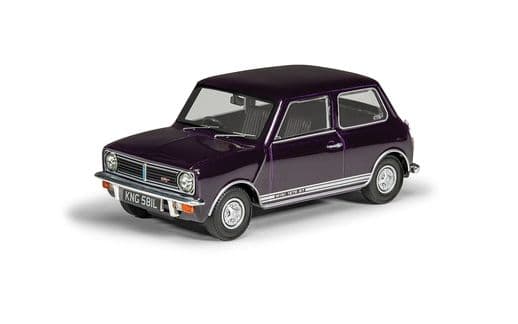
For those readers who have already watched our latest range launch video, you will recall David highlighting two models which represent different ends of the size scale when it comes to our Vanguards range, the impressively gargantuan Ford Ranger Raptor and particularly diminutive Mini 1275 GT. The Mini included in this latest range was originally announced as part of the 2020 model range, but was never actually released - finally, this beauty in black tulip is going to join the range.
A vehicle which is considered something of an enigma within the impressive history of the mighty Mini, the 1275GT was a new type of sporting Mini design, but one which got off to something of a sluggish start. Due to ongoing labour and manufacturing issues, the car did not achieve serious production status until early 1970 and despite possessing an extremely purposeful appearance, did not initially find favour across the motoring world.
It was always compared with the famous Cooper S models, the hugely desirable sport bred models in the range, but with the early 1275s not being able to boast performance to match this highly regarded predecessor, the car's introduction struggles continued. Thankfully, following the end of Cooper S Production in 1971 and with parts used it their production now becoming available, the 1275GT began to make its own mark in the world of motorsport. As a consequence, the car also began to find widespread favour across the UK motoring market, with its purposeful looks beginning to be viewed as an appealing facelift for the sporty Mini range. Perversely, some of those much maligned early cars in the range have gone on to become highly desirable items and can fetch tidy sums, if a clean example ever comes up at auction.
VA13508 - Mini 1275GT, Black Tulip
The 1275GT modelled here was built at Longbridge on January 22nd, 1973, and delivered to Kennings Norwich, Norfolk on the 26th. It was purchased by John A. W. Barnham of Walsingham, Norfolk, on February 1st, 1973, and he used the car for many years completing around 79,000 miles before putting it into storage.
The current owner, Aberdeen-based Derek Bain, bought it unseen in September 2016 as a restoration project from the original owner's grandson, after seeing an internet advert. He knew from photographs that it was very rusty but, even so, when it was delivered to him he was dismayed to have his foot go through the floor as he was getting in!
Derek had, however, commenced his mechanic's apprenticeship at BMC/BL dealers ABC Motor Services, Aberdeen, in 1972. Since then he'd always wanted a Black Tulip 1275GT so, undaunted, he stripped the car and started by welding in a complete floor from M-Machine, and a plethora of other BL Heritage panels.
He was able to save the front subframe but needed to buy a new rear unit and every piece of interior trim. Except for the final painting, the cylinder rebore and crank regrind, he did every aspect of this complete restoration himself including rebuilding the engine and gearbox, brakes, interior and suspension, using new parts throughout.
This rather pretty addition to the Vanguards range is scheduled for an Autumn release.
Hopefully the two models covered in a little more detail in this edition will encourage all those who haven't done so yet to go and discover all the die-cast delights announced as part of the September to December 2023 range, all of which are now available on the Corgi website. As always, we will be endeavouring to bring you continuing development details from more of these projects within our fortnightly Die-cast Diaries update blogs.
If you haven't already done so, please head over to the Corgi website to view our latest model collection, where you might just discover some unexpected additions.
That's another edition done and dusted, however, we will be back as usual in two weeks' time, with a further selection of model project updates to bring you. Between editions, we are always interested to hear your views on all things Corgi, so if you feel like dropping us a line to comment on anything blog, collecting or Corgi model related, or even to suggest a topic you might like to see us cover in a future edition, please do drop us a line at diecastdiaries@corgi.co.uk.
If you can’t wait for the next blog, you will find plenty of Corgi model collecting discussions taking place on our official social media channels, access to which can be obtained by clicking on the respective links at the foot of the Corgi website homepage.
Link access to Corgi social media sites.
Thank you for continuing to support our Die-cast Diaries blog. Our next edition is scheduled for publication on Friday 22nd September.