
Welcome to the latest edition of Corgi Die-cast Diaries, your regular blog review of all the news, updates and topical stories from the captivating world of Corgi die-cast model collecting.
As we continue on our development journey to bring you updates on all the new models scheduled to be joining the Corgi range over the coming few months, we are delighted to be featuring a trio of Vanguards and a stunning Spitfire in USAAF markings in this latest edition of our blog. Each one of these updates comes complete with a selection of exclusive imagery which will bring each project right up to date, and as always, Die-cast Diaries readers will be the first people outside the Corgi Team to be seeing them.
As we are now having to embrace shorter daylight hours and the prospect of a long winter ahead, many of us will probably be planning a little collection housekeeping over the coming months, something we’ve also been doing over the past few days. That being the case, we will be ending this latest blog by looking at several current Aviation Archive model releases which are now very much on the ‘endangered’ list, and for those who might be thinking of adding them to their collection logbooks, now might be the time to act. With some now down to single figure availability on the Corgi website, this information will hopefully be of interest to those considering adding them to their collections.
We have a quadruple collection of future model releases in the DCD spotlight, as we head into our latest Corgi weekend.
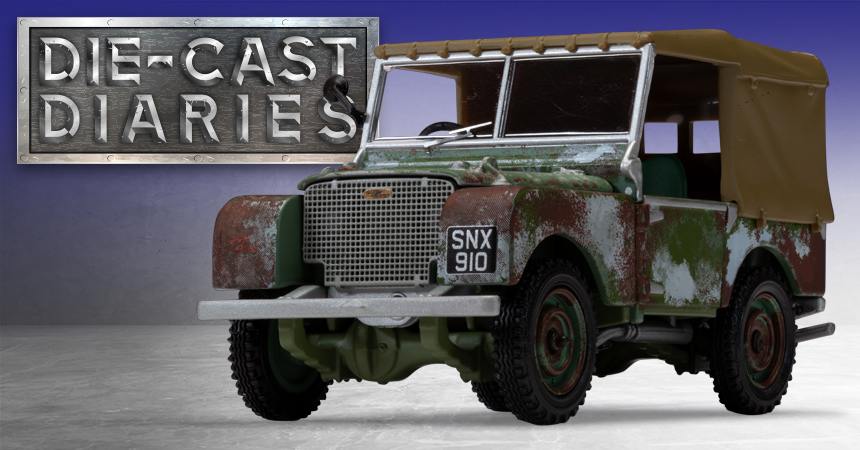
As a hard-working utility vehicle, would we have a Land Rover looking any other way than well used?
When searching through any range of Vanguards models, it isn’t difficult to see why modern cars and motor vehicles hold so much appeal for so many people, and indeed, why this range continues to thrive. With some of the most famous names in popular motoring represented, these models replicate the beautiful lines of the real vehicles which inspired their inclusion, and feature the striking paint finishes which often have descriptions which are as imaginative as the cars are striking.
Sometimes though, a car’s story doesn’t have to be all about how pristine it looked as a showroom centrepiece, and is more about the position it holds within the heritage of a particular model range, with this story made all the more impactful by its less than perfect presentation. One release which highlights how appealing such a model can be to collectors is the latest impending release from our Land Rover tooling, a car which can trace its lineage right back to the very beginning of the Land Rover story, and one which has incredible appeal despite its less than pristine appearance.
Angular and purposeful, you probably wouldn't expect a rugged, hard-working utility vehicle to attract the admiration of the motoring world, however, that is exactly what the Land Rover series managed to do rather effectively. Entering production back in 1948, the Land Rover was an attempt by the Rover Company to re-enter the motoring market during the financial austerity of the post Second World War period, producing an affordable agricultural and light industrial vehicle with a multitude of applications, on similar lines to the Jeep of WWII, but subtly different.
The Land Rover was designed with little in the way of driver comfort in mind, but was intended to operate effectively in the most demanding of situations, quickly earning a reputation for practicality and reliability. The pick-up version featured an enclosed cab and open rear compartment, which could be used to transport anything from farm machinery to livestock and animal feed over all kinds of terrain. If you had a tough motoring job that needed doing, Land Rover had just the vehicle for you.
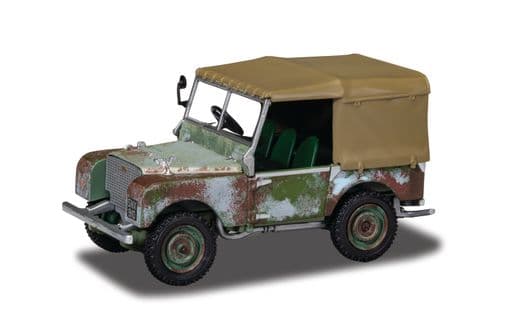
Our latest Vanguards Land Rover model release is our tribute to a rather famous vehicle, with these images being an exclusive first look at a production sample of it.
From those humble beginnings, Land Rover went on to create something of an automotive phenomenon, although it has to be said that the vehicles which proudly wear that name to this day are very different to the Series 1 vehicles which first rolled off the production lines. For those originals, luxuries and the latest levels of driver/passenger comfort were way down the list of priorities, they were all about functionality and reliability. Some have even described the first Land Rovers as possessing the sophistication of a petrol powered lawnmower, but then usually qualify the statement by including how it may have been basic, but was also wonderfully capable.
The concept behind the Land Rover was that this was essentially a farmer's friend, a vehicle which would help him go about his business efficiently with an absolute lack of fuss - when he needed it, the Land Rover would always be ready for action. Built around a strong and highly effective ladder type chassis, the aluminium body was light and robust, meaning that the vehicle could be powered by a relatively low power output engine, but one which with the use of a high and low range four wheel drive system, allowed the vehicle to handle almost any terrain.
In many respects, the Land Rover was designed to fend for itself, with its owners wanting nothing more than to fill it with fuel and get on with their busy day and in this regard, the Land Rover proved to be exceptional. Described as the finest off-road capable vehicle of its generation, these vehicles may not have been kept in pristine condition, but they were loved for their rugged simplicity nonetheless and relied upon for their functionality. Even if your Land Rover had a prang and sustained a few dents and scratches, a quick lick of paint would have it looking as good as new - well, at least in acceptable farmyard condition.
The rest of this story is the stuff of modern motoring legend, a range of vehicles which built an enviable reputation for rugged effectiveness, a story which continues to this day. As such, the Land Rover continues to be of huge interest to model manufacturers, with the Vanguards range being no exception, and our latest impending addition to this series of models is an absolute classic, particularly when it comes to the wider Land Rover story.
VA11119 – Land Rover Series 1 80in ‘L07’ SNX 910 – Light Green (weathered)
Rover launched the Land-Rover at the 1948 Amsterdam Motor Show. They displayed three examples, one indoors on the stand, and two outside demonstrating their new machine’s remarkable abilities; all three were pre-production prototypes, different in detail specification to what would emerge when production commenced.
The vehicle modelled was one of the demonstrators, although it was then left-hand drive. After the show it was allocated to Jack Swain’s Engine Department, converted to right-hand drive and used to test engine updates. It was retained by Rover, being driven on trade plates, until 1955 when it was sold to a local buyer, a Mr Smith, and given the Solihull number plate SNX 910.
Thereafter, L07 had numerous owners in the Midlands and lived in Alvechurch Worcestershire for twenty years from 1968. By 2016 it was back in Solihull, sunk up to its axles in mud, awaiting a restoration. The owner offered L07 and another Series 1 to a Land Rover specialist, a friend of his spotted some of the unique prototype features in the pictures he showed him, and it was acquired by Jaguar Land Rover Classic in 2017. They were amazed by how original the vehicle was, and displayed it at Mell Square, Solihull, as part of Land Rover’s 70th anniversary celebrations.
This vehicle was then mechanically restored by JLR Classic, who left the bodywork in its patinated state as it tells the vehicle’s incredible story.
A beautiful impending addition to the Vanguards range, we’re currently looking at a late 2025 release for this next Land Rover, but will bring you further information should that date move forward slightly.
As one of the most famous aircraft of all time, it comes as absolutely no surprise to learn that the Supermarine Spitfire made the transition from classic fighting aeroplane to scale die-cast model subject with consummate ease, and with well over 20,000 aircraft produced, there is no shortage of appealing schemes and interesting stories for model manufacturing companies to draw from. That being said, we think that we might just have struck Spitfire gold with our latest impending addition to the Aviation Archive range, not just because it presents the aircraft as one of the 600 plus Spitfires used by the Americans during WWII, but because an aircraft wearing this very scheme is currently wooing the crowds on the UK Airshow scene.
Our 1/72nd scale Aviation Archive range first welcomed a Spitfire Mk.IX into its ranks back in 2006, and whilst many DCD readers will no doubt have this and a few subsequent releases within their collections, the current Corgi development team were of the opinion that an aircraft possessing this pedigree was definitely deserving of the very latest design and manufacturing treatment, from a range perspective. That being the case, we decided to return to the subject during 2021, creating a beautiful new tribute to this famous aircraft in die-cast metal, one which we were proud to unveil to the collector world the following year.
As we’re now preparing to receive the fourth release from this relatively new tooling, we can say with the confirmation of supporting data behind us, that this decision has proved to be particularly popular with our loyal collectors and how the popularity of the Spitfire as a subject thankfully shows absolutely no sign of abating.
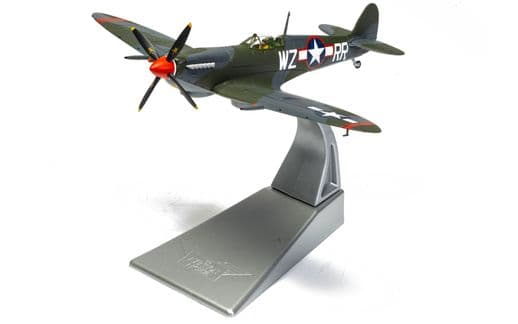
Our next release is a bit of a cracker, and we’re pleased to be in a position to bring you the latest exclusive images of an advanced production sample model in this latest blog update.
As one of the world's premier fighting aeroplanes, the Supermarine Spitfire was of interest to any air arm able to get their hands on them, including the Americans. Some American volunteer pilots travelled to Britain before the US had entered the Second World War, flying with the Royal Air Force and flying both the Hurricane and Spitfire operationally. Once America had entered the war, most of these pilots transferred to US units, exchanging their Spitfires for the mighty Thunderbolt, a massive fighter which wasn’t referred to as the ‘Juggernaut’ for nothing.
RAF pilots joked with their American colleagues that if they were to be attacked by a Messerschmitt, they could unstrap themselves and run around the fuselage dodging the bullets as they went. As we now know, the P-47 Thunderbolt would prove to be an excellent fighting aeroplane, however, American pilots who had time on Spitfires never lost their affection for the British fighter.
The USAAF did use the Spitfire operationally, with around 600 examples eventually seeing American service, something which again illustrates the high regard in which the aircraft was held. The 31st Fighter Group arrived in the UK during the summer of 1942, scheduled to fly the Bell P-39 Airacobra, which were following on behind. Having already flown the fighter in the ETO, RAF officials convinced the Americans that the P-39 was unsuitable for combat operations in Europe and furnished their pilots with Spitfires.
As with all the images used to illustrate this latest blog update, these are all exclusive first looks at a production sample of the model being reviewed.
The 31st FG used their Spitfires extensively during operations in support of the Allied amphibious landings at Dieppe, however, their time flying from bases in the UK would be short and by October, were sent to Gibraltar to take part in the impending invasion of North Africa.
During this vital, yet little known aspect of the Second World War, it was crucial for Allied forces that the Axis powers were removed from North Africa, so this could be used as a launch platform for further operations across the Mediterranean and into the Italian mainland. The Spitfires of the American 31st FG were heavily involved in these operations, flying fighter sweeps, attacking ground targets and escorting Allied bombers, often flying from recently captured enemy airfields.
Moving on to cover amphibious operations against Sicily and at Salerno, their Spitfires were often required to operate from bases which were less than ideal, having nothing but the most basic of amenities for the comfort of air and ground crews. A move to the airfield at Pomigliano brought about a welcome change in this situation, as it could boast a concrete runway and permanent accommodation blocks for group personnel.
As arguably the most famous fighting aeroplane the world has ever known, the Spitfire didn’t only wear the famous roundel of the Royal Air Force during the Second World War, it would also represent several air arms, including the USAAF. When the 309th Fighter Squadron moved to support Allied operations in North Africa, and subsequently on to Sicily and Italy, they took their Spitfire Mk.V fighters with them, and would find themselves fully committed to the fighting.
Receiving upgraded Mk.IX variants of the Spitfire from April 1943 onwards, these powerful aircraft would be used to provide fighter cover for Allied bombers across the MTO, and even to protect earlier variants of the Spitfire which were still operational.
This beautifully presented Spitfire was the mount of Lt Robert Connor, who playfully embraced the less than flattering nickname his squadron mates had given him, by having distinctive artwork painted on the starboard side of his Spitfire. It featured the stuttering cartoon character Porky Pig and his Loony Tunes catchphrase ‘That’s All Folks’ inside something resembling a large slice of white bread.
The aircraft carried the name ‘Porky II’ as the pilot was thought to have named an earlier assigned Spitfire Mk.V as Porky, and he wanted to distinguish between the two. The 309th would finally exchange their Spitfire Mk.IX aircraft for new North American P-51B Mustangs which possessed greater range in March 1944, but not before they had written a particularly interesting chapter in the annals of USAAF chronicles.
An aircraft wearing these same markings is now one of the star attractions on the UK Airshow circuit, operating as The Suffolk Spitfire, and resplendent in its unusual USAAF markings. Of course, she comes complete with her Porky II artwork and smart red detailing, one of the most distinctive restored Spitfires flying in the world today.
This stunning impending addition to the Aviation Archive range is scheduled to be in our warehouse and available for dispatch early next month.
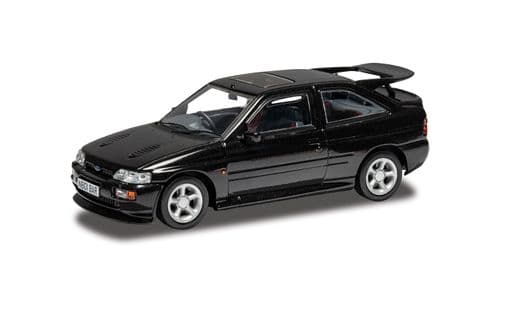
Would you describe the Ford Escort Cosworth as either the Ultimate Escort, or the working man’s supercar?
The continuation of a hugely successful series of cars, Ford unleashed their latest range facelift for their Escort in 1990 and as the first family orientated Escort Mk5 models started to appear in showrooms around the country, performance car lovers began to get excited about the prospect of more ‘interesting’ variants to come. Initially at least, the market reception for the new model was a little lukewarm, however, the strong market position the Escort had secured over many years, coupled with almost constant development, continued to assure its long-term success.
The company would subsequently go on to unveil their purposeful and sporty looking Escort RS Cosworth model, a performance car which drew significant inspiration from Ford’s successful rallying credentials, creating a brute of a car, and how everybody loved it. In addition to its stunning good looks, this performance beast was powered by a turbocharged 2.0L Cosworth 16-valve engine and was capable of attaining speeds of around 150mph, making this the most powerful Escort ever produced and in the eyes of many admirers, claimed the crown as the ‘Ultimate Escort’.
As any Ford motorsport devotee will tell you, in order for cars to compete in production-based competition, the manufacturer in question has to do exactly as this term implies, and base the competition car on a production vehicle. Obviously, from a motoring enthusiasts perspective, this is an exciting proposition, not least because the cars which have to be made available for public sale and for use on public roads will share much of the performance and technology featured on the competition cars.
We have two impending Ford Escort RS Cosworth releases to add to our collections.
As a consequence of this, the feisty Ford Escort RS Cosworth would become one of the most desirable cars to be driven on Britain’s roads, and despite the motorsport division always wanting to drive their cars at breakneck speeds, in order for that to be allowed, thousands of their number would have to stick steadfastly to Britain’s speed limits. The production requirement made available for public sale was 2,500 cars, however, in the period between 1992 and 1996, more than 7,000 of these handsome performance cars would actually be produced.
Developed by Ford’s Special Vehicle Operations in Borehamwood, the Escort Cosworth had little in common with a basic family Ford Escort in truth, as it was bred for competition and conceived to win, however, it can be surprising to learn that they were actually manufactured in Germany. Always looking and sounding incredible whenever they appeared in a competition environment, the Ford Escort Cosworth was often described as ‘The working man’s supercar’, which for a road car was actually quite the badge of honour to wear.
The Vanguards range is looking forward to welcoming not one, but TWO new model examples of the Ford Escort RS Cosworth within the space of the next few weeks or so, and with both likely to be incredibly popular additions, let’s take a closer look at each one now.
VA14807 – Ford Escort RS Cosworth Lux in Ash Black
The 1995 ‘small turbo’ Cosworth modelled is a Lux, meaning it was built with a passenger airbag, an electric sunroof and a stereo with a separate CD player below. A leather interior was a very commonly specified option on Escort Cosworths, especially Lux models, but this car has a ‘Red Hexagon’ velour interior, which is now rare and sought after by enthusiasts.
The current owner, Cheshire-based AIan Bull, is a Senior Quality Engineer at Ford’s Halewood Transmissions Plant, and has worked there since starting an apprenticeship in August 1990. Alan is the car’s fourth owner and bought it from dealers ‘Junction 28’ in September 2014, after a long search for the right example.
Alan, an RSOC member for over thirty years, wanted an unmodified example and was attracted to this car, which had then covered a documented 33,000 miles, because of its originality.
The third owner, South Wales-based Ciro Ciano, had kept it for sixteen years, looked after it well, and only reluctantly sold it to allow him to buy his dream car. Alan and his sons, Thomas and Michael, who both work at the same Ford plant, have rebuilt the suspension using original parts and carried out various other jobs to keep the car mechanically perfect. They have, however, resisted the temptation to modify it or turn it into a concours car, instead they enjoy using it as it is, and have covered over 6,000 enjoyable miles.
VA14808 – Ford Escort RS Cosworth Lux in Auralis Blue
The ‘small turbo’ Escort Cosworth Lux modelled, was produced at the Karmann factory, Germany, in early 1996. Only 200 were made in this fetching shade, the first 189 of which were produced in 1995, so this is one of the last 11 made after the Christmas break.
It was ordered as a dealer demonstrator by Dagenham Motors Limited, Wintersells Road, West Byfleet, Surrey, who specified a black leather interior and registered it for the road on 20th February 1996. They serviced it on 14th January 1997, just before selling it, at which point it had covered 505 miles, so they were obviously very selective about who they allowed to test drive it.
The car was serviced again in September 1997 after 9,000 miles, then sold to a new owner in August 1998. In 2010 the car was bought by its fourth owner, who kept it for twelve years and lightly modified it.
The current owner, Buckinghamshire-based enthusiast and RSOC member Grant Newell, bought the car from Hendy Performance in June 2022 when it had still only covered 43,000 miles. He’s had the underside dry ice blasted, and the engine rebuilt and modified to produce 360bhp by Cambridgeshire-based Cosworth expert Harvey Gibbs. He’s also installed 6-pot AP Racing brakes with 362mm front discs.
This much-admired, still low-mileage, car won Best Classic on the Oval Owners Facebook Group Stand at the 2023 RSOC National Day.
We’re expecting both of these attractive models to be in our warehouse by the end of this month, or the beginning of the next, but should that expectation change, we will endeavour to inform collectors in a forthcoming edition of DCD.
As we head towards entering the busiest period for sales through the Corgi website, and as the longer nights offer all collectors the opportunity for some model display and cataloguing housekeeping, we thought it might be a good idea to look at some of the current Aviation Archive releases which are now limited in number and in some cases, down to single figure availability. This might be of interest to those who have been sitting on the fence over recent months, and may be considering pressing the button on one of the models featured, but in all cases, having this information should allow for considered decisions.
As our collectors know only too well, the vast majority of our Aviation Archive models are limited edition releases, meaning that once they have gone, they are never re-issued and indeed, unlikely to be released in a similar presentation again. In order to provide a little greater availability of certain ‘classic’ releases, we have tried to increase the number of non-limited release models over recent years, in an attempt to encourage lapsed collectors back into the Corgi fold, and to make the range more attractive to new collectors looking to join our ranks, but these are still in the minority.
The four models featured above are all relatively recent releases, with each one proving to be particularly successful from a collectability perspective. All are now down to the last few examples available, and in the case of the Messerschmitt Me 410, this actually sold out last week, but we were able to re-allocate a small number back to our web-sales team, to cope with demand. Two of the models are now down to single number availability, with the others being not that far behind, and with our busy period just around the corner, several may not survive past the coming weekend.
As this year marked the 85th anniversary of the Battle of Britain, the models we released in support of this proved incredibly popular, with the Spitfire and Messerschmitt Bf 109 already selling out, and with the Hurricane and Stuka both falling within this ‘last of the many’ categorisation. Interestingly, although both models are now only available in small numbers, that number is exactly the same for both the Hurricane and Spitfire – how strange is that!
Anyway, for one final time, and in support of this year’s Battle of Britain anniversary, here is the product page description for this magnificent B of B Luftwaffe Junkers Ju-87 Stuka release, just for those still to decide.
During the late afternoon of 8th August 1940, more than eighty Ju87 Stukas and their fighter protection left their bases in Northern France to make one final attack of the day against the British Convoy CW9 ‘Peewit’ off the south coast of the Isle of Wight, which had been attacked mercilessly by German naval and air forces since the early hours. Each Luftwaffe raid was met by strong opposition from the Royal Air Force, and this third raid was to be no exception.
As Ju 87 Stuka S2+LM was about to launch its diving attack, it suffered engine failure, causing the aircraft to immediately lose height. At the same time, a Hawker Hurricane from No.145 Squadron attacked the aircraft, with a short, well aimed burst from the fighter killing the rear gunner and severing fuel lines, ensuring the pilot had to immediately look for a suitable place to set the stricken aircraft down. Landing in a field at St Lawrence, just inland from the sea, the aircraft came to rest in a wooded area, but remained relatively intact, incredibly, with its full complement of bombs still in place.
Significant as one of the Stukas which took part in the devastating raids against Convoy CW9 ‘Peewit’ in the English Channel, this particular aircraft was also significant as the first intact Stuka to fall into British hands, and was immediately prepared for transportation to the mainland for evaluation.
A stunning 1/72nd scale representation of a Battle of Britain Stuka, this model is still currently available on the Corgi website, and from a collector perspective, might be a great way with which to cash in all those accumulated Hobby Rewards points.
I’m afraid that’s it for another edition, but we’ll be back as usual in two weeks’ time with a further exclusive selection of the latest Corgi die-cast model updates. As ever, you could always drop us a line if you felt moved to do so, to comment on anything blog, collecting or Corgi model related, or even perhaps to suggest a topic you might like to see the team cover in a future edition. As always, our diecastdiaries@corgi.co.uk address is the one to use.
If you can’t wait for the next blog, you will find plenty of Corgi model collecting discussions taking place on our official social media channels, access to which can be obtained by clicking on the respective links at the foot of the Corgi website homepage.
Link access to Corgi social media sites.
Thank you for continuing to support your Corgi Die-cast Diaries blog. Our next edition is scheduled to be published on Friday 17th October, and we look forward to seeing you all back here then.
Thank you for your continued support