
Welcome to the latest edition of Corgi Die-cast Diaries, your regular blog review of all the news, updates and topical stories from the captivating world of Corgi die-cast model collecting.
As the title above suggests, we have a trio of exciting new project updates for you in this latest Corgifest, which unusually includes models produced on two, three and four wheels. We’re proud to be continuing our association with Richard Hammond and his own exciting new adventure by bringing you details of our Vanguards scale tribute to his beloved new van, a workhorse for his Smallest Cog business, but one which is cared for like one of his classic cars. If you might be needing to get somewhere in a little more of an excitable manner, then the latest release in our ‘Bond Bike’ series will definitely be of interest to you, especially if you like your models in larger scale and in extremely high quality.
Taking a slightly more historic tone for our final subject this time around, our Aviation Archive update for this edition features our scale representation of one of the most feared aircraft of the Second World War, one which was the very embodiment of Blitzkrieg, the Junkers Ju87 Stuka. Unfortunately for the Luftwaffe, the Battle of Britain highlighted the vulnerability of the Stuka, with the aircraft modelled here actually being the first intact example to fall on British soil during the conflict.
We will have a large selection of production sample model images to illustrate each of our latest updates, as we prepare to imminently welcome all three models to the current Corgi range.
A moving impending addition to the 2025 Vanguards model range.
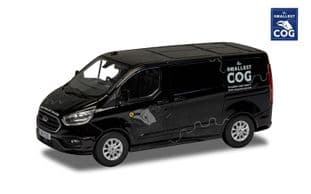
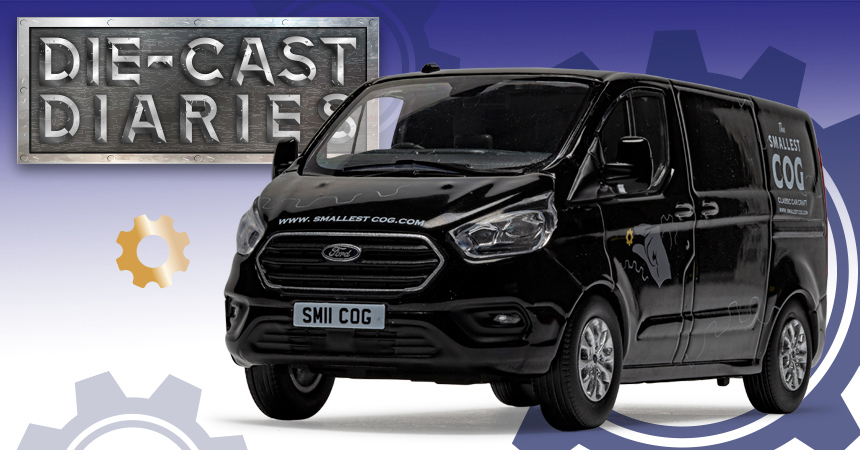
For most people, vans are something of a motoring necessity, something you need when moving house or having new items delivered to your home, and in truth, probably something that might get on your nerves if you’re stuck behind one on a narrow road. If you own one, or drive one for a living, you might have a different view of the humble van, as the latest models feel like, and certainly drive like a high quality family car from just a couple of years ago, complete with all the mod cons you might expect. As far as Richard Hammond is concerned, he loves his little Ford Transit Custom, not just because it’s an effective travelling billboard for his new enterprise, but because it brings back some pleasant motoring memories for him.
In an episode aired on his excellent DriveTribe YouTube channel, he describes how as a young radio presenter, he took a second job to make ends meet, one which saw him collecting and delivering furniture. After a while, the boss bought him a brand new van to use and our engaging presenter described how this was a really special moment in his life, one which still brings back very happy memories for him. Every time he gets behind the wheel of his beloved Transit, even though this van is so much better than the one he was driving all those years ago, he immediately gets those same feelings of pride and fulfilment, which is perhaps just as well, as he’s had to sell some of his car collection to fund this new business enterprise, including his new van.
The Ford Transit story as we know it, began with the release of the first series 1 vehicles back in 1965, when the Ford Company decided they were going to produce a new range of light commercial vehicles to support everyday trade and business activities, whilst at the same time, challenging the market dominance of rival manufacturers in this potentially lucrative field. Those first tentative steps marked the beginning of a period of market domination for Ford, with the Transit going on to be the vehicle of choice for thousands of tradespeople and business owners, becoming the best-selling vehicle of its type for many years to come.
All the images used to illustrate this update feature and advanced production sample of this rather famous Transit Custom.
The success of respective Transit ranges was mainly down to the physical size of the load carrying compartment, larger than its competitors and therefore able to carry more goods and oversized loads, with all this functionality achieved by a vehicle which was both reliable and stylish. The styling was rather American in execution, functional, but with that little something undefinable about it, and didn't the British market love it. In addition to this, Ford were clever in maximising the potential of the Transit, by taking it away from the feeling that it was just a workman's mode of transport and aligning it much more closely with a large and robust family car, something akin to a modern MPV (Multi-Purpose Vehicle). This feature was actually born out of necessity, as Ford's design teams were instructed to use as many components from their existing car ranges as possible, making both development and manufacture more cost effective, whilst at the same time giving this commercial load lugger a very different feel.
In addition to this, all this stylish load carrying capacity was mainly pulled along utilising Ford's existing range of car engines, with these cost savings ensuring that Transit pricing always remained extremely competitive.
As the Transit soon became the van of choice for thousands of tradesmen and businesses up and down the country, so the demand for these vehicles reached unprecedented levels. Indeed, as waiting times for new vehicles continued to increase, the second hand market flourished, becoming increasingly tight, with this increased demand dictating that used Transits always retained their value, a situation which didn't relieve the pressure on the new vehicle market.
Having unearthed such a winning formula, Ford were careful to maximise the potential of the Transit, making it an indispensable tradesman's tool and continually refining their vehicles, making ever more body-style options available and further increasing levels of interior comfort and equipment. Their mantra was that if Transit owners were going to be spending long periods of time in their vans every day, they wanted to make this a comfortable and pleasurable experience for them, almost as if they were in a family car of reasonable specification. The seemingly endless number of configuration options would give Transit buyers an incredible level of choice when it came to selecting their van and with 6 body styles, the option of either a short or long wheel base chassis and no fewer than 32 different door combinations, the choice of your new Transit was not an exercise for the indecisive amongst us - they really did have a Transit for every conceivable application.
The many admirable qualities possessed by the Transit were not lost on the less salubrious members of British society, as the load carrying capability, speed and car-like handling of these vehicles made them a popular choice for many with dishonest intentions. Indeed in 1972, it was estimated that over 90% of bank raids which took place in the country used a Transit as their getaway vehicle.
Clearly, this posed quite a problem for the country's Police Forces, however, they did come up with an ingenious solution to this problem - they simply bought lots of Transit vans themselves! Using uprated vehicles with powerful engines, Police Transits were even more capable than the standard machines (the ones they were chasing), with speed, great handling and that legendary load carrying capability making them an arresting proposition. A less celebrated Transit claim to fame would be that it became one of the most stolen and broken into vehicles in British history, although it is not known if this is because criminals either wanted to use them for a job (or knew someone who did), or if they were just an easy target for the opportunist thief. Either way, warning labels stating that 'No tools or equipment are left in this van overnight' also became associated with Transit ownership.
Continuing the 60 year legacy of this magnificent vehicle, the latest incarnation of the Transit is the one which attracted the attention of the Corgi team and has recently joined the Vanguards range in 1/43rd scale die-cast model form. The Transit Custom was unveiled at the 2012 Commercial Vehicle show in Birmingham and has continually benefitted from soft upgrades and trim level improvements over the years. The culmination of many years of commercial vehicle design and manufacturing expertise, these latest vehicles are the perfect combination of quality, functionality and style, with the now legendary choice of range options facing any Transit customer making one of these vehicles suitable for any conceivable business or recreational application.
With levels of style and comfort which continue to maintain the market position of the Transit, the interior spec of these vehicles are much closer to what you would expect to find in a quality family car than in a commercial vehicle, with the exterior styling also belying the rugged, hard-working nature of these vans. With vans, double cab-in-vans and Kombi vehicle options available, if you are driving a Transit these days, you are most certainly not a motoring poor relation.
Our Vanguards 1/43rd scale die-cast representation of the current Transit helps to maintain this proud legacy in model form, with this latest release presenting a vehicle which is actually quite the screen star in its own right, one of the higher-profile Transit Customs out there.
Herefordshire-based classic car restoration workshop, The Smallest Cog, was founded by TV presenter Richard Hammond in January 2021. The Transit modelled arrived at the workshop in February 2022 and has remained in constant use. Richard was excited to have, what he considers to be, ‘his’ van, as the first new vehicle he ever had charge of was a high-top Renault Traffic belonging to the antique pine furniture business he worked for as a young man; he has loved vans ever since. He made a short film for the DriveTribe website about this Transit, praising its performance and comfort whilst also describing it as a time machine that reminded him of his youth.
The van was put to work immediately, being used for everything from collecting parts or equipment to popping out to get lunch. It’s also employed as a tender and occasional tow vehicle for The Smallest Cog’s racing team, carrying the parts, tools and tea making equipment that are an essential part of classic car racing. The racing team began as a PR exercise for the workshop, allowing them to showcase their technical abilities by building an MGB GT, which is now partially sponsored by Corgi, to race in the Classic Sports Car Club’s Swinging 60’s Racing Series. It was initially driven by Anthony Greenhouse, but more recently Richard has also raced the car because he couldn’t resist the lure of the racetrack.
We’re expecting this appealing new model to be available imminently, so if you have your example pre-ordered on the Corgi website, or placed with your usual supplier, please keep an eye out for notification over the coming few days.
Incidentally, the Corgi team will be present in a BIG way at the DRIVETRIBE LIVE event on Saturday 30th August, and will bring you more details in a forthcoming edition, but for those interested, the link above will take you to the event website, where you can secure your tickets.
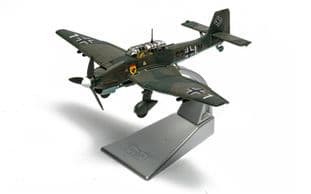
The latest impending addition to our range of 1/72nd scale Ju87 Stuka models is an absolute cracker, and one which has an interesting story to tell.
When it comes to aircraft which earned an infamous reputation during the dark days of the Second World War, arguably no other aircraft comes anywhere close to matching the fearsome legacy of the Junkers Ju87 Stuka, a flying artillery piece which was intentionally equipped to spread terror and confusion. When one of these terrifying aircraft started its bombing dive, the undercarriage spat mounted sirens began to wail, giving those on the ground a few seconds to contemplate their fate, which was now completely in the hands of the Stuks crew above.
dive bomber first and foremost, its potential as a fearsome propaganda weapon for the Wehrmacht was not lost on the Germans, who intentionally added airflow driven sirens to the undercarriage spats of these aircraft. Once a Stuka began its near vertical bombing attack dive, the sirens emitted a terrifying wailing sound which was intended to spread fear and confusion amongst the enemy, who knew that when this horrendous sound finally abated, the bombs would start to explode around them. Not content with this, the bombs themselves could even be equipped with cardboard sirens, continuing the terror of their attacks still further. With the distinctive profile of the Stuka and the fact that its very presence confirmed that war was coming, it's no wonder that the Stuka was considered the very embodiment of German military prowess, by many Western Europeans.
One of the main reasons for the early success of the Stuka was that it was designed from the outset as a precision attack aircraft and incorporated several advanced features to help crews successfully accomplish their dangerous missions. Featuring a relatively thick and incredibly strong wing, one which was designed to withstand the rigors of the violent bombing dive, the Stuka's design incorporated a number of automatic features which helped the pilot concentrate on the task at hand. These included automatic dive brakes, which limited the speed of the dive attack and allowed some stability during this relatively violent manoeuvre, along with an innovative automatic dive recovery system, which prevented the aircraft from crashing due to pilot induced ‘G force’ blackout. Worryingly for those people unfortunate enough to be in its path, once a Stuka crew initiated their attack sequence, it was almost impossible to defend against.
As Europe descended into war again, just 21 years after the end of the war to end all wars, the Stuka would have a prominent role to play in those early months of conflict, writing itself into the pages of military history. With its thick gull wings and fixed main undercarriage spats, the Stuka may not have been the most modern looking aircraft available to the Luftwaffe, however, it had a vital and particularly high-profile combat role to perform. Stuka units relied on a tried and trusted system of direct communication, with specially trained observers embedded with pioneer and mechanized infantry units on the battlefield. In addition to hitting pre-assigned strategic targets, strikes could also be requested in real time by ground advisors.
The Stuka was a precision strike aircraft and unlike the indiscriminate, saturation destruction inflicted by traditional bombers, Stukas were directed at specific, strategic targets, which could include troop concentrations, bunkers and strongpoints, armoured vehicles and anything which may be holding up the advance of ground forces. Their primary role was to keep advancing ground troops moving forward and the enemy in disarray, with the speed of this lightning war being the reason for its unprecedented success - as long as they kept moving forward, the enemy couldn't regroup and plan a cohesive counter offensive.
At the time of its crash landing on the Isle of Wight, this aircraft was probably just about the most sought after Luftwaffe aircraft in Europe.
From a psychological perspective, it could be argued that the reputation the Stuka managed to create proved to be much more than the sum of its actual wartime contribution, despite its success during the early stages of WWII. With its precision strikes and screaming sirens, the Stuka may not have spread widespread destruction itself, but it did come to be regarded as a highly visible bringer of war and how if you were unfortunate enough to find yourself in the vicinity of Stuka operations, you absolutely knew war wouldn't be far behind.
Unfortunately for Stuka crews, despite its fearsome reputation, when they were operating in contested airspace and up against manoeuvrable and capable enemy aircraft, they were hardly capable of effectively defending themselves and unless they were able to count on the protection of strong Luftwaffe fighter forces, a great many aircraft would fall to the guns of Allied fighters. Despite the fact that the Stuka would see service throughout the Second World War, the battles of France and Britain would prove disastrous for the Luftwaffe's Stuka units, essentially consigning the aircraft to something close to obsolescence.
During the German Blitzkrieg in 1939-40, the Junkers Ju87 Stuka proved to be a devastatingly effective weapon capable of delivering precision bombing attacks against ground targets. The Stuka attacked at a 60-90º angle with its dive brakes extended to control its speed and increase bombing accuracy. When the aircraft was about 450m (1,500 ft) above the target, the pilot released the bomb and initiated the automatic pull-out mechanism. This ensured that the Stuka recovered from its attack dive even if the pilot blacked out from the high g-forces. The aircraft was fitted with the infamous Jericho-Trompete (“Jericho Trumpet”) wailing sirens, which were used to weaken enemy morale during attacks. The sirens were eventually removed due to increased drag.
During the Battle of Britain, five Geschwader were equipped with the Ju87 Stuka. After some initial success against British shipping operating in the English Channel, it soon became clear that the dive-bomber required heavy fighter escort to operate effectively. Poor manoeuvrability and a lack of both speed and defensive armament made the Stuka extremely vulnerable to modern RAF fighters, resulting in heavy losses. On 16 August 1940, StG 1 and StG 2 lost nine Stukas between them in a raid on RAF Tangmere. Two days later, seventeen Stukas of StG 77 were lost attacking Ford and Thorney Island. In just six days of combat from 12 to 18 August, forty-one Ju87s had been destroyed, forcing Reichsmarschall Hermann Göring to withdraw the aircraft from the Battle.
Despite its reputation as the airborne spearhead of Blitzkrieg and the prelude to attack by German ground forces, once Stuka operations were taking place across the English Channel and facing a determined and organised opponent, its reputation soon began to become tarnished. Requiring constant protection from Luftwaffe Messerschmitt Bf 109s and 110s, the much vaunted Stuka simply couldn’t defend itself in contested airspace, and crews soon began to pay a terrible price.
During the late afternoon of 8th August 1940, more than eighty Ju87 Stukas and their fighter protection left their bases in Northern France to make one final attack of the day against the British Convoy CW9 ‘Peewit’ off the south coast of the Isle of Wight, which had been attacked mercilessly by German naval and air forces since the early hours. Each Luftwaffe raid was met by strong opposition from the Royal Air Force, and this third raid was to be no exception. As the two sides clashed, those involved reported more than sixty aircraft engaged in a huge dogfight, with each one fighting for its life, and bombs falling all around the remaining ships in the convoy.
Although RAF Fighter Command were quick to show the vulnerabilities of the Stuka during the Battle of Britain, the die had already been cast, and this airborne artillery piece had already terrified the population of western Europe.
This Ju87 Stuka S2+LM was about to launch its diving attack, when its engine failed, with the aircraft immediately starting to lose height. At around the same time, a Hawker Hurricane from No.145 Squadron attacked the aircraft, with a short, well aimed burst killing the rear gunner and severing the aircraft’s fuel lines, meaning that the pilot had to immediately look for a suitable place to set the stricken aircraft down. Landing in a field at St Lawrence on the Isle of Wight, just inland from the sea, the aircraft came to rest in a wooded area and was secured by locals, but was relatively intact, incredibly, with its full complement of bombs still in place.
Significant as one of the Stukas which took part in the devastating raids against Convoy CW9 ‘Peewit’ in the English Channel, this particular aircraft was also significant as it was the first intact Stuka to fall into British hands, and was therefore quite the coup for the British military. Plans were immediately put in place to dismantle the dive-bomber and transport it to the mainland, where it would be re-assembled and used for test and evaluation purposes. As it transpired, a second, more complete aircraft came into British hands just a few days later, so S2+LM was instead directed to a scrapyard for disposal. The other Stuka was later stripped by souvenir hunters, but by that time, Stuka raids against British targets were becoming almost non-existent, which also removed the need to evaluate these enemy aircraft.
One of the most famous military aircraft of all time had met its match in the skies over Britain, but would be forced to soldier on until the very end of the Second World War.
One of the most popular toolings in the entire Aviation Range, we’re delighted to have this historic Stuka in the range in this Battle of Britain 85th Anniversary year. We expect this fantastic new model to be in stock and available early next month, but this might be one you consider pre-ordering in advance – it’s been a popular one!
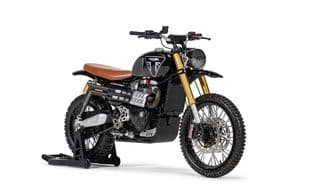
This time chasing 007 rather than transporting him, this latest Triumph Scrambler model release continues our successful motorcycle series in some style.
One of the benefits of producing some of the most exciting films to have ever appeared on the silver screen over the past sixty-two years of so, is that you also build up a huge following of devoted fans who not only look forward to the latest thrilling movie instalment featuring their favourite secret service agent, but also become avid collectors of anything related to their on screen hero.
This phenomenon is something which has been a driving force within the Corgi model range for nearly as long as the James Bond film franchise has been in existence, with some of the most popular die-cast model releases in the industry emanating from this Corgi/James Bond association. This proud association continues to this day, and in 2022, witnessed the introduction of a new range of high quality, highly collectable 007 related model releases, but models linked to Bond on two wheels.
Initially, we actually announced these models in 1/24th scale, but as our development team progressed through the project, they were of the opinion that these new models could be much more. The unusual decision to halt the project and start again was not taken lightly, but as the first test shots of these motorcycles began to appear in the larger 1/12th scale, we absolutely knew that we’d made the right call.
Real versus Corgi. This Triumph/007 display in Wonderworks shows just how meticulously our design team have replicated this powerful scrambler in scale.
In addition to being beautifully detailed collector’s models, our 1/12th scale motorcycle series benefit from extremely high quality presentation packaging.
James Bond finally returned for his twenty fifth on screen adventure in 2021 and in ‘No Time To Die’, we found our hero enjoying something of a tranquil life in Jamaica, having left active service. His peace is short-lived when his old friend Felix Leiter from the CIA turns up asking for his help. The mission to rescue a kidnapped scientist turns
out to be far more treacherous than initially expected, leading Bond onto the trail of a mysterious villain armed with dangerous new technology.
Several of the exciting action scenes featured in the new movie heralded the franchise debut of an iconic British motorcycle brand into the Bond phenomenon. Driven by both the villainous Primo and 007 himself during a high octane chase through the Italian city of Matera, the Triumph Scrambler 1200 is put through its paces with some daring stunts in the streets of this historic city, scenes which had us all gripping the edge of our seats, and probably thinking how cool it would be to own one of these fantastic machines.
The Triumph motorcycles also made a dramatic appearance later in the film, when Bond was trying to avoid the attention of villainous pursuers once again, whilst hiding in a Norwegian forest. With some of his pursuers riding Triumph Scrambler 1200s, the eerie sound of their engines reverberating around the misty forest, like some fearsome mythical creature trying to hunt him down, only added to the drama of the situation, and also gave the director further opportunity for some high octane on screen excitement.
CC08403 - James Bond 007 - Triumph Scrambler 1200XE (Norway) 'No Time To Die'.
An iconic British Motorcycle brand makes it’s James Bond franchise debut in No Time To Die.
Having tracked his estranged wife Madeleine Swann to her childhood home in Norway, James Bond discovers she has a daughter named Mathilde. Their reconciliation is suddenly interrupted by rogue State Department agent Logan Ash and a hoard of henchmen reporting to the villainous Safin. Fleeing across the Norwegian countryside, Bond, Madeleine and Mathilde are pursued by multiple vehicles including riders on Triumph Scrambler 1200 XE motorcycles. Reaching the cover of a nearby forest, the distinctive engine roars of the Scramblers echo around the trees as they flee on foot. The three are confronted by one rider who Madeleine shoots just before he is able to attack Bond, with the Scrambler toppling on top of the man as he falls dead in the undergrowth.
A final selection of images featuring the real motorcycle, and our faithful scale die-cast representation of it. Calling all 007 fans.
First launched in 2018, the Triumph Scrambler 1200 has rapidly become a modern Triumph motorcycle icon, setting a new benchmark thanks to class-leading riding capabilities both on and off road, outstanding specifications and extensive customization options. The Scrambler combines an iconic style and silhouette with the capability of an adventure motorcycle by design, featuring a specially tuned high power 1200cc Bonneville 8 valve parallel twin engine and a 21” front wheel that offers a commanding riding position and incredible off-road riding potential.
Following the use of a Triumph Scrambler 1200 XE in the opening sequence of No Time To Die, the motorcycle type appeared again during the off-road chase sequence set in Norway. Much of the scene was actually filmed in Scotland, and several Triumph motorcycles were outfitted for off road use with the example modelled here the most prominent in the extended scene. The motorcycles performed dramatic jumps at high speed down a sloping hillside and through flowing water while being ridden ‘flat out’ by the films stunt team.
This magnificent new addition to our 007 model range is speeding its way into our warehouse as we speak, and should be available to chase Bond about your display cabinets from early next month.
So exciting we had to show it twice! Corgi artwork in different formats to announce our attendance at this year’s Royal International Air Tattoo.
With RIAT now less than a week away, we can finally start getting excited about our attendance at this year’s show and we’re very much looking forward to catching up with all you Corgi fans out there. This will be the first time Corgi have attended the show with an independent display stand since coming under Hornby ownership and quite possibly ever, so it’s quite a big deal for us.
From a showground positioning perspective, we’re going to be in a different position to where the Airfix stand has been for the past few shows, and whilst we will still be next to our beloved comrades, we should now be positioned in the Blue Zone, near the Aviation Club and a little further along towards the control tower than previous years. Set up day can be a little frenetic for all concerned, but once we’re in position and set up on Thursday, we’ll put out a couple of posts on Corgi socials to let everyone know exactly where to find us. If in doubt, just look for the massive Corgi flags a fluttering.
Members of the team will be available to show you around the stand and discuss all things Corgi, and we will have some exciting things going on over show weekend. We may or may not have a new product announcement or two to make, and there will definitely be a tempting selection of show special bargains to be had for those who are quick on the draw! Unfortunately, we don’t have room for a massive amount of stock and once these show specials have gone, we’re afraid they’re gone.
We have so much planned for show weekend that we can’t wait to get going now, but everything will be all the more memorable if we get the chance to speak to as many Corgi fans and Die-cast Diaries readers as possible. So, if you’re going to RIAT this year, please do come and find us, and let’s talk Corgi!
Please do keep an eye on official Corgi social media channels from the middle of next week, as we intend to keep everyone informed on all our RIAT activities.
See you all there.
We’re afraid that's all we have for you this time around, however, we’ll be back as usual in two weeks’ time with a further exclusive selection of the latest Corgi model updates. As ever, you could always drop us a line if you felt moved to do so, to comment on anything blog, collecting or Corgi model related, or even perhaps to suggest a topic you might like to see the team cover in a future edition. As always, our diecastdiaries@corgi.co.uk address is the one to use.
If you can’t wait for the next blog, you will find plenty of Corgi model collecting discussions taking place on our official social media channels, access to which can be obtained by clicking on the respective links at the foot of the Corgi website homepage.
Link access to Corgi social media sites.
Thank you for continuing to support your Corgi Die-cast Diaries blog. Our next edition is scheduled to be published on Friday 25th July, and we look forward to seeing you all back here then.
Thank you for your continued support