

Welcome to the latest edition of Corgi Die-cast Diaries, your regular blog review of all the news, updates and topical stories from the captivating world of Corgi die-cast model collecting.
It's a Corgi weekend once again and from the title of this latest update, the Vanguards model collectors amongst us will be expecting quite a significant edition for them and they would be right. With our usual selection of exclusive imagery and project updates, we have news of three impending additions to the Vanguards range, including one newly tooled model which is being shown for the very first time in final advanced production sample form. We have a selection of images gathered from a recent scanning trip to the Ford Heritage Centre and just so this edition is not completely devoted to four wheeled modelling subject matter, we take a look back at an Aviation Archive oldie but goodie which is a scale representation of the fighter mount of the youngest air ace of the Great War, and a beautiful model which is about to disappear from the Corgi website for good.
It's time to stick the kettle on, clear the decks and spend a few moments emersed in the comforting die-cast world of Corgi.
Your latest blog exclusive, the first time this new model tooling has been seen in fully decorated metal sample form and doesn't she look a picture!
In the world of popular motoring, the term 'classic' is very much open to interpretation and a car which one person thinks is very much deserving of this tag may be met with stern resistance from another. Surely there few people who would argue that such designs as the Aston Martin DB5 and Austin Healey 3000 are deserving of classic status, but should a car intended to be owned by large numbers of the general population be considered for such an accolade?
If we can include such cars, then surely the trusty Ford Cortina has to be in contention, a car which resulted from a strategic attempt by Ford to produce a popular car which would satisfy the requirements of the average British family’s motoring needs and crucially, one which would challenge the current market share of companies like BMC and Vauxhall at that time. Using existing construction techniques, particular emphasis was placed on price and mechanical reliability, but not at the expense of styling - the Cortina was always intended to be a bit of a looker and by adding a little motorsport success into the mix, they quickly found that they had a popular motoring winner on their hands.
Regularly updating the original Mk.I design, the Cortina became so popular with British motorists that the Ford marketing department confidently proclaimed that the only car any new Cortina iteration had to beat was the old Cortina it replaced and as it went on to be the best selling family car in the country on several occasions, it seems that their boast was not without substance.
Our ability to scan this actual car at the Ford Heritage Centre means that this new tooling release will be a faithful scale representation of this handsome vehicle.
With the Cortina taking its place on the British motoring scene from September 1962, this year marks the 60th anniversary of its introduction and a series of five different versions which would become the motoring staple of families up and down the country, not to mention the nation’s army of travelling salespeople. Incidentally, marking the opposite end of Cortina production in the UK, this year also marks 40 years since the final Cortina rolled off the production line, making this quite a year for remembering this hugely popular series of vehicles.
First announced in 1979, the angular and purposeful styling of the Mk.5 Cortina could be seen in the driveways of homes the length and breadth of the country and would also become the vehicle of choice for Britain’s army of travelling salespeople. More than 2.8 million Cortinas were sold during the car’s 20 year production run and this Mark 5 series variant is as important to our Vanguards range as it was to the Ford Motor Company (in scale terms, of course).
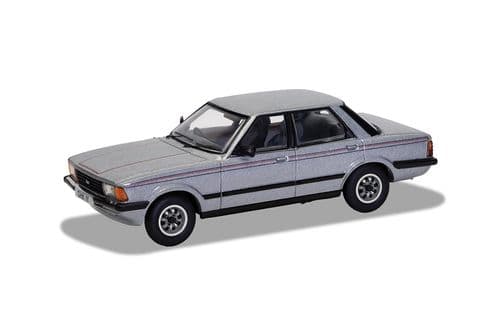
VA15001 Ford Cortina Mk5 Crusader 1600 'The Last Cortina' Strato Silver
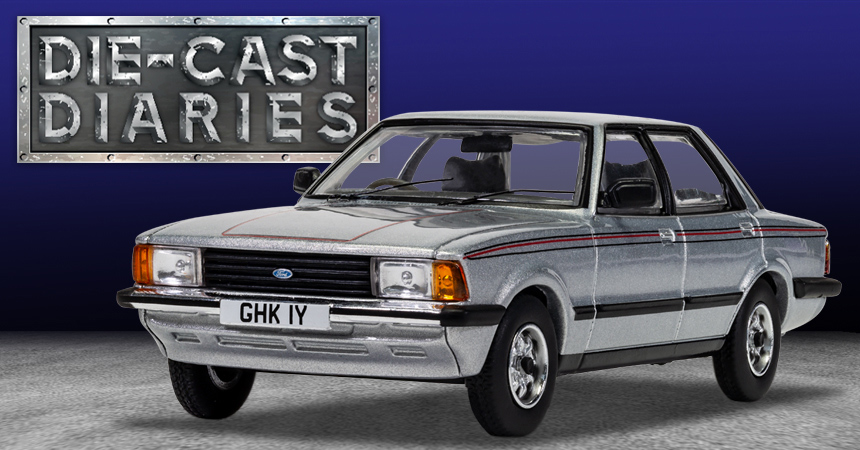
We are delighted to now be in a position to bring you a final update from this new Cortina tooling project and not only an exclusive first look at a fully decorated sample model, but confirmation that the product images you are seeing here feature a final advanced production sample of the model - the new Cortina Mk.5 is nearly here!
As we have already seen in a previous edition of the Corgi blog, this latest new tooling project benefitted from our ability to conduct a highly accurate LIDAR scan of a donor vehicle at the very outset of the design process, with the actual car we scanned destined to be the livery option selected for the initial release from this tooling. The Corgi team paid a visit to the Ford Heritage Centre last year, where we were able to conduct the scanning of this handsome and rather historic vehicle. Carrying the registration GHK IY, this Cortina Crusader is actually the final one manufactured in Britain and makes for a fitting subject for our first release from a new tooling we are proud to be introducing to the Vanguards range.
The information produced in support of this new tooling release reads as follows:
After twenty years of continuous production, the last British-made Cortina, the car we have modelled here, was driven off the production line on 22nd July 1982 by Ford UK's Chairman Sam Toy. It would be retained by Ford, road registered in December 1982 and has since remained in the company's Heritage Collection and was used extensively for press and PR work. This work included appearances on the TV programmes James May's Cars of The People and The Grand Tour, as well as featuring in numerous magazine articles. The UK market only Crusader edition Cortina grew out of a friendship between Toy and Victor Matthews, who was then the Chairman of Trafalgar House Investments, the company which controlled the Daily Express newspaper.
Two more exclusive product images, which feature an advanced production sample of the new Cortina Crusader, the first time this model has been seen in a diecast, fully finished state.
Every Cortina Crusader featured the Daily Express Crusader emblem on the boot lid as well as Ghia-styled interior trim in Durham velour, cut-pile carpet, a long centre console incorporating a radio, wheel rim embellishers and distinctive pin-stripping with matching decals. The Crusader was launched in April 1982 and was available in three engine sizes, 1.3, 1.6 or 2-litre. Over 30,000 of this run-out edition Cortina were produced because it offered remarkable value - the list price of a Crusader 1600 was only £5435 when the GL, which was not so lavishly equipped, cost slightly more at £6054. Cortina Mk1 production commenced at Dagenham on June 4th, 1962, and in that period of just over twenty years 4.3 million Cortinas were produced with each generation going on to sell over a million examples.
A stunning new addition to the Vanguards range, this new Cortina Crusader is scheduled to be with us and ready for dispatch by mid-November, so it's time to check those pre-orders.
Amongst the embarrassment of motoring riches on show at the Ford Heritage Centre, the Focus RS was the one car which positively demanded your attention!
We didn't want to leave the subject of our scanning trip to the Ford Heritage Centre without including one more photograph and one we clearly had to keep under wraps until a certain new model had been announced and was available for pre-order on the Corgi website. During our research trip, we were also given the opportunity to inspect Ford Focus RS Mk.3 EX16 KSJ and we have to say, she was most definitely one of the most desirable cars we have ever seen. Obviously the subject of yet another spectacular Vanguards new tooling project, the Focus RS holds the position of being quite possibly the favourite modern Ford for many thousands of motoring enthusiasts, particularly as this 2.3litre, 350 hp, 0-60 in 4.7 seconds beast has all of Ford's extensive motorsport pedigree shoehorned into its eye-catching bodyshell. With active four wheel drive for exceptional traction and acceleration, the Focus RS has the performance to back up its sporty appearance and who wouldn't want to own one of these stunners?
With this model (VA15301) only making it onto the Corgi website with the launch of the recent September - December range launch, it didn't come as a surprise to anyone in the Corgi offices that this stunning model immediately powered to the top of the model pre-ordering charts and as it currently stands, it is still top, with very few models remaining to be snapped up. We know all too well that we have a Nitrous Blue winner on our hands here.
Let's now take a quick look at the product copy which has been produced in support of this new model and will forever be linked with this future Vanguards classic release.
Ford understand the reverence in which the RS badge is held and set out to make the Mk3 Focus RS the ultimate fast Ford. As soon as the first magazine road tests were published it was clear that they had achieved their goal. It had performance that could humble supercars costing twice as much yet it remained a practical 5-door hatchback that could easily be used as an everyday car. Highlights included four-wheel drive, launch control and a drift mode that created an internet sensation just after the car was launched in 2016 as stunt drivers and journalists battled to see who could drift a standard Focus RS in the most spectacular manner.
The resultant ebullient press coverage and bargain launch price of £31,000 meant the RS practically sold itself and was an instant classic. The car modelled was the first right-hand-drive example in the UK. Top Gear Magazine followed its production at the Saarlouis plant in Germany and their Journalists Ollie Marriage and Rowan Horncastle then drove it off the production line and back to the UK. It was subsequently road tested by Autocar, Piston Heads, Evo Magazine and many others. Most famously, however, it was the car Jeremy Clarkson chased Richard Hammonds new right-hand-drive Ford Mustang with during Series 1, Episode 6, of The Grand Tour. It has been retained by Ford and is one of the best-known cars in the company's heritage collection.
The SPAD S.XIII was one of the great fighting aeroplanes of the First World War and the mount of many a French and US air ace.
One of the most popular series of Corgi models produced over the past fifteen years or so has been our 1/48th scale WWI fighter series, beautifully detailed aircraft models which replicate machines from the early days of aerial warfare and the mounts of the very first Knights of the Air. A range which has grown with the addition of both the Bristol Fighter and the Fokker Eindecker over recent years, we are always looking to improve these models in any way we can, be that with the level of decoration detail and accuracy we challenge the factories to replicate, or by maximising the potential of the individual tooling designs themselves.
With these models finding favour with a great many collectors, many previously released models have now become incredibly difficult to get hold of, presumably because once they disappear from the Corgi website, individual collectors are loathed to sell theirs on to fellow collectors who might be looking for one. With that in mind, we thought it might be a good idea to draw blog readers attention to a current release in this series which is now down to just a handful of remaining models and just about to enter the realms of model releases of the past. The model also happens to be a scale representation of the aircraft flown in combat by the youngest French air ace of the Great War, Pierre Marinovitch.
This beautiful model release depicts an aircraft which was used to great effect by one of the most notable airmen of the latter stages of the Great War and one who earned the distinction of being the youngest French air ace of the conflict. Aviation Archive collectors may also have noticed that this particular release was linked to another 1/48th scale model release, the Albatros fighter flown by Martin Mallmann, a combination which was brought down by Marinovitch during aerial combat.
With the emergence of the aeroplane as an essential weapon of war during the savage fighting of the Great War, many of the world’s early aviators chose to embellish their aircraft with flamboyant paint schemes and distinctive markings, which seemed rather appropriate for these first Knights of the air. Many of these emblems may have had their origins in the heraldic symbols of the past, or simply represented an individual pilot’s desire to stand out from the crowd, but whatever their origin, they quickly became an invaluable recognition aid for fellow pilots during the melee of a swirling dogfight. More readily associated with airmen of the Central Powers, one of the most distinctive markings adopted by an Allied unit during WWI was the ‘Grim Reaper’ carried by the fighters of Escadrille Spa 94 of the French Air Service, a particularly sinister sight in the skies above the trenches.
This certainly proved to be the case during the last year of the war, as the excellent Spad fighters flown by French and American airmen began to take a heavy toll of Luftstreitkräfte aircraft. Young French airman Pierre Marinovitch gained his ‘Ace’ status on 19th January 1918, with he shared in the destruction of Jasta 19 Albatros D.V 2111/17, flown by Martin Mallmann, north of Manre-Beine. Interestingly, he shared the victory with American volunteer pilot Austen Ballard Crehore, Marinovitch’s best friend and regular flying partner.
Only sixteen years old at the start of the Great War, Pierre Marinovitch made no secret of his desire to do his duty and fight for his country. Whilst still only seventeen, he enlisted in the 27e Régiment de Dragoons, only to almost immediately change his mind and apply for pilot training, successfully gaining his wings in the spring of 1917. Following a period of illness, he was assigned to Escadrille Spa 94 ‘The Reapers’ and by the end of 1917 already had three aerial victories to his name. Known as ‘Marino’ to his squadron mates, his flying style was not liked by all, with some questioning his flying ability and simply describing him as having a good shot, however, nobody could question his bravery and aggression in the air.
As his victory tally continued to rise, he also came to the attention of the French press, who were desperately looking to find heroes who could inspire a population scarred by the ravages of war. Hearing of his aerial exploits, they proclaimed Marinovitch to be ‘The youngest French ace’, by virtue of his tender years and used him as something of a poster boy. Throughout the rest of 1918, ‘Marino’s’ victory tally would continue to rise and by the end of hostilities, he had at least 21 aerial victories to his name, the highest scoring ace in his squadron and the 12th ranking French ace of the entire war. Continuing to fly after the war, Marinovitch was tragically killed in a flying accident on 2nd October 1919, just weeks after celebrating his 21st birthday.
Currently available on the Corgi website, our representation of the Spad fighter flown by Marinovitch is now down to just a handful of available pieces and if you feel this model of his distinctive fighter would look good in your WWI aircraft collection, now would be a good time to act.
They always say that good things come in threes, something which is certainly true when you are a Vanguards new model collector.
After that little Great War aviation interlude, its back to the world of impending new Vanguards model releases and two new models we are expecting to arrive in our warehouse at the same time as the Cortina Mk.5 Crusader 1600. When it comes to cars which captured the imagination of the British motoring public, there can be few that had a greater impact that the stylish Ford Capri, a design which started life as the intended European motoring equivalent of the hugely successful Mustang Mk.I introduced by the American parent company and was first unveiled at the end of the 1960s.
Marketed in the UK as a stylish, yet affordable two-plus-two sports coupé aimed at the working man, the Capri proved to be a real success for Ford and would go on to enjoy a 17 year production run, with almost 2 million cars sold during that time. It is hardly surprising that this handsome car proved to be such a winner, particularly when learning how Ford’s marketing department at the time positioned the car to the British public. The Capri was described as ‘The car you’ve always promised yourself’ and with motoring temptation like that, how could we possibly resist? For those of us who were captivated by the style and performance of the Capri, if you are lucky enough to see one of the roads today, it will immediately grab your attention and probably have you thinking how much you would still love to own one.
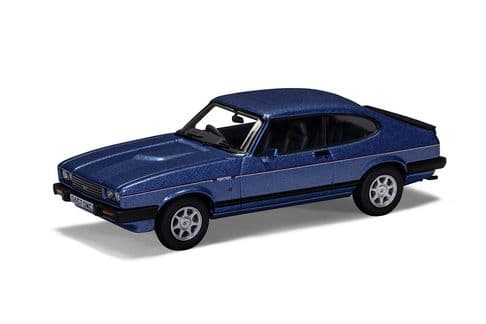
VA10822 Ford Capri Mk3 2.8 Injection Special in Paris Blue.
The Capri we have modelled here was originally supplied by Trimoco Ford, Chelmsford, Essex, on August 8th, 1986. It was purchased by local man Mr R.F Robinson, who used the car regularly and had Trimoco carry out the first four services, with the vehicle covering almost 20,000 miles in two years. The second owner kept it until 2006 when it was purchased from a dealership in Leicester by Warwickshire-based Mark Eales, a long-standing Capri enthusiast. The paint was peeling away by then, so he had the car comprehensively stripped and repainted by Phil Leach at PL Car Bodies in Warwickshire. The bodyshell was free of corrosion and didn't need any welding, although a new-old-stock front valance was fitted to replace the damaged one.
The car was bought by current owner, Lancashire-based car enthusiast Neal Buckley, from Classic Car Auctions (CCA) in December 2018. He was impressed by the car's condition, liked the colour and bought it because he wanted to add the Capri to the small collection of cars he offers for hire to be used at social events such as weddings, or by film and TV companies wanting characters to drive period vehicles in the production. He carried out some minor work on the car to make sure it was reliable, including fitting a new radiator when he first purchased it and has used it regularly since.
In his ownership, this vehicle has appeared in both Coronation Street and The Crown and been used for various social functions.
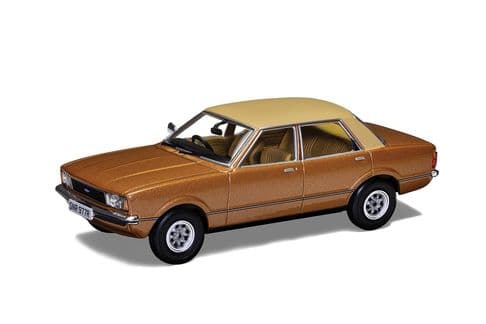
VA11917 Ford Cortina Mk4 1.6 GL in Arizona Gold.
Ending with the same subject where this latest blog update began, we return to the famously clean lines of the Ford Cortina, but this time in Mk.4 series guise. In this colour combination, the Cortina looked particularly attractive and if you were fortunate enough to have one of these on your drive, you would have definitely been the envy of your neighbourhood.
The Cortina we have modelled here was first purchased from Hanger Ford of Leicester on 15th April 1977, by proud owner Mr John H Piggott who specified the unusual Arizona Gold and Tan vinyl roof colour scheme. The total cost of the car was £2752.31, which included an extra £18.99 for the metallic paint, £47.62 for the vinyl roof and £45.50 for undersealing treatment. The car was regularly serviced by Hanger Ford in the years which followed and records show it had only covered 20,941 miles when they conducted their last service in May 1986. It was taken off the road in 1995 but remained in Leicester with members of the original owner's family, who decided to sell it in late summer 2012.
It was next purchased, complete with detailed history file, by Stockport-based enthusiast John Baugh for £550 who, despite only having a narrow garage, embarked on a complete restoration of the car. Doing all the work himself, he completed the work in a remarkably sort 261 days, finishing with an MOT pass on 7th June 2013. The Cortina's restoration story was detailed in the September 2013 edition of Practical Classics.
Current owner, Edinburgh-based Sammy Fielding, initially drove to London in June 2018 to buy a different Cortina which on his arrival, proved to be a disappointment and consequently didn't work out. Before going home empty handed, he decided to look for others locally on line and discovered this car whilst he was browsing. On first sight, he immediately knew he would be driving this car back to Edinburgh and to this day, he is still the proud owner of this rare classic.
Both the two models above and the Cortina Mk.5 Crusader 1600 which featured earlier have now been cleared for production and as all three are scheduled to arrive in our warehouse by the middle of next month, are probably therefore already on the water by now. All three models each possess a particular appeal of their own and we wonder which one or ones will be finding their way into your collection.
That's all we have for you this time, but we will be back as usual in two weeks' time with a further look at all the latest Corgi model developments and project updates. Between editions, we are always interested to hear your views on all things Corgi, so if you feel like dropping us a line to comment on anything blog or Corgi model related, or indeed to suggest a topic you would like us to include in a future edition, please feel free to do so at diecastdiaries@corgi.co.uk.
If you can’t wait for the next blog, you will find plenty of Corgi model collecting discussions taking place on our official social media channels, access to which can be obtained by clicking on the respective links at the foot of the Corgi website homepage.
Link access to Corgi social media sites.
Thank you for continuing to support our Die-cast Diaries blog. Our next edition is scheduled for publication on Friday 21st October.

