

Welcome to the latest edition of Corgi Die-cast Diaries, your regular blog review of all the news, updates and topical stories from the captivating world of Corgi die-cast model collecting.
As the Corgi team are preparing for our attendance at this year’s spectacular Royal International Air Tattoo, there really could only be one subject for this latest edition of our new project update blog, and that’s aeroplanes. To be more specific, we will be focusing on two of our latest impending model releases which immortalise some of the world’s most significant aircraft as scale die-cast collectable models, with our subjects this time being classic British aircraft from the Second World War. Completing our series of releases planned to commemorate this year’s significant 80th Anniversary of D-Day and Operation Overlord, this time we will be featuring two single engined aircraft which could hardly have been more different, one providing devastating aerial support for troops fighting on the ground in an extremely high-profile manner, whilst the other remained very much in the shadows, fighting something of a clandestine war.
Both models have received plenty of support from both collectors and our trade partners since they were announced, so we fully expect this pairing to join the others in finding new homes in the weeks following their impending release and as the exclusive model images we will be showing feature advanced production samples of each model, we won’t have to wait much longer to get our hands on them now.
As mentioned previously, we will be attending this year’s Royal International Air Tattoo along with our Airfix colleagues and we look forward to meeting as many Die-cast Diaries readers as possible over the duration of the show. We will have details of our planned activities a little later in this update.
New Aviation Archive models are squarely in our crosshairs in this latest edition of Die-cast Diaries.
An unusual D-Day aviation pairing, our soon to be released Hawker Typhoon and Westland Lysander models will help tell the story of D-Day air operations, whilst also serving as a highly collectable way in which to mark this year’s 80th Anniversary commemorations.
Although the recent D-Day 80th Anniversary commemorations have rightly centred around the incredibly brave men who landed in Normandy from seaborne craft or by parachute during the opening of the Allies second front from 6th June 1944 onwards, the success of D-Day depended heavily on air power and a coordinated program of aerial actions which began well before D-Day itself. By D-Day, the Allied air forces had secured an unprecedented mastery of the skies and approximately 11,590 Allied aircraft had been allocated to the support of the invasion fleet and the airborne troops who landed behind enemy lines in advance of the beach landings, signalling the start of this momentous day.
As the Aviation Archive range has been presenting the world’s greatest aircraft as collectable scale die-cast models for over 25 years, we were determined to mark this year’s significant D-Day anniversary in some style, not only by releasing a series of appropriate models, but also by presenting them in bespoke commemorative packaging which would add much to the collectability of these models.
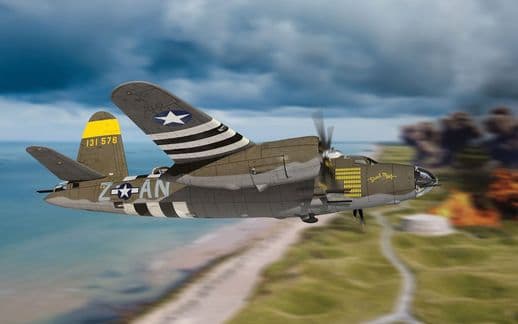
Clearly, the identification markings which were hastily applied to many of the aircraft allocated to D-Day operations have become such a high profile aspect of Allied air power during that period that they were always going to be playing a part in our subject planning, however, we wanted to replicate this in a way which reflected the variations in the markings on D-Day itself and in the months which followed. For that reason, we have full identification markings applied to our sub-range B-26 Marauder and Spitfire, partial underside markings to represent post D-Day operations, and fuselage only markings applied to an aircraft type which isn’t usually associated with D-Day operations, all for your collecting delectation.
For this pre-RIAT 2024 edition of Die-cast Diaries, we are pleased to be marking the impending release of the final two models which make up our D-Day 80th Anniversary collectable tribute by bringing you an exclusive first look at pictures of advanced production samples featuring the new models, and they’re both little crackers. Both feature famous British single engined aircraft which made a significant contribution towards ensuring the success of D-Day, even if they could hardly be more diametrically opposed as individual aircraft types.
One is a famous fighter-bomber which earned an almost mythical status in the weeks and months which followed the D-Day landings, a battering ram of an aeroplane which could even be likened to resembling one of the airborne horsemen of the apocalypse. The other went about its business in a much less overt manner, like an assassin in the night, gathering intelligence which was just as devastating as any shell or bullet.
Let’s take a closer look at both of these aviation classics now:
One of the most famous aircraft types of the Second World War, the Hawker Typhoon was originally developed to be the high-altitude interceptor fighter replacement for the Hurricanes which fought during the Battle of Britain, with the new aircraft being referred to within internal Hawker circles as their ‘Super Hurricane’. A troubled test programme and subsequent service introduction quickly highlighted the fact that the Typhoon was not the aircraft designer Sydney Camm had been hoping it would be, however, all was not lost, and it would soon display its capabilities as a low altitude strike fighter.
An aircraft type which came into its own throughout the summer of 1944 and specifically in support of the D-Day landings in Normandy, the Hawker Typhoon came to be regarded as something of an airborne battering ram and a fearsome close air support fighter the Allies came to rely upon. In the weeks following the Normandy landings, large numbers of marauding Typhoons filled the skies over northern France ready to pounce on anything which could potentially be used against the Allied invasion forces. Bunkers, artillery emplacements, troop concentrations, rail yards and military vehicles were all to become fair game for the Typhoon and the Wehrmacht quickly learned to fear and respect the aggressive tactics of the RAF’s Typhoon squadrons.
In the weeks which followed the D-Day landings, on days when the weather was good enough to allow flying operations to take place, RAF Typhoons provided close air support for the advancing Allied ground forces, effectively keeping German forces pinned down, preventing enemy armour from advancing across open country to reinforce combat hotspots during daylight hours. If any tanks were foolish enough to emerge from the cover of the trees and buildings which had been shielding them, they were immediately pounced upon by eagle-eyed Typhoon pilots, who had become expert in attacking such targets at extremely low altitudes and at high speed.
Although the unguided air to ground rockets the aircraft fired were not actually as effective in operation as the history books might suggest, the sheer number of aircraft in the air at any one time and the destructive potential they possessed, effectively ensured that German armour proved far less effective than it might have been during the savage fighting in Normandy.
The following series of images all feature an advanced production sample of this latest Hawker Typhoon release, one which is already destined to disappear from the Corgi website in short order.
With its bespoke anniversary packaging, the new Typhoon is destined to be a highly prized addition to many an Aviation Archive collection.
Born on the Isle of Wight in July 1918, John Robert Baldwin would go on to join the RAF Volunteer Reserve at the outbreak of the Second World War and would serve as ground crew during the Air Component of the British Expeditionary Force’s operations during the Battle of France. He would later volunteer to train as a pilot, being commissioned in 1942, and on successfully gaining his wings, was posted to RAF No.609 Squadron in November the same year, where he would fly the mighty Hawker Typhoon, an aircraft with which he would become inextricably linked. By the beginning of 1944, Baldwin was already a Typhoon ‘Ace’ pilot, but was now fully engaged in flying D-Day preparation missions.
The need to keep the massive Allied seaborne armada amassing in southern ports secret from the Germans required all enemy radar stations along the coast of Northern France to be destroyed, along with the strategic ‘softening up’ of targets across a vast area. These targets were often heavily defended by flak batteries and Typhoon operations at low level were some of the most perilous any Allied pilot would be asked to undertake. Indeed, all Typhoon pilots shared the opinion that you couldn’t truly call yourself a combat pilot unless you had spent time flying operationally with a Typhoon unit. The Typhoons based at Needs Oar Point in Hampshire were heavily involved in these D-Day support operations.
By the end of his tour of duty in April 1944, Baldwin had amassed at least 13 aerial victories, having flown an incredible number of missions in his trusty Typhoon. He would return to operational flying after taking a short break, and following promotion to the rank of Wing Commander RAF No.146 Wing, again flying Typhoons and again embarking on a punishing schedule of flight operations, this time in support of the Allied ground advances through France and missions against V-1 Doodlebug sites.
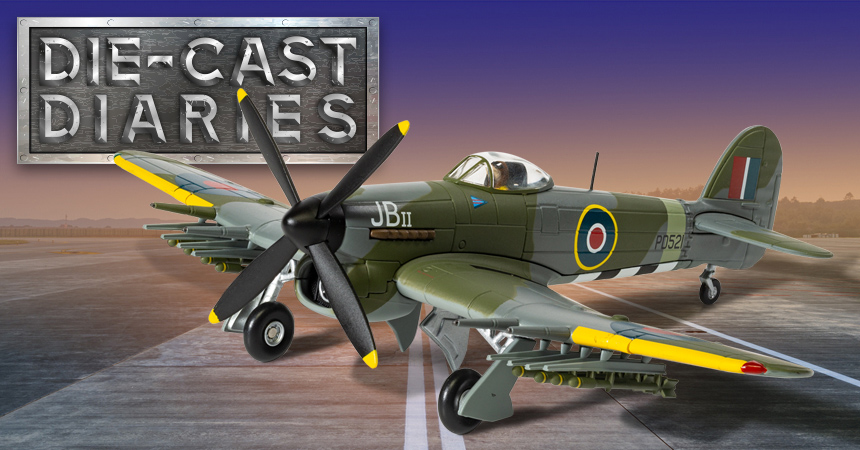
A beautiful model, this scheme presents an aircraft flown by the highest-scoring Hawker Typhoon ‘Ace’ of the Second World War.
Leading the entire Wing on at least sixteen occasions, Baldwin’s logbook shows at least 110 sorties as being flown in support of these missions, but with other official records suggesting that figure should actually be closer to 170, as this Wing Commander was determined to lead his men from the front during these dangerous missions.
Baldwin’s reputation was such that he was assigned at least two different Typhoons at the same time, each one configured for different types of mission. One aircraft was equipped with bombs, whilst the one referred to by Baldwin as ‘JBII’ sported the rocket projectiles RAF Hawker Typhoons became so famous for using. One famous wartime picture shows two of Baldwin’s Typhoons parked next to each other, both clearly showing the different ordnance each one was configured to carry, serving as a fascinating record of this ace pilot’s wartime contribution and his personal aircraft collection.
John Robert Baldwin would end the war as the highest-scoring Hawker Typhoon ‘Ace’, with 15 confirmed victories, 1 shared and 4 probables to his name.
One of the most distinctive British aircraft of the early war years, the Westland Lysander was originally intended to perform various Army Co-operation roles and even though it proved to be particularly effective in this role, also proved versatile enough to take on several others, excelling in some. Possessing excellent short field/rough field performance, the Lysander proved to be an exceptional observation platform and during the early months of the Second World War, would also be tasked with performing gunnery training, light bomber, and reconnaissance roles, in addition to helping establish an air/sea rescue service for the Royal Air Force.
Joining several other aircraft types pressed in this role, Lysander’s which could be spared used their great visibility and slow speed performance to quickly locate downed airmen and drop a life raft, also marking the location with smoke markers for the rescue boats which would be following in their wake. Many airmen forced to bail out into the English Channel owed their lives to the Air Sea Rescue Lysanders.
The Lysander made its combat introduction during the Battle of France, where its versatility saw the aircraft used for reconnaissance, delivery of supplies and light bombing duties. It was even reported that one aircraft claimed a Luftwaffe Heinkel bomber destroyed, even though the skies over France would ultimately prove disastrous for Lysander crews. With the aircraft effectively unable to defend itself against Luftwaffe fighters, it became clear that the Lysander could not be operated in contested airspace by day, but would that extend to operations flown by moonlight?
The Lysander’s later used in a clandestine role would prove to be something of a revelation, and specialist crews would bravely operate these aircraft alone and unarmed to fly cross channel sorties, delivering, and/or extracting agents at great personal risk to those involved, but operations which were crucial to the eventual outcome of the Second World War. Underlining the ultimate success of this unusual aircraft, thirty RAF and Commonwealth squadrons would operate the Westland Lysander across the world during WWII.
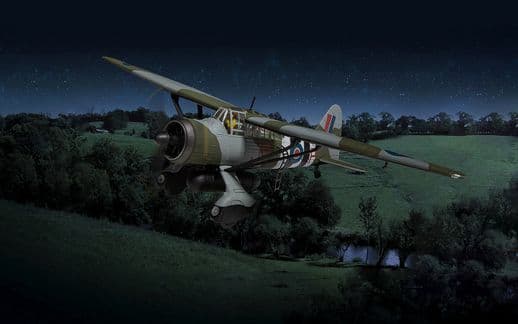
In the months leading up to and just after D-Day, the Westland Lysanders of RAF No.161 Squadron made a significant, yet largely unheralded contribution towards the success of this massive Allied operation. Flying incredibly perilous clandestine ‘Spy Shuttle’ operations, unarmed Lysanders were flown on nights where moonlight allowed, carrying up to 3 agents into enemy occupied France and often bringing others back on the return flight. These operations were vital in securing intelligence information and disrupting German activities right across Europe but were incredibly perilous for those involved.
If you find yourself looking for a slightly more unusual aircraft to represent the aviation commitment to the success of D-Day, we think our new Lysander is just that, in addition to being just a stunning looking model.
More distinctive bespoke box artwork graces the packaging of this new D-Day identification marked Westland Lysander release.
With Lysanders being hunted by Luftwaffe nightfighters and members of the French resistance hunted mercilessly by the Germans, these operations were taking place right under the noses of the Germans and even if a Lysander did manage to land in the correct field, they would often arrive back at their home base with damage from enemy small arms fire.
One of the most unusual Lysanders to ever take part in these famous clandestine operations, this aircraft was flown by Dutch pilot Luke ‘Lucky’ Newhouse and sported D-Day identification markings around its rear fuselage, but significantly, not on its wings. A rather unique aircraft, squadron records show that Newhouse flew this Lysander for the first time on the night of 4/5th August 1944 during ‘Operation Scimitar’, where he landed in France delivering three agents, bringing back another three on the return flight back to England. Even with the addition of D-Day markings, these nocturnal Lysanders were unusual in that they often came under fire from both enemy and friendly forces, so secretive were their important missions.
Luke Newhouse is a fascinating character. He trained as a pilot in Canada and volunteered for service in Europe despite the fact that he was quite a bit older than most other pilots attempting to do the same thing, and he was also a wearer of glasses. He was initially told that he could possibly find a position flying transport aircraft, but would actually end up flying some of the most challenging and dangerous missions any pilot could be asked to perform, secretive clandestine flights into enemy occupied France.
Not only requiring exceptional airmanship and navigational excellence as standard, these missions were vital to the success of D-Day, with those flying them being a very special breed of airmen. Flying alone and often with just the light of the moon for guidance, there was no room for error with these sorties and if anything went wrong, it was unlikely that anyone would be coming to your assistance.
One of the more interesting toolings within the Aviation Archive bank, has a Westland Lysander ever looked this good in die-cast?
We were fortunate enough to have been given access to a fascinating selection of original wartime images via a Lysander expert and with the blessing of the Newhouse family. They feature Luke Newhouse leaning against the undercarriage sponson of this very Lysander, showing him in his trademark spectacles and with the aircraft sporting its distinctive fuselage D-Day identification markings.
We used these pictures during our research for this release and are delighted to not only be introducing this unusually presented Lysander into the Aviation Archive range, but also to be placing the collector spotlight on the vital clandestine work Luke Newhouse and his fellow pilots did in furthering the Allied cause during the Second World War, particularly in support of D-Day.
We think that both of these models make for fitting and slightly unusual additions to the Aviation Archive range and the perfect die-cast way with which to commemorate this year’s 80th Anniversary of D-Day. Both models are scheduled to arrive in our warehouse next month and should therefore be taking their positions in display cabinets right across the world in just a few weeks’ time.
As the world’s greatest Airshow, the Royal International Air Tattoo plays host to an impressive annual gathering of aeroplanes and aviation enthusiasts, one which is regarded as a ‘can’t miss’ event in the Airshow calendar for a great many people. Also attracting thousands of overseas visitors each year, everything about RIAT is on an impressive scale, with the combined military strength assembled at this Gloucestershire airfield making it one of the world’s most powerful air forces for the duration of the show.
As usual, a team from Airfix and Corgi will be in attendance at the show this year and for those who have visited us in year’s past, we will be in our usual location at the eastern end of the airfield, situated next to the meet the pilots & crew tent. We’ve all been in training for the coming long hours on our feet and reduced sleep, but we’re all very much looking forward to meeting as many Corgi collectors as possible – if you have your tickets and will be heading to RIAT this year, please do pop down and say hello.
From a Corgi perspective, we’re very much looking forward to Friday 19th July at 10am, when we will be unveiling a new model exclusively to visitors inside our marquee, before following this up by notifying Corgi fans not at Fairford a little later, via our website and official social media channels. We will also be on hand to discuss Corgi issues of the day, so if you can please spare a few minutes to drop by and see us during your visit to RIAT this year. For those not coming this year, fear not - we will be gathering plenty of content over the weekend and will be including details of the unveiling event in a forthcoming edition of our blog.
So, in summary, we will be LIVE at RIAT next week and we are very much looking forward to meeting as many Corgi fans as one airfield can hold. Please do drop by to see what we have going on.
That's all we have for you in this latest edition, however, please join us again in two weeks’ time for another exclusive insight into the wonderful world of Corgi model collecting. Between editions, we are always interested to hear your views on all things Corgi, so if you feel like dropping us a line to comment on anything blog, collecting or Corgi model related, or perhaps to suggest a topic you might like to see us cover in a future edition, please do get in touch at diecastdiaries@corgi.co.uk.
If you can’t wait for the next blog, you will find plenty of Corgi model collecting discussions taking place on our official social media channels, access to which can be obtained by clicking on the respective links at the foot of the Corgi website homepage.
Link access to Corgi social media sites.
Thank you for continuing to support your Die-cast Diaries blog. Our next edition is scheduled for publication on Friday 26th July.


