


Welcome to the latest edition of Corgi Die-cast Diaries, your regular blog review of all the news, updates and topical stories from the captivating world of Corgi die-cast model collecting.
Well, that seemed to go down well! In the previous edition of our Corgi model update, we introduced readers to our new 1/72nd scale Martin B-26 Marauder tooling by exclusively publishing images of the engineering sample model which had just arrived at Corgi HQ, and to say it was well received is probably the understatement of the year. A model we felt was a perfect fit for the Aviation Archive range, we were delighted to see the overwhelmingly positive comments either sent in to us or posted on various social media platforms and how our confidence seems to be shared by a great many collectors. You can rest assured that we will be bringing you regular Marauder updates over the next few months as this new model speeds headlong towards its initial release, starting with a first look at the pre-production sample wearing the scheme livery for the first B-26 to join the range.
For this final edition of the year, we will be taking a slightly alternative look at the subject of Corgi model photography and how despite being incredibly busy and under constant pressure from a workload perspective, our creative team sometimes manage to produce something appealingly 'different' when it comes to product photography. In an attempt to gauge reader opinion on the subject, we will be revisiting some of the images we have included over the past year or so, to see if these provide additional interest when it comes to deciding whether a particular model appeals to you, or indeed if traditional model photography serves that purpose more than adequately.
As we pen this introduction, we are hoping to also be including another huge new tooling exclusive later in this edition, along with announcing a little festive competition for everyone to enter over the coming holiday period, with a stunning 'sold out' model release awaiting our lucky winner.
Let's hope these plans come together, but for now, let's get stuck into this selection of unusual Corgi model images.
When it comes to the new model images we include with each new edition of Diecast Diaries, we are usually given access to the beautiful images which are about to, or may have just been added to the respective product landing pages of the models in question on the Corgi website. These images feature the model pictured at various angles, allowing the collector to see if this model will be one which will be taking its place in their collection and are always presented on a clear white background for very specific and totally understandable reasons.
To enable the website to load quickly and efficiently, the majority of images across the various Hornby Hobbies websites are showcased on a plain white background, not to mention the fact that this uniform appearance tends to be much easier on the eye of the viewer in most cases. Having said that, we're not averse to including images which feature actual box artwork composites on the website, however, this is usually only after the model has been released and whilst it often shows as the lead image, is just one of several featured on the product page.
Even though all these images are gratefully received by us as we attempt to put our blogs together, there is the odd memorable occasion where our photographer Mike allows his love for Corgi models to open his creative floodgates, producing a small selection of images which really are something that little bit different for us and our readers alike. Images which celebrate our love for diecast model collecting, when we post these pictures, we always receive many messages telling us how much they enjoy seeing them and how they really do enhance the appeal of the models they feature.
Unfortunately, these images only appear sporadically because they create additional work for Mike around his already busy schedule and indeed he will often produce these in his own time, just because he likes to create them and he knows how much we like to show them. They are most definitely worth a second look, even though some of the models they feature have now long since sold out, perhaps in part down to the impact of these images.
In view of this year's Dambusters anniversary, there really was only one place to start with this feature and that was with Avro Lancaster BIII Special ED825, AJ-T, ‘T-Tommy’, Flt. Lt Joe McCarthy, 617 Sqn RAF, Operation Chastise, May 1943. This was the aircraft in which George 'Johnny' Johnson, the last surviving 'Dambuster', flew on that fateful night and the team were looking forward to presenting one of these models to him following its release. Unfortunately, as we all now know, we didn't have the honour of doing that, as Mr Johnson sadly joined the rest of his squadron mates around this time last year.
With the crews of the newly formed RAF No.617 Squadron now briefed on the targets they were being sent to attack, raid preparations for American pilot Flt Lt Joe McCarthy and his crew could hardly have been more challenging. Having practiced exhaustively in their usual aircraft ED915/AJ-Q 'Queenie', the crew discovered their Lancaster had developed a technical problem in the seconds immediately prior to taking off for 'Operation Chastise', the audacious RAF raid against the mighty dams of the Ruhr Valley. The issue was serious enough to force the crew to abandon their aircraft and transfer to reserve Lancaster ED825/G AJ-T 'Tommy' just minutes before they were due to take off.
Their new aircraft eventually left Scampton at 22.01 hrs bound for arguably the most difficult target of the entire raid, the Sorpe Dam, which was protected by a huge earth bank. Having practiced attacking targets flying low, straight and level towards them, they would instead have to drop their 'Upkeep' mine in a completely different manner. Flying low over the German village of Langscheid, they would have to avoid the tall steeple of the village church on the run-in, before diving steeply to extremely low altitude to fly along the length of the dam wall, dropping the non-spinning 'Upkeep' mine at exactly the halfway point. This attack approach proved so difficult that the aircraft's bomb aimer George Leonard 'Johnny' Johnson could not release the mine on nine previous attack runs, however on the tenth and whilst flying at a little over 30 feet, the Lancaster was perfectly aligned. Johnson shouted, 'Bomb gone!' over the intercom, much to the relief of the aircraft's crew, with the mine exploding exactly where intended, creating a huge crack in the structure. Unfortunately for them, the huge earth bank which supported the Sorpe Dam held firm, but would require extensive repair works to be undertaken in the weeks which followed the raid.
Lancaster ED825 arrived safely back at RAF Scampton at approximately 03.30 in the morning of 17th May 1943, where the crew would learn that whilst the raid had been a success, the men of No.617 Squadron had paid a terrible price. Of the 19 Lancasters which had left the airfield only hours earlier, eight aircraft and their crews had failed to return. The bomb aimer onboard Lancaster ED825/G AJ-T 'Tommy' during its attack against the Sorpe Dam and the man with the responsibility for releasing the aircraft's 'Upkeep' mine was George Leonard 'Johnny' Johnson. Unless the aircraft was in the optimum position to deliver the mine on target, Johnson would not release the weapon, telling the pilot to go around and have another run at it. On that fateful night, it would take ten attack runs before he was happy to release the mine and allow the pilot to set course for home and their place in the history books.
Being very different from the usual images used to illustrate new Corgi model releases, these appealing 'specials' are always welcome additions to our blog and help to cement the popularity of the models they feature.
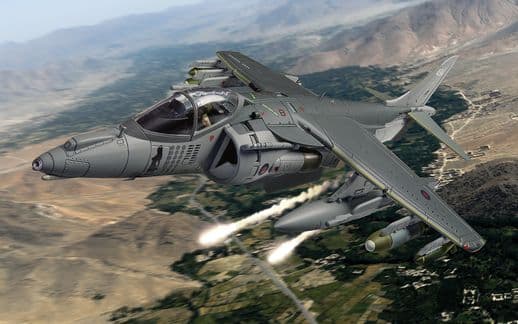
Bringing things right up to date, the latest addition to our 1/48th scale post war jets range saw Mike getting creative once again, this time as he attempted to give this image of our new Harrier a decidedly desert deployment appearance, something he managed to do in some style. British Aerospace Harrier GR7A, ZD437/49A 'Michelle', RAF No.1 Squadron, Operation Herrick, RAF Kandahar, Afghanistan, 2007 - 'A model visit' represents a spectacular tooling addition to the Aviation Archive range and carries the following certificate description.
During one of the busy periods of operational flying from RAF Kandahar in support of 'Operation Herrick', a morale boosting visit was arranged for British troops to meet two rather high profile celebrities between hectic flying commitments. Page three pin up girls Michelle Marsh and Lucy Pinder travelled to Afghanistan to show their support for the troops and in preparation for their visit, ground crews made two rather unique artistic additions to two of their Harriers. Harrier ZD437 had a silhouette of Michelle Marsh applied to her nose at the head of her impressive mission marking scoreboard and was also given the name 'Michelle'. The other aircraft, Harrier ZD404, benefitted from a similar application, but this time sported a representation of Lucy Pinder and appropriately given the name 'Lucy'.
The two celebrities appeared to be rather taken with this unique tribute and several photographs of them posing with their respective Harriers were taken and used for publicity purposes. Unfortunately, RAF officials were less enthusiastic about this development and quickly ordered the artwork to be removed, meaning that these Harriers would only carry their rather notorious artwork for a relatively short period. During Operation Herrick, the vast majority of British aircraft committed to the mission were based and operated from RAF Kandahar.
BAe Harrier GR7 ZD437 was still based at Cottesmore on the occasion of the type's final operational flight on 15th December 2010, although she had long since shed her famous page three nose artwork.
A trio of Escort Mk.II speedsters, this type of image will usually only ever be seen here on DCD, but are a popular feature when they are published.
Although Mike has a real interest in aviation, his eye for an interesting model image also extends to other releases across the various Corgi ranges, with new Vanguards models definitely attracting his creative attention. The image shown above gathered together three different Ford Escort Mk.II RS 2000 releases together for an impromptu photoshoot and whilst Mike had previously shot all three separately for product page and marketing purposes, he couldn't resist a little simulated garage photograph for the enjoyment of DCD readers. If that was a real image, that garage would certainly be needing to review their insurance coverage if these beauties were being stored overnight.
When these (real) cars were being marketed, it seemed as if hardly a week went by without the sight of a racing Escort taking the chequered flag at some rally/motorsport event or other across the world being seen on our tv screens or in the motoring press. As such, who on earth wouldn’t want to own a car which possessed motorsport heritage such as this? Even though the vast majority of Escorts on Britain’s roads were what you would expect a popular small family car to look like, everyone who saw them knew that beneath that plain exterior, there was a rally sport beast being suppressed.
As we now all know, the Escort range would go on to be a resounding success for Ford, and over the course of its 33 year production run, would result in the manufacture approximately 4.1 million vehicles in six distinctly different marks, produced for the British, European and world motoring markets. On several occasions during that run, the Escort had the distinction of being Britain’s best-selling car, a fact which serves an indicator as to why the Escort also made such a popular transition into the world of scale diecast models.
Looking for all the world like a real Mustang, do you prefer images like this, or the more usual white background shots which are the staple of the Corgi website.
Although we can never count on Mike having the time or ability to supply one of these 'special' images when delivering his latest picture brief, when they do turn up, they always take a prominent position in any blog update in which they appear. One of the most recent Vanguards releases to benefit from his 'special' treatment was the first release from our new Ford Mustang Mk.6 Mach 1, our scale homage to a real American muscle car and one which looks stunning in this initial Fighter Jet Grey colour scheme.
Ford’s 2015 sixth-generation Mustang was the first to be officially offered in the UK as
a factory-built, right-hand-drive car and in 2021 the iconic Mach 1 was added to the range. Mach 1, the term used to indicate supersonic flight, first graced a production Mustang in 1969 when jet aviation references were very much part of the American lexicon. The original fastback-only Mach 1, which featured a ‘low-gloss’ black finish on a bonnet secured by competition-type pins, was an instant hit, helped by the publicity created when it captured 295 speed and endurance records at the Bonneville Salt Flats. The 2021 Mach 1 echoes that high-performance heritage by featuring a sonorous DOHC 454bhp V8.
In addition to featuring evocative graphics, the 2021 Mach 1 could be ordered with a 10-speed automatic gearbox or a Tremec 6-speed manual with rev-matching software, just one of a host of features aimed at making it more driver-focused and prepared for track use. They also included separate engine and transmission oil coolers, massive six-piston Brembo brakes and clever MagneRide® adjustable dampers calibrated to work in harmony with stiffer springs and anti-roll bars. The manual example modelled was one of the first UK-specification Mach 1s and joined Ford’s PR fleet in September 2021. It was road tested by various magazines including EVO, CAR, What Car and Auto Express as well as starring in the music video for singer James Arthur’s song, ‘Ride’.
We hope to be able to include more of Mike's impressive 'special' model release imagery as we head into another year of update blogs and we also hope that they continue to provide something just that little bit different for collectors and Diecast Diaries readers alike.
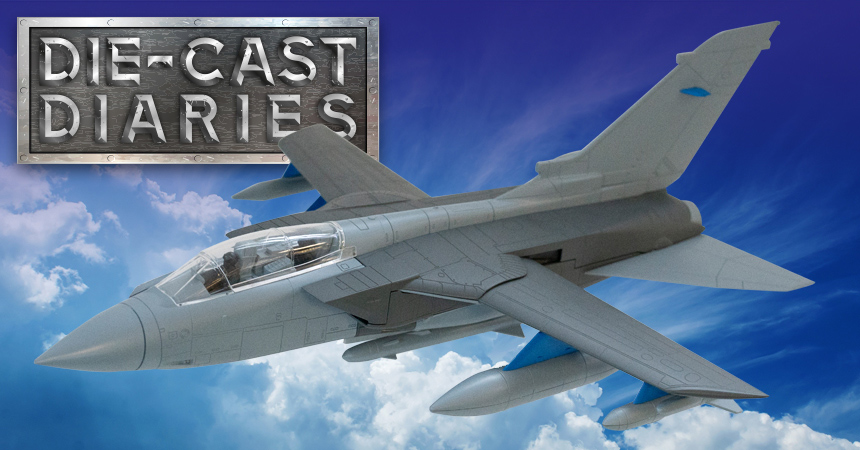
A festive exclusive, the following selection of images all feature the engineering sample model produced in support of the new 1/48th scale Panavia Tornado model, a real heavyweight addition to the Aviation Archive range.
As you can see from the heading above, thankfully, our plans did come together for this final blog of the year and we are delighted to be in a position to bring you a sizeable pre-Christmas treat, in the form of an exclusive first look at the engineering sample from our new 1/48th scale Panavia Tornado tooling. As we always do in situations such as these, even though we know you are aware that we're showing these images much earlier in the development process of a new tooling project than has historically been the case with pre-Hornby Corgi, we have to impress on everyone that this is an advanced development sample model and as such, is still subject to alteration. Nevertheless, we know everyone likes to be kept abreast of developments, so please enjoy these images as interesting update exclusives, whilst embracing all the usual caveats.
Our new 1/48th scale Panavia Tornado GR tooling is a major project addition to the Aviation Archive range and really does take this range of post war jet models to new heights, a beast of a model representing what has to be considered the most successful British strike jet of the post war era. In this larger scale, the Tornado looks truly spectacular and as the tooling benefits from a significant suite of weaponry options for us to access, a fully tooled up 1/48th scale RAF Tornado is definitely going to be a sight to behold.
The Tornado was the result of an international collaboration to produce a world-leading multi-role strike jet, initially envisaged as a replacement for such types as the widely adopted Lockheed Starfighter. The initial proposal was to develop a multi-purpose fighter bomber, however, with several nations expressing an interest, it soon became apparent that differing requirements and constantly changing specifications could create something of an aviation nightmare for those involved, if they weren't careful. Eventually, the project was streamlined to include just three nations, Britain, Germany and Italy, all of whom formed the Panavia Aircraft GmbH company to handle aircraft development, with the separate Turbo Union company established to handle the aircraft's engine development.
Please be aware that as an engineering concept model, this is still only a representation and as such, could be subject to further change.
The new aircraft was initially referred to as the Multi Role Combat Aircraft (MRCA) and began as a project to develop both single and twin seat variants of the same design, however, the need to include all the very latest avionics technology and the demanding role profile the new aircraft would be required to perform soon led designers to proceed with the development of a single, two seat aircraft. Able to fly low and fast, and featuring sophisticated terrain following radar, the Tornado was also able to carry a vast array of weapons and electronic equipment, all intended to make this the world's most capable strike aircraft and one which could be configured for any offensive situation.
The first Tornado aircraft produced for the Royal Air Force were delivered to the Tri-national Tornado Training Establishment during the summer of 1980 and two years later, No.IX(B) Squadron would have the distinction of being the first RAF unit to be equipped with the capable new aircraft.
As one of the world’s most capable low-level strike aircraft, able to operate by day or night and in all weather conditions, Royal Air Force Tornados would eventually go on to post an impressive 37 years in service and would see plenty of action during that time. Always at the forefront of the RAFs offensive capability, successive capability upgrades and improvements allowed the aircraft to deliver the latest precision munitions effectively, in addition to gathering vital battlefield reconnaissance information, all in the most demanding of operating environments. Whether taking part in international bombing competitions, or actually deployed to war zones around the globe, RAF Tornado crews were asked to fly some of the most dangerous missions imaginable time and time again, which they did with outstanding success.
During Operation Ellamy in 2011, Tornados operating from RAF Marham and the forward operating base at Gioia del Colle in Southern Italy, were involved in combat missions over Libya, imposing a no-fly zone during the Libyan Civil war, aimed at protecting the civilian population from possible attack. Equipped with Sky Shadow ECM pods which helped the aircraft evade enemy interception over the combat zone and the devastatingly effective Storm Shadow air launched cruise missile, RAF Tornados destroyed numerous armoured vehicle targets and artillery pieces, ensuring the success of this coalition air operation.
A very heavy model, with plenty of detail and optional parts, many collectors will be looking forward to getting their hands on one of these beauties.
Underlining the operational effectiveness of the RAF’s Panavia Tornado strike jets, despite the fact that the aircraft was scheduled to be withdrawn from service at the end of March 2019, the last eight jets only returned to their home base at RAF Marham from their final overseas deployment in early February that same year. Flying from RAF Akrotiri in Cyprus, the jets had been undertaking missions over the Iraqi – Syrian border in support of Operation SHADER, the culmination of almost 28 years of continuous active service for the Tornado.
It could be argued that on the eve of its retirement, the Tornado GR4 was more effective a strike and reconnaissance platform than it had ever been and whilst its retirement was met with sadness by the crews who had flown and worked on this magnificent aircraft over the years, there was also great pride in having played their own small part in helping establish the Tornados impressive service record.
One of the most famous aircraft of the post war era, the Panavia Tornado will make for a significant addition to the Aviation Archive range and in this larger 1/48th scale, will be quite the imposing display centrepiece. With a high metal content and lots of optional features, this really has to be the best news with which to head into a new year for the aviation collector and we can't wait to bring you a further update early in January. For now though, please do enjoy this selection of exclusive Tornado imagery, but please also bear in mind that they all feature a development sample which may still be subject to change.
How to you fancy winning this long sold out 1/48th scale Lightning F.6 model? All you have to do is to let us know which your favourite Corgi model of 2023 was to be in with a chance. Check details below for further information.
We couldn't post this final blog of the year without taking this opportunity to thank our loyal readership for their steadfast support throughout the year and indeed for the past eight years of producing Diecast Diaries. The entire Corgi team are grateful that you continue to take an interest in what we're doing and for consuming our regular update blogs in ever increasing numbers. We will endeavour to continue bringing you all the latest model exclusives throughout the coming year, always placing our readers in pole position when it comes to finding out all the latest developments from the world of Corgi.
Before we sign off for the year, we just have a couple of additional features to tell you about. Firstly, our annual Corgi Q&A video will be posted on the official Corgi YouTube channel over the next few days, where Head of Brand David Mather and myself will be fielding the latest selection of sometimes quite probing questions sent in by Corgi fans. Although we can't promise to give you too many clues regarding the exciting new tooling projects the team intend to introduce over the coming months and years, we hope you will find out one or two interesting details if you spend a few festive minutes in our company over the holidays. If nothing else, you'll be able to see how the past year has aged us both, and indeed if we've already been replaced by better looking AI generated alternatives.
The Q&A video is scheduled to be posted on Christmas Eve, but once available, can obviously be viewed at your convenience.
If you don't manage to secure the Corgi model of your dreams this coming festive period, or even if you do, how do you fancy celebrating (or trying to cheer yourself up) with a little Corgi Christmas competition? The prize awaiting our lucky winner has been hidden away in the darkest recesses of the Corgi office for most of the year and is a pristine example of the sold out third release from our 1/48th scale English Electric Lightning F.6 tooling (AA28403), a truly spectacular model release.
Marking English Electric Lightning F.6 XS904 / BQ, RAF No.11 Squadron, Binbrook, August 1987, ‘The Last Lightning Show’, an aircraft which has been in the care of the Lightning Preservation Group at Bruntingthorpe Airfield for many years now, this is our large scale representation of one of the most exciting aeroplanes to ever take to the sky and a fitting prize for any competition winner to get their hands on.
To be in with a chance of winning this model, all you have to do is let us know what your favourite Corgi release of the past twelve months was and that's it! Please send your selection to marketing@corgi.co.uk, giving your e-mail the title Christmas Competition to help us collate all eligible entries efficiently. We will be accepting entries until the eve of our return to work at midnight on Monday 1st January, so you have plenty of time to stake your claim for victory. Our Head of Brand will select a winner at random from the e-mails received prior to the deadline, with our lucky winner being notified by e-mail as soon as practicable.
Good luck to all who enter.
Finally, before we all head off to enjoy a little last minute Christmas shopping, in preparation for the impending big day itself, may I take this opportunity to wish everyone a very happy Christmas and a prosperous New Year from everyone here at Corgi. Thanks’ once again for your incredible support throughout 2023 and we look forward to seeing you all back here again early in the new year for more Corgi development updates.
Merry Christmas.
That's all we have for you this time around, however, we will be back in the New Year, with a further selection of model project updates to bring you. Between editions, we are always interested to hear your views on all things Corgi, so if you feel like dropping us a line to comment on anything blog, collecting or Corgi model related, or even to suggest a topic you might like to see us cover in a future edition, please do drop us a line at diecastdiaries@corgi.co.uk.
If you can’t wait for the next blog, you will find plenty of Corgi model collecting discussions taking place on our official social media channels, access to which can be obtained by clicking on the respective links at the foot of the Corgi website homepage.
Link access to Corgi social media sites.
Thank you for continuing to support our Die-cast Diaries blog. Our next edition is scheduled for publication on Friday 12th January.