

Welcome to the latest edition of Corgi Die-cast Diaries, your regular blog review of all the news, updates and topical stories from the captivating world of Corgi die-cast model collecting.
The announcement of our current January to April 2023 model range at the beginning of the year included details of a very special new model that we had been working on for quite some time, our die-cast tribute to this year's 80th anniversary commemorations of the Dambusters raid. In fact, this model is so important to us that it was chosen as the cover image for the latest catalogue, a graphical attempt to recreate the heroics of the 133 aircrew who took part in this historic raid - if you haven't managed to get your hands on a copy yet, you can still download a pdf copy using this link. In view of the status this model holds within the current Aviation Archive range and indeed the wider heritage of this popular collection, this latest update will be devoted entirely to this impending release, its development and the story of the real aircraft which inspired its inclusion in the range. Also including a selection of exclusive images featuring an advanced production sample of the new model, we will also have box artwork, catalogue/webpage imagery and a rather appealing scenic diorama representation of this Avro Lancaster B.III (Special), all for your viewing enjoyment in this edition.
In addition to this, we will also be including details of a very special new film which will be making its screen debut just a couple of days prior to the 80th Anniversary of the raid and in doing so, will provide a unique and poignant perspective on the Dambusters raid. Entitled 'Attack on Sorpe Dam', the film is narrated throughout by George 'Johnny' Johnson, a man who was known as the 'Last Dambuster', and actually took part in the raid. For this reason alone, the new film is certain to be both an enlightening and extremely emotional experience for anyone fortunate enough to see it and anyone who has even the slightest interest in the subject will surely want to make sure they have the chance to see it. The Corgi team will be in attendance at the Premier, along with our new Lancaster model and we will bring you all the relevant details at the end of this latest update.
An advanced production sample of the Avro Lancaster B.III (Special) ED825/G model we have produced to commemorate the 80th Anniversary of the Dambusters Raid.
Within the 25 year history of the Aviation Archive range, arguably no individual model tooling has done more to introduce new collectors to this ever growing range of scale die-cast model aircraft than our 1/72nd scale Avro Lancaster, a truly magnificent piece of die-cast engineering. The Lancaster had actually been selected as one of the very early model subjects with which to establish this range and whilst it was a significant development for this relatively new hobby, this first model was in the smaller 1/144th scale and there was much more to come.
Once the first 1/72nd scale models had joined the range and people started to notice the marketing campaign Corgi unleashed in hobby publications and enthusiast magazines such as Flypast and Aeroplane, curiosity got the better of us and we simply had to inspect one of these new models for ourselves, in the metal, so to speak. For most of us, our formative years and indeed our love of aviation started with Airfix and the joy of modelling. This simple pastime pleasure encouraged us to find out a little more about the aircraft we were building, their histories, the colours they were presented in and the heroes who flew them and left us with a passion for the subject which will probably remain with us until our last breath. Despite this healthy infatuation, as life and responsibilities got in the way, our kit stashes may have grown exponentially, but our time spent modelling became just a fading memory.
That being said, we never lost our love of aircraft or of owning scale representations of our favourite machines and as a return to plastic modelling was not an option for many of us, did Corgi now have the answer and could they come to our collecting rescue? With beautifully finished models now in 1/72nd scale and the appealing weight of die-cast as their trump card, this new series of larger models immediately found favour with thousands of aviation enthusiasts and brought new people into the ranks of the die-cast collecting hobby from 2000 onwards. The following year, an exciting and impressive new model was announced and if anyone was still sitting on the die-cast fence, this model had them jumping in feet first!
The 1/72nd scale Corgi Avro Lancaster tooling was probably responsible for attracting more people to the die-cast aviation collecting hobby than any other tooling in the Aviation Archive range.
Just as the original adverts for 1/72nd scale Spitfires, Hurricanes and Messerschmitts had done, once the arrival of the new Avro Lancaster tooling in the same scale was publicised, model shop owners just opened their doors and awaited the stampede, as aviation enthusiasts flocked to see if the new model was any good. For an aircraft which meant so much to enthusiasts and to British aviation history, surely a die-cast Lancaster model in this scale couldn't live up to our high expectations and would be a huge anti-climax once we had the chance to inspect one for the first time. To our absolute delight, the exact opposite proved to be the case and once you had seen one, you simply had to have it and even more than that, it would go on to form the basis of many a new die-cast aviation collection, it really was that good.
Since that first release, our 1/72nd scale Avro Lancaster has remained one of the most popular toolings in the entire Aviation Archive range and every time a new Lancaster model is released, it still manages to attract more collector support than almost any other model in the range, even including the very latest now tooling releases. Within this back catalogue of Lancaster releases, there have been several representations of aircraft which took part in the famous Dambusters raid, so as we approached this year's 80th Anniversary, we knew we wanted to do something a bit special in making our own Aviation Archive tribute to the occasion. With the intention of presenting 'The Last Dambuster, Mr George 'Johnny' Johnson' with a 1/72nd scale Corgi representation of the aircraft he flew on that May night in 1943, we thought this release would make for a fitting tribute to the 133 aircrew who took part in that historic raid.
As we all now know, Johnny Johnson has sadly now joined his squadron mates and we didn’t have that opportunity, however, that doesn’t alter the fact that adding this model to the Aviation Archive range will still make for a fitting tribute to the Lancaster in which Johnny Johnson and the rest of his crew attacked the Sorpe Dam on the night of 16th/17th May 1943 and therefore also a fitting way to mark this 80th anniversary year. As we will see later, there is another reason why this particular Lancaster release will prove significant this year.
An iconic aviation shape, the 23 Avro Lancaster B.III airframes selected for Type 464 (Provisioning) conversion were very different to the aircraft which formed the backbone of Bomber Command.
The box artwork of this latest Lancaster model release mark this as a very special addition to the Aviation Archive range.
The Avro Lancasters which took part in the Dambusters raid were very different to those which formed the backbone of Bomber Command's bombing offensive during WWII and had been modified to carry a unique weapon which had been in development for some time. Despite this, once the project received official approval, the top secret work to prepare these aircraft for this 'special' raid would have to be completed very quickly indeed. In Lancashire, twenty three Lancaster B.III airframes were taken from the Avro assembly line at Woodford for conversion to Type 464 (Provisioning) standard. The actual difference between the Lancaster B.I and the B.III variant was in the powerplants each model used, with the B.I being fitted with Rolls Royce produced Merlin engines, whilst the B.III was equipped with the licence built American Packard version of the same powerplant.
Visually, the most noticeable differences between standard Lancasters produced at that time and the 23 selected for Type 464 (Provisioning) conversion was the removal of both the top ventral turret and the aircraft's mighty bomb doors, the latter allowing the unique Vickers designed mine support frame to be installed under the aircraft. With this unit and the loaded Upkeep mine extending far beneath the line of a Lancaster's bomb bay, there was no question that these could be retained and with the time available to them, the design team actually did quite a tidy job in fairing over the deletions to make the aircraft as streamlined as possible.
The most important modification was the installation of the Vickers designed and manufactured mounting frame and supporting struts for the Upkeep mine, made from a combination of cast aluminium and machined steel and attached to the supporting frame by a series of heavy duty brackets. Everything about this installation was robust, as it had to hold the 9,250lb mine securely in place, allow it to rotate at 500 rpm and release it correctly on demand, quite the feat of engineering. The cast aluminium calliper arms were fixed to the frame by several heavy duty brackets, but also utilised a series of thick steel cables for tensioning and to allow the arms to release the mine at the precise moment. On loading the mine, it would be offered into the supporting frame, which would be clamped around it at the centrally located disc pivot points. The cables would then be tensioned to pull the arms securely into place and a degree of fine tuning and final tensioning could be achieved by use of the cables and their securing bolts.
With grateful thanks to our friends at the Avro Heritage Museum, these original drawings show the design modification required to produce the 23 Type 464 (Provisioning) Lancasters for the Dambusters raid. Marked as 'MOST SECRET', they are a fascinating link to the Dambusters story and form part of their magnificent collection.
Specific instructions added to the drawing above, warning anyone viewing it about the highly sensitive nature of the details it contained. A fascinating insight into how the Dambusters raid came together from a Lancaster modification and Barnes Wallis perspective.
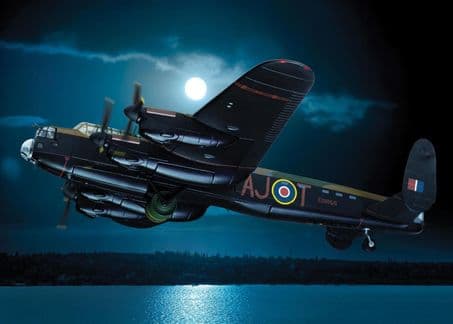
The evocative catalogue image produced to announce the production of this Dambusters anniversary tribute release.
Once in position and in order to allow the mine to skim over the surface of the water, it would have to be rotated at exactly 500 rpm in reverse prior to release, an important aspect of the weapon's delivery which was achieved by the installation of the Vickers Variable Speed Gear Motor. This was located in front of the mounting frame and fixed to the roof of the front section of the bomb bay, an area which was then covered by a newly fabricated front section of the bomb bay, but a covering which could be removed to allow access to the VSG hydraulic motor installation if required. The unit employed a large drive wheel on its starboard side to power the rotation of the mine, connected to the wheel on the starboard calliper arm by a heavy duty rubber drive belt.
The Vickers Variable Speed Gear Motor unit operated under its own hydraulic system and was controlled by a gearing mechanism, the control lever for which was passed through the roof of the bomb bay, to protrude through the floor of the wireless operator's station. For the dams attack, the normal procedure would for the Wireless Operator to start the motor ten minutes prior to mine release, then turning the control lever to regulate the mine's rotation speed. What he was aiming for was an optimum rotation velocity of 500 rpm and as you might well imagine, the spinning 9,250lb mine did create quite an amount of vibration, so whilst ten minutes was actually quite a short period of time for the mine to get up to speed and to stabilise, it was long enough for the crew to bear. Once the mine had been released, the drive system was disengaged and the motor shut down for the rest of the sortie - now it was just a case of fighting their way home over enemy territory.
Charged with forming a new ‘Specialist’ Squadron at RAF Scampton in March 1943, the highly regarded Wing Commander Guy Gibson gave his assessment of the challenge which lay before him by stating ‘This Squadron will either make history or it will be completely wiped out’. Taking experienced volunteer crews from within 5 Group Bomber Command, Squadron X, as it was known then (later to be numbered No. 617 Squadron Royal Air Force), was formed under the strictest possible levels of security, which for the men who joined, would mean censorship screening for all written correspondence and monitored telephone conversations to loved ones.
Initially, the Squadron received ten standard Lancaster bombers for training purposes, taking aircraft from existing operational units as these had been tried and tested on operations. It was felt that new aircraft were usually prone to suffering from numerous annoying little technical issues and the squadron's tight training schedule meant that there was absolutely no time to waste on such matters. The training would prove to be intense to say the least and would be both physically and mentally demanding for the men of No.617 Squadron. Crews would be required to fly their Lancasters at low level by both day and night and over some of the most demanding terrain in the UK, including the steeply protected approaches to three specific reservoir sites around the country – Eyebrook in Leicestershire, Abberton near Colchester and Derwent Dam in Derbyshire. These locations were selected to prepare the crews for their impending 'Special Mission', although at that time, neither they, nor Wing Commander Gibson were aware of their actual intended targets.
On 8th April 1943, the first of 21 modified type 464 ‘Provisioning’ Avro Lancasters arrived at Scampton, with most featuring two under-fuselage spotlights and all having modified bomb bays. Within this modified bomb bay, these aircraft had been equipped with strong mounting arms and a drive mechanism on the starboard side to allow the ingenious ‘Upkeep' mine to be carried and delivered as required. Although often referred to as ‘Bouncing Bombs’, Upkeep resembled more of a large metal oil drum than anything else, but weighing in at just over 4 tonnes, this powerful mine was developed with one specific aim in mind, to destroy the supporting wall of a dam. Just a few days before the raid was due to take place, 56 of these Upkeep mines were delivered to Scampton, which must have been the cause of significant interest amongst the crews training hard on the ten standard Lancasters at the airfield.
On 12th May, less than five days before the raid was scheduled to take place, some No.617 Squadron crews began training with their new 'Type 464 Provisioning’ Lancasters complete with their unusual bombs, with Gibson and his crew being the first to release one of the mines. Performing practice releases at the test site at Reculver on the north Kent coast, crews were amazed to see these large rotating mines actually skipping along the surface of the sea and heading inland towards the beach, leading many of them to immediately assume that their intended target would be the massive German battleship Tirpitz.
Two further images showing an advanced production sample example of this magnificent new Avro Lancaster B.III (Special) model, our 80th Anniversary of the Dambusters Raid commemorative release.
With a relatively short training period ahead of them and using new weapons and specific delivery methods which appeared to be constantly changing at that time, not everything went entirely to plan during the practice release sorties and several Lancasters were damaged by the huge plume of water which followed the release of their mine. If the Lancaster was flying too slow or too close to the water at the point of release, the resultant splash plume could cause damage to the aircraft and see it taken off operational duties. Indeed, one Lancaster was so badly affected by a splash plume during one of these practice sorties that it was still in maintenance on the night of the raid itself, meaning the attack force was now down to just 19 aircraft.
With the crews of the newly formed No.617 Squadron Royal Air Force now briefed on the targets they were being sent to attack, raid preparations for American pilot Flt Lt Joe McCarthy and his crew could hardly have been more stressful. Having practiced exhaustively in their usual aircraft ED915/AJ-Q 'Queenie', the crew discovered their Lancaster had developed a technical problem in the seconds immediately prior to taking off for 'Operation Chastise', the audacious RAF raid against the mighty dams of the Ruhr Valley. The issue was serious enough to force the crew to abandon their aircraft and transfer to reserve Lancaster ED825/G AJ-T 'Tommy' just minutes before they were due to take off, something which could have been a bad omen for the superstitious amongst them.
Their new aircraft eventually left Scampton's runway at 22.01 hrs bound for arguably the most difficult target of the entire raid, the Sorpe Dam, a structure which was protected by a mighty earthwork bank. Having practiced attacking targets flying low, straight and level towards them with a spinning mine, they would instead have to drop their 'Upkeep' mine in a completely different manner. Flying low over the German village of Langscheid, they would have to avoid the tall steeple of the village church on the run-in, before diving steeply to extremely low altitude to fly along the length of the dam wall, dropping the non-spinning 'Upkeep' mine at exactly the halfway point along the wall.
This attack approach proved so difficult for the pilot to fly correctly that the aircraft's bomb aimer George Leonard 'Johnny' Johnson wasn't able to release the mine on nine previous attack runs, however on the tenth and whilst flying at a little over 30 feet above the wall, the Lancaster was perfectly aligned. Johnson shouted, 'Bomb gone!' over the intercom, much to the relief of the aircraft's crew, with the mine exploding exactly where intended and creating a huge crack in the supporting structure. Unfortunately for them, the huge earth bank which supported the Sorpe Dam held firm, but would require extensive repair works to be undertaken in the weeks which followed the raid, taking up manpower and resources which had to be diverted from other vital war work.
Approaching a 1/72nd scale Sorpe Dam, this Lancaster looks about ready to release its Upkeep mine.
Our photographer Michael getting creative with an advanced production sample of the impending Avro Lancaster B.III (Special) ED825 release - doesn't she look fantastic!
Avro Lancaster ED825 arrived safely back at RAF Scampton at approximately 03.30 on the morning of 17th May 1943, where the crew would learn that whilst the raid had been considered a spectacular success, the men of No.617 Squadron had paid a terrible price. Of the 19 Lancasters which left the airfield only hours earlier, eight aircraft and their crews had failed to return. The bomb aimer aboard Lancaster ED825/G AJ-T 'Tommy' during its attack against the Sorpe Dam and the man with the sole responsibility for releasing the aircraft's 'Upkeep' mine on the target was George Leonard 'Johnny' Johnson. Unless the aircraft was in the optimum position to deliver the mine on target, Johnson could not release the weapon and was forced to tell his pilot to go around and have another run at it. On that fateful night, it would take no fewer than ten attack run attempts before he was happy to release the mine and allow the pilot to set course for home and a place in the history books.
At the age of 101, George Leonard 'Johnny' Johnson was the last surviving airman from the Dambusters raid, but sadly joined the rest of his comrades in early December last year. All 133 of the Dambusters heroes are reunited once more.
Full box presentation of a very special addition to the Aviation Archive range, one which should be available in time to mark the 80th Anniversary of the Dambusters Raid.
As you can see from the box artwork presentation image included with this review, we included a commemorative roundel featuring Johnny Johnson on this release, in the hope that we would be able to present him with an early production sample model, but we were all extremely saddened to learn that we wouldn't get that opportunity. Nevertheless, we decided to keep this on the new model as it still serves as a fitting anniversary tribute to Johnny Johnson, the crew of Lancaster ED825 and the 133 airmen of the Dambusters raid.
The model images we have included here show an advanced production sample of our latest Lancaster 'Special' release and we are expecting the model to be available towards the end of April and therefore in time to mark the 80th Anniversary of the Dambusters raid. With 3/4 of the available production run already allocated, we don't expect this very poignant addition to the Aviation Archive range to be available much after the anniversary commemorations have taken place.
A still image taken from the new film 'Attack on Sorpe Dam', showing a flight of 'Type 464 Provisioning’ Avro Lancaster B.III (Specials) about to leave RAF Scampton to attack the great dams of the Ruhr Valley on the night of 16th/17th May 1943.
In 2017, film makers Andrew Panton and Piotr Forkasiewicz were lucky enough to meet George “Johnny” Johnson and during their meeting, Johnny explained to them how the attack on the Sorpe Dam involved a completely different method of attack to the one used against the Mohne and Eder Dams. He pointed out that the attack on the Sorpe didn't feature in the original 1955 Dambusters movie, which started the film makers thinking. This was the point where Andrew and Piotr decided to set out on a journey to create a film that tells Johnny’s Dambusters story in a way he wanted it to be remembered.
The Attack on Sorpe Dam film follows the story of Johnny and his aircrew from March 1943, on joining a newly formed squadron, to take part in a top secret, 'special operation' which held the potential of actually shortening the war in Europe. Johnny describes the dangerous low flying training and events leading up to the operational briefing on May 16th 1943, where he and the rest of his crew finally discover what they were expected to do and how they came to terms with what seemed like an impossible task. They were to fly at 100 feet in a four engined Lancaster bomber, at night and over many miles of occupied enemy territory. On reaching the target, they would be required to drop a new weapon which had previously never been used operationally, with pin-point accuracy and in a way they had not practiced. All they had to do then was to make their way back home safely, with every gun in occupied Germany looking to target them. Nothing like this had ever been attempted before.
The film’s Director Andrew Panton commented. “Johnny and I wanted this film to provide an accurate representation of what actually happened and be true to the facts. Johnny was involved throughout the production reviewing the research and screenplay as well as checking through the final edit to make sure he was happy with it.
One of the interesting aspects of this film is that Johnny provides the entire narrative telling the story in his own words, exactly as it happened. Furthermore the visual effects totally reflect this narrative. The visual interpretation of the narrative really helps the viewer understand and experience the events as Johnny describes them. For people who are looking for a historically accurate first-hand account, of what it was like to be a part of the Dambusters operation, brought to life with new visual effects, this film is for them.
A historic account of the attack on the Sorpe Dam on the night of 16th/17th May 1943, the new film is narrated throughout by George “Johnny” Johnson and will make for a fascinating and unique experience for anyone fortunate enough to see it.
Being able to interview Johnny at the Sorpe and Mohne dams in Germany allowed me to establish specific details regarding the line of attack and the routes taken which needed to be shown in the film. The support of Dr John Sweetman author of Operation Chastise and Dr Robert Owen, Official Historian of the 617 Squadron Aircrew Association has been much appreciated in making sure specific details in the film are accurately depicted.
The film project has essentially been based on the collaboration of two people, Piotr and myself, and evolved from something quite small back in 2017 into something much larger today. Along the journey, many people and organizations have provided support to help make sure we could preserve Johnny’s story for current and future generations.
I am delighted to have Airfix and Corgi as a film premiere sponsor and am very grateful for their support."
The Attack on Sorpe Dam film will have its worldwide premiere in a Bristol cinema on Saturday 13th May 2023 and representatives from both Airfix and Corgi will be present at the event and will be inviting a number of guests.
Following the premiere on May 13th, the film will go on a tour around the UK including two days in Lincolnshire at the Kinema in Woodhall Spa on Tuesday May 16th and 17th.
Further information about the film can be found on attackonsorpedam.com.
We will have further information about the premier event and our attendance in a future edition of the blog and you can also look forward to an event review, complete with pictures in either a forthcoming edition of Die-cast Diaries, or in a special edition of our Aerodrome blog.
We are afraid that's all we have for you in this latest edition of Corgi Die-cast Diaries but we will be back as usual in two weeks' time with a further selection of model project updates. Between editions, we are always interested to hear your views on all things Corgi, so if you feel like dropping us a line to comment on anything blog or Corgi model related, or indeed to suggest a topic you would like us to include in a future edition, please feel free to do so at diecastdiaries@corgi.co.uk.
If you can’t wait for the next blog, you will find plenty of Corgi model collecting discussions taking place on our official social media channels, access to which can be obtained by clicking on the respective links at the foot of the Corgi website homepage.
Link access to Corgi social media sites.
Thank you for continuing to support our Die-cast Diaries blog. Our next edition is scheduled for publication on Friday 10th March.

