
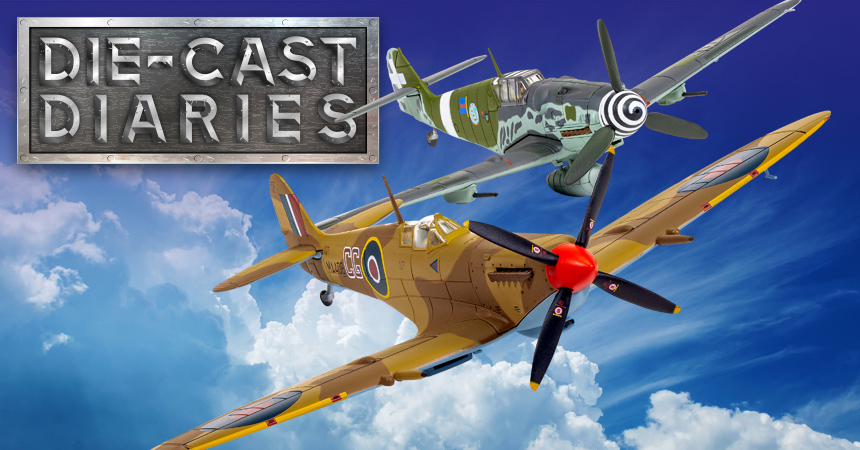
Welcome to the latest edition of Corgi Die-cast Diaries, your regular blog review of all the news, updates and topical stories from the captivating world of Corgi die-cast model collecting.
Quite rightly, the past few weeks have witnessed the nation commemorating the heroic exploits of 133 airmen of the newly formed RAF No.617 Squadron and their audacious attempt to cripple the German war industry by destroying the great dams of the Ruhr Valley using a new and up to that point, operationally untested specialist weapon, the Upkeep mine. Truly one of the most historic bombing raids in the history of warfare, these commemorations have overshadowed another significant wartime anniversary which took place that same year, one which we were also determined to mark in our Aviation Archive range in 2023. Taking place between July and August 1943, Operation Husky was an Allied amphibious operation to attack what Winston Churchill described as the 'Soft underbelly of Europe' and would see around 500,000 Allied troops committed to the invasion of Sicily, in a precursor to an attack on the Italian mainland itself.
In this latest edition of Die-cast Diaries, we will be featuring exclusive imagery from the two advanced production sample models of our Operation Husky fighter pairing, one being just the second release from our new Supermarine Spitfire Mk.IX tooling, with the other being a fascinatingly unusual representation of our much loved Messerschmitt Bf 109G tooling. We will look at why Operation Husky was so important to the eventual outcome of the Second World War and therefore why this model pairing makes for such a fitting tribute to the personnel on both sides who fought so valiantly in this often overlooked campaign.
Paying one final blog tribute to the 80th Anniversary of the Dambusters raid, we will be ending this edition by reporting on our attendance at last weekend's Attack on the Sorpe Dam film premier in Bristol, a memorable and moving occasion which was a triumph for all concerned. It was particularly poignant as the film features Britain's last Dambuster, George 'Johnny' Johnson heavily, who was sadly taken from us before he could enjoy this occasion. If you have even the slightest interest in this historic raid, you really must try to see this magnificent film.
Mediterranean Theatre air combat Aviation Archive style, these two impending range additions help to commemorate this year's 80th anniversary of Operation Husky, the Allied invasion of Sicily.
It would probably be fair to say that many people consider the D-Day Normandy landings as the only and certainly most significant Allied amphibious landing on Axis held territory during the Second World War, however that is most definitely not the case. Taking place almost a full year earlier, 'Operation Husky' was a combined service operation to land two Allied armies on the Island of Sicily, with the aim of driving Italian and German forces from the Island and thus providing a staging post for the invasion of the Italian mainland itself. Described by Winston Churchill and the 'Soft underbelly of Europe', the plan wasn't without opposition within the Allied military hierarchy, as both the Soviets and many American commanders favoured an assault against Northern Europe, as this was seen as the most likely development to relieve pressure off Soviet forces fighting the Germans in the East.
The British argument was simple. Although a landing on Sicily would not be unopposed, Italian forces in particular were thought be demoralised following their loss of North Africa and with the ever-increasing strength of Allied forces in the region, would they have the stomach for the fight? With 54 Italian divisions still fighting, more than 2,000 aircraft in service and a powerful navy all still available for Axis operations, if Husky could knock Italy out of the war, Germany would be forced to rush troops and equipment to the Italian front, as they could not risk the Allies sweeping through the country and attacking the German mainland from the south. Clearly such a response would strip other fronts of vital recourses, further weakening the German position as the Allies planned their proposed main assault on Fortress Europe. The scene was set for a major amphibious operation and a historic turning point in the war.
Operation Husky began with an airborne troop assault to capture key targets in advance of the main amphibious landings, and whilst things appeared to go wrong right from the start, the Allied assessment of Italian troop morale proved to be accurate, with many simply deserting their posts at the first sign of Allied opposition. The main amphibious forces were similarly unopposed, however, once Axis troops managed to sort themselves out and arrange their Etna Line defences, things became much more difficult for the attacking Allies. Thankfully, the combined Allied forces could call on the services of several exceptional commanders and the might of a powerful air force and it didn't take too long before the German and Italian forces embarked on a full scale withdrawal from the Island. Brave rear-guard actions allowed 100,000 Axis troops to escape to the Italian mainland, however around 100,000 Italian prisoners were also taken.
Check your six, the new Corgi Spitfire Mk.IX has some unwelcome Italian company on his tail.
With Sicily now in Allied hands, the Mediterranean Sea lanes were now open to their use, further strengthening their position in the region. The next stage of the plan was to launch a devastating bombing campaign against the Italian mainland, hammering home the futility of continued resistance and forcing the Italian population to consider surrendering to the Allies. The plan worked and after Mussolini was deposed, the new Italian Government asked the Allies for an armistice, which was signed in early September 1943, effectively knocking Italy out of the war. Germany acted swiftly, attacking Italian forces and occupying the country and for the rest of the war, would continue fighting, having been forced to commit significant resources to the Italian campaign.
The timing of Operation Husky was also quite significant, as the amphibious landings took place less than a week after the Germans had launched Operation Citadel on the Eastern Front, a huge armoured offensive in the Kursk salient, the plans for which Hitler was forced to change following the developments in Italy. From this point forward, the Germans would be fighting against an increasingly determined Allied opponent on many fronts, with Operation Husky meeting most, if not all of the aims and objectives intended in further weakening German forces and by association, helping to reduce pressure on their ally in the East.
Operation Husky is always overshadowed by the D-Day Normandy landings, which are much more widely known, however, Husky was actually the largest amphibious operation of WWII in terms of landing area size and indeed the number of troops landed on the first day. It would be a significant development in the history of the Second World War and undoubtedly had an impact on the success of the D-Day landings which followed and the eventual Allied victory.
With Operation Husky rarely receiving much historical recognition, we wanted to make sure that this year's 80th Anniversary didn't pass without our Aviation Archive range including at least a couple of suitable scale die-cast representations of aircraft which took part in this and the aerial duels which followed in Italian skies. We think both are interesting and appealing additions to the range and are particularly excited to see how our Regia Aeronautica Messerschmitt Bf 109G is received, as Italian aircraft subject matter is definitely underrepresented in the range and the success of this release might lead to more subjects being covered in the future.
Let's take a closer look at the two new models in question now, using a series of exclusive final sample model images to illustrate the details which inspired each model release.
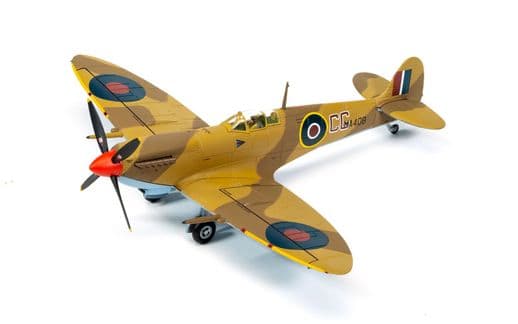
Catalogue image produced for the new Colin Falkland Gray Spitfire Mk.IXc.
Desperate to ensure the Spitfire maintained its ongoing combat effectiveness, designers at the Vickers Supermarine Company were almost constantly engaged in modifying, upgrading and improving their famous fighter throughout the Second World War, however, during that time, there were occasions when unexpected Luftwaffe advancements called upon their immediate flexibility and ingenuity. With a significant new variant of the Spitfire already at the advanced stages of development, the introduction of a capable new German fighter aircraft in the skies over occupied Europe caused great concern amongst RAF officials, who were now losing Spitfires at an alarming rate and needed an immediate response. With the proposed squadron introduction of the new Spitfire Mk.VIII variant still some months away, Supermarine designers had the idea of mating the intended new powerplant for this aircraft, the Rolls Royce Merlin 60 series engine, with existing Spitfire Mk.V airframes already on the production line, a temporary solution which might just buy them the time they needed.
The idea was given official approval and the RAF's Emergency Interim Fighter Programme got underway, with the new variant given the designation Spitfire Mk IX, a stop-gap solution which would actually prove to be something of a fighting thoroughbred. In actual fact, this undertaking was not without several rather significant challenges for the team at Vickers Supermarine to overcome and but for the severity of the situation in the skies over Europe, may have actually been regarded as too problematic to achieve. Attaching the powerful new variant of the Merlin engine to existing Spitfire airframes was fraught with challenges, as the new unit was larger, wider and featured a redesigned rear section, all of which made this far from a simple exchange of engines. Supermarine technicians had to remove all existing systems and connections, design a new engine mount, then replace all fittings with newly upgraded components, all of which were essentially hand built. In fact, it could be argued that many of the first Spitfire Mk.IX fighters were hand built, with each one having an incredible number of man hours devoted to their production.
Once test aircraft were passed to the Air Fighting Development Unit and later on to the Aeroplane & Armament Experimental Establishment for extensive evaluation, it was found that this interim, stop-gap Spitfire was a marked improvement on existing Spitfires in performance terms. What had started as something of a desperate attempt to address a critical situation facing the Royal Air Force would actually result in the service introduction of an exceptional fighting aeroplane and the continuation of the Spitfire's incredible story. The Spitfire Mk.IX would go on to be considered so successful that it would become the second most heavily produced variant in the entire production run of the fighter, second only to the Mk.V and if including aircraft powered by the American produced Packard Merlin engine in this number, actually eclipsed the Mk.V in terms of production numbers. It would also be the last major Merlin powered variant of the Spitfire, before the introduction of the mighty Griffon.
Just the second release from our new 1/72nd scale Supermarine Spitfire Mk.IX tooling, this beautiful machine looks very different to the first release, wearing these attractive MTO markings. These images show an advanced production sample of the new mode.
Just one of many Commonwealth airmen who served and fought with great distinction within the Royal Air Force during the Second World War, New Zealand national Colin Falkland Gray initially had some difficulty in joining the force, twice failing to do so on medical grounds. Having spent some time improving his fitness levels, he was eventually accepted for a short service commission in the late summer of 1938, but rather than stay and train with the Royal New Zealand Air Force, elected to travel to Britain for his flying training, where he would gain his wings and later graduate as a probationary Pilot Officer in October 1939 without too many difficulties. This proved to be a rather tumultuous period for the Royal Air Force and Europe as a whole, as Britain and her allies were now at war.
By the end of the so called Phoney War, Gray was flying Spitfires with No.54 Squadron at Hornchurch, gaining as much operational experience as he could in advance of what seemed certain to be waiting just around the corner, a clash with the all-conquering Luftwaffe. He would make his combat introduction during the Battle of France, flying patrol and fighter support sorties over the areas of Calais and Dunkirk, during which time he would gain both his first combat experience and his first aerial victory. He would go on to see plenty of combat action during the Battle of Britain and by the time No.54 Squadron were withdrawn for rest and replenishment, Gray had amassed an impressive total of at least 14.5 confirmed combat victories, making him the seventh most successful RAF pilot of the battle.
With his victory tally continuing to grow, along with a succession of commendations, decorations and promotions, Gray would later take command of No.81 Squadron in the Mediterranean Theatre of Operations at the end of 1942, initially reporting to Gibraltar, where he and the rest of his new unit were to take delivery of their new Spitfire Mk.IX fighters, the first MTO squadron to do so. Operating from several airfields in North Africa, Gray would continue to score victories over his adversaries, which now included the opportunity to pit his flying skills against the fighters of the Regia Aeronautica.
This new Spitfire is expected to be available next month, our Aviation Archive tribute to this year's 80th Anniversary of Operation Husky.
During his time serving in the MTO, Gray continued to display exceptional airmanship when in combat and a burning desire to sweep the enemy from the skies. On one occasion, his Spitfire developed engine problems which forced him to abort his position in the operation and return to his home airfield, however, on arrival, found the base had just been shot up by several Focke Wulf fighter bombers. Incensed, he immediately gave chase, but his engine was not producing its usual power output, so he was unable to catch them, however, on transiting back to his home airfield, he came across a lone Messerschmitt fighter, which he promptly dispatched.
During his time serving in the Mediterranean, Gray would operate from airfields in North Africa, Malta and Sicily in support of the Allied war effort and by the time he returned back to Britain having accepted a staff position with No.9 Group, he had been credited with 27.5 aerial victories, a figure which made him the top scoring New Zealand air ace of the Second World War. Although he would fly operationally again before war's end, he would not increase his victory tally further.
In its striking desert livery, Gray's Spitfire Mk.IX MA408 proves the old aviation adage that any colour looks good on a Spitfire, however, it has to be said that this one is particularly attractive. Colin Gray used this fighter during Operation Husky, the Allied invasion of Sicily, but was just one of several Spitfires in which he flew and scored victories during his time in the Mediterranean. He and his fellow MTO pilots effectively cleared the skies of Axis aircraft and helped pave the way for eventual Allied victory, both in this theatre of operations and further afield.
Colin Falkland Gray would retire from the Royal Air Force in early 1961, before returning to his native New Zealand.
A Messerschmitt Bf 109G (Trop) supplied to the Regia Aeronautica to help bolster their forces against ever increasing numbers of Allied aircraft in theatre, but was this a case of too little, too late?
Just as the famous Fokker Eindecker had previously done during the Great War, the Messerschmitt Bf 109 would redefine aerial warfare and just like its predecessor, was an aircraft which was designed to dominate the sky. An aircraft which incorporated all the latest technological developments the aviation world had to offer, this project may have advanced as a lightweight monoplane fighter, but possessed the one attribute all hunting aeroplanes needed, and that was great speed. Produced in response to a Reich Aviation Ministry requirement for an advanced single-seat fighter aircraft, the design submitted by Bayerische Flugzeugwerke was radical in the extreme, diminutive and lightweight in construction and utilising the most powerful in-line aero engines in development in Germany at that time.
Taking much of its design inspiration from the successful Messerschmitt Bf108 Taifun four-seat sports touring aircraft which preceded it, the Bf 109 was a relatively small, yet powerful monoplane fighter, one which was incredibly fast, heavily armed and highly manoeuvrable. At a time when the world's major air forces were mainly equipped with biplane designs for their front line fighter force, you might think that German pilots were desperate to get their hands on an aircraft which was so advanced that it was at the very forefront of world aviation, but that didn't initially prove to be the case. As they were used to slower, highly manoeuvrable aircraft with open cockpits, the enclosed cockpit of the Messerschmitt Bf 109 must have been more than a little claustrophobic for them, however, they soon warmed to the many impressive qualities of this aviation phenomenon, an aircraft which would allow them to dominate the skies.
Interestingly, due to the advanced nature of the design and the fact that the new German built powerplants were not ready, the prototype aircraft was actually powered by a British Rolls Royce Kestrel engine, something of a strange dichotomy for a fighter which would go on to become the scourge of the Royal Air Force.
Proving successful during flight trials with competing rival aircraft from other famous German aircraft manufacturers, the Messerschmitt Bf 109 would eventually enter service in 1937, a time where it's interesting to note that the Royal Air Force were just withdrawing their Bristol Bulldog biplane fighter from service and introducing the Gloster Gladiator, with the Luftwaffe clearly holding a significant technological advantage at that time. Nevertheless, even in Britain, the winds of aviation change were blowing and both the Hawker Hurricane and Supermarine Spitfire were already in development.
An Axis aircraft with a difference, the famous Messerschmitt Bf 109 pressed into Regia Aeronautica service during the second half of 1943.
The Messerschmitt Bf 109 would go on to become something of an aviation legend, manufactured throughout the Second World War and eventually produced in greater quantities than any other fighter aircraft in history. In expert hands, the Bf 109 was a formidable adversary until the very last days of the war and as a consequence, would be flown by many of the world's most prolific air aces at times during their service careers. The fighter would also see service with several other European nations during WWII, including Finland, Hungary and notably with Italy's Regia Aeronautica. Just as was the case with its traditional adversary the Spitfire, the name Messerschmitt came to be used in common parlance to refer to any enemy aircraft seen encroaching in British skies.
As the Regia Aeronautica came under increasing pressure from ever greater numbers of Allied aircraft in the Mediterranean Theatre, aircraft combat losses soon began to outstrip the rate at which those losses could be replenished by their ailing aircraft industry. The Italians had already been using German engines to power some of their fighters, however, this was still not enough and if the Germans wanted Italian forces to continue fighting the Allies, a more radical solution would be required. At a time when the Luftwaffe needed every fighter it could muster, it was decided that new Messerschmitt Bf 109 fighters would be supplied to the Italians, with aircraft taken straight from the production lines, a combination of F-4, G4 and G6 variants. As such, the aircraft were delivered in standard factory applied finishes, complete with Luftwaffe markings, which clearly required some work before they could be committed to combat.
German national insignia was painted out using the closest Italian paint shades available and whilst most existing camouflage was retained, any future modification would be done using standard Regia Aeronautica paint stocks. Italian national insignia and theatre markings were applied, but this was still very much the most famous Axis aircraft in the skies, just under new ownership.
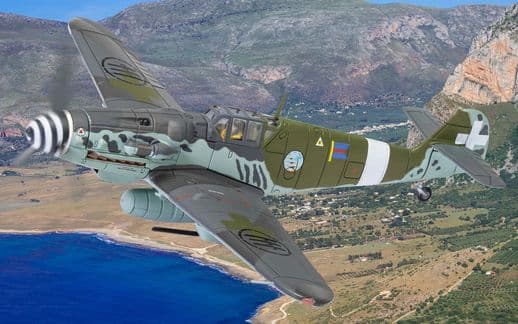
Two more images featuring an advanced production sample of this unusual presentation of the famous Messerschmitt Bf 109G-6 (Trop)
The Messerschmitt Bf 109G variant was undoubtedly superior to the Italian fighter types pilots had been flying previously, however, they were familiar with their Macchi 202 and 205 fighters, something which would have been crucial to them in a combat situation. Whether it was down to a lack of effective conversion or the fact that Allied air forces were becoming stronger by the day at that stage of the war, the use of Messerschmitt Bf 109 fighters by Italian pilots did little to change Axis fortunes in the Mediterranean and proved to be little more than an interesting footnote of the conflict. Hunted by Allied aircraft whilst in the air and on the ground, Regia Aeronautica use of the Messerschmitt Bf 109 was effectively nothing more than symbolic, despite the best efforts of their brave and tenacious pilots. By the time No.150º Gruppo was withdrawn from Sicily back to Ciampino near Rome, they only had three serviceable Messerschmitt Bf 109G fighters available to make the flight.
One of the leading figures within the Regia Aeronautica during the Second World War, Antonio Vizzotto may not have appeared amongst the list of most successful Italian air aces of the WWII, however, he was a skilled and brave pilot, exceptional leader of men and arguably the most decorated Italian airman of that period. Involved in some of the most successful early war operations by Italian air units, Vizzotto would become an inspiration to fellow pilots and his countrymen alike, gaining regular promotions and viewed as something of a national hero. With the rank of Maggiore, Vizzotto was given command of No.150º Gruppo, a fighter group which comprised Nos 363a, 364a and 365a Squadriglia and as Italian forced headed for North Africa, Vizzotto and his units were requested to join the operation by Italian ground units who were aware of the unit's reputation for success in aerial combat.
Despite scoring several notable early successes, the increasing strength of Allied air power in the region gradually eroded any chance of victory and even when the unit traded their Macchi C.202 fighters for German Messerschmitt Bf 109Gs during the spring of 1943, it was only a matter of time before the Allies secured a hard fought superiority in the air.
Our second aircraft model release intended to mark this year's 80th Anniversary of Operation Husky.
In April 1943, No. 150º Gruppo under the command of Maggiore Antonio Vizzotto were the first unit to re-equip with German Messerschmitt Bf 109G fighters and subsequently committed to combat, operating from both Santo Pietro and Sciacca airfields on Sicily. Soon facing the might of the Allied forces during Operation Husky and the invasion of Sicily, they were unable to either post telling air combat successes, or prevent the fall of Sicily and would be reduced to fighting defensive, retreating actions for the remainder of the war.
The 'Gigi Tre Osei' emblem adopted by 150º Gruppo was related to Italian celebrity pilot and Olympic gliding champion Luigi Caneppele, a highly decorated airman and national hero who was lost whilst serving on operations during the North African campaign. In his honour, the emblem of the Italian gliding association licence (three stylised soaring eagles) was modified to include a North African oasis scene and included the 'GIGI TRE OSEI' wording, a tribute 150º Gruppo pilots proudly took into combat against Allied air forces.
The distinctive Messerschmitt Bf 109G-6 fighter presented here was the mount of Maggiore Antonio Vizzotto in actions during the Allied invasion of Sicily, where Regia Aeronautica pilots faced overwhelming odds in the face of the Allied onslaught. A beautifully unusual presentation of a wartime Bf 109G fighter, this aircraft retains most of its factory applied Luftwaffe camouflage, with German national insignia mostly painted out and new Regia Aeronautica and theatre markings added, with the rear fuselage also benefitting from a coat of Italian Verde Oliva Scuro paint. Adding weight, but also much needed additional firepower, Vizzotto's aircraft was also fitted with under-wing cannon gondolas, each complete with 120 rounds of ammunition.
Both of these new model release make for eye-catching additions to any die-cast collection, in addition to effectively marking this year's 80th Anniversary of Operation Husky. We are expecting the Messerschmitt to arrive in our warehouse imminently, with the new Spitfire following on in next month, but please keep an eye on the respective product pages on the Corgi website for all the latest availability details.
Premiere night for the new film Attack on Sorpe Dam.
In what proved to be an unforgettable and extremely poignant occasion, a small team from Corgi and Airfix were invited to attend the world screen premier of the new film Attack on Sorpe Dam last Saturday evening, as guests of the film's creators Andrew Panton and Piotr Forkasiewicz. The film tells the often overlooked Dambusters story of the attack against the Sorpe Dam on the night of 16th/17th May 1943 and is made all the more powerful by the fact that it is narrated throughout by George 'Johnny' Johnson, a man who was sat in the bomb aimer's position aboard Avro Lancaster B.III (Special) ED825 AJ-T as they attacked the Sorpe Dam on that historic night.
Production of this film has dominated the lives of film makers Andrew and Piotr over the past few years, but what they have managed to create is quite magnificent, a unique record of the Dambusters raid narrated by a man who was actually there. Revealing many details about the raid, preparations for it and most importantly, the airmen who flew it, which historians and modellers alike will find fascinating, the film has digitally recreated RAF Scampton as the crews prepared for this audacious raid and thanks to work done in conjunction with the University of Bath, employed sophisticated motion capture technology to give everything about the production an impressive air of authenticity.
The Attack on Sorpe Dam film follows the story of Johnny and his crew from March 1943, on joining a newly formed Squadron X, to take part in a top secret, 'special operation' which held the potential of actually shortening the war in Europe. Johnny describes the dangerous low flying training and events leading up to the operational briefing on May 16th 1943, where he and the rest of his crew finally discover what they were expected to do and how they came to terms with what seemed like an impossible task.
A display of distinction, David and James prepared to welcome those fortunate enough to have a ticket for this special film premiere occasion.
Mission accomplished, David congratulates Andrew Panton on a film job very well done.
They were to fly at heights of less than 100 feet in a four engined Lancaster bomber at 232 mph, by day and night and over many miles of occupied enemy territory and on reaching the target, they would be required to drop a new weapon which had previously never been used operationally, with pin-point accuracy and in a way they had not practiced in the preceding weeks. What they didn't know was that on the night itself, an engine problem with their Lancaster would force then to change to the only reserve aircraft on the airfield, and whilst they were scheduled to be the first aircraft to take off of the main attack waves, they would actually be the last, making their way to the target completely alone.
Once they had successfully delivered their Upkeep mine, all they had to do was make their way back to Scampton with every gun in occupied Germany looking to target them - all they could do was fly low and fast, keeping their eyes peeled for signs of enemy aircraft activity and anti-aircraft batteries. Nothing like this had ever been attempted before.
The film is an absolute triumph and everyone in the audience was held transfixed by the unfolding story and our good fortune to be able to see its world premiere screening in the week of the 80th Anniversary of the Dambusters raid itself.
As a little Aviation Archive footnote, the film's creator Andrew Panton told us that Johnny was actually a big fan of the Corgi Lancaster model and when he had taken one to show him during one of their many meetings during the film planning stages, he knew exactly which aircraft it was and the crew members which would have been aboard it. We are all really sad here at Corgi that we didn't have the opportunity to present him with an example of our latest Lancaster release, the one which depicts the aircraft in which he flew during their attack against the Sorpe Dam.
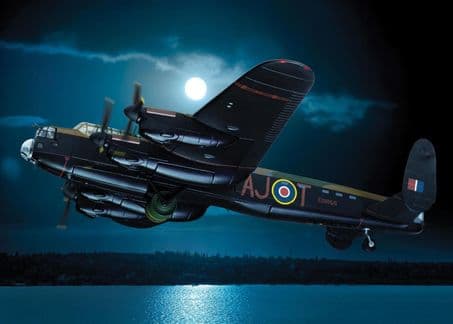
Our latest Dambusters Lancaster release is our die-cast tribute to the aircraft flown by Joe McCarthy whilst attacking the Sorpe Dam, the aircraft in which George 'Johnny' Johnson served as bomb aimer. A model which has proved to be a popular way in which to mark the 80th Anniversary of the raid, this model is already close to sell out.
In summary, the Attack on Sorpe Dam film is an exceptional piece of work and anyone with even the slightest interest in history and in particular, the Dambusters raid, really do need to see it, especially in this 80th Anniversary year. With screenings now taking place across the country, please visit the Attack on Sorpe Dam website for location details and ticketing information.
We are afraid that's all we have for you in this latest edition of Corgi Die-cast Diaries but we will be back as usual in two weeks' time with a further selection of model project updates. Between editions, we are always interested to hear your views on all things Corgi, so if you feel like dropping us a line to comment on anything blog or Corgi model related, or indeed to suggest a topic you would like us to include in a future edition, please feel free to do so at diecastdiaries@corgi.co.uk.
If you can’t wait for the next blog, you will find plenty of Corgi model collecting discussions taking place on our official social media channels, access to which can be obtained by clicking on the respective links at the foot of the Corgi website homepage.
Link access to Corgi social media sites.
Thank you for continuing to support our Die-cast Diaries blog. Our next edition is scheduled for publication on Friday 2nd June.

