
Welcome to the latest edition of Corgi Die-cast Diaries, your regular blog review of all the news, updates and topical stories from the captivating world of Corgi die-cast model collecting.
Following the frenetic activity of our latest range launch and the previous range overview edition of Die-cast Diaries, thankfully we can now settle down to the more civilised and comparatively sedate business of looking a little more closely at some of the individual releases which will be vying for positions amongst our displays in the weeks and months to come. Before we crack on with this though, we know you will be interested to hear how well the new range has been received and whilst we haven’t collated all the numbers yet, we think this could be one of our most successful launches to date. In a forthcoming edition, we will give you a breakdown of all the frontrunners just for a little bit of harmless collecting fun, but to illustrate the situation, both the models about to be reviewed in this update are already close to being fully allocated/sold out.
In this latest edition, we will be covering two model releases which have already found favour with Corgi collectors, one which has been released over the previous few days, with the other scheduled to follow along a little later in the year. Our second feature for this edition looks at one of the aircraft models introduced to the Aviation Archive range to mark our die-cast tribute to this summer’s D-Day 80th Anniversary commemorations, an Allied fighter which possesses historical provenance which is second to none. Prior to this, we will be looking at a new collector’s set announced with our recent range launch, one which consists of a trio of motoring icons within its distinctive, high quality presentation packaging, a range of vehicles which continue to enjoy something of a cult following to this day.
With classic Corgi models taking centre stage yet again, and our first look at a selection of exclusive supporting model imagery, we are delighted to be bringing you the latest update from some of our most eagerly anticipated new collectables.
The Ford Capri may have been able to trace its origins back to the American Mustang, but it was Europe where the car found its most loyal supporters.
As we all start to plan our summer events schedule with the promise of much better weather to come, if we find ourselves attending an event where classic and contemporary cars are part of the display, we can look forward to renewing our association with lovingly maintained examples of a true icon of Britain’s motoring heritage, a car which may well have been out of production for almost four decades, but is still a head turner whenever you see one. If you classed yourself as a style conscious motorist, then you will not only be familiar with the Ford Capri, you’d probably still love to own one even now.
The Ford Capri project started life as the intended European market derivative of the hugely successful Ford Mustang Mk.I introduced in the US by the American parent company, with the European car being first unveiled to an excited motoring world at the end of the 1960s. The spectacular success of the Mustang took Ford officials by surprise and clearly highlighted a consumer appetite for mass-market cars which offered something more than just functional motoring. At that time in the UK, Ford could only claim the Lotus Cortina as being anything resembling a slightly sportier model, with the rest of the range being manufactured for the masses, with a reputation for being reliable, if a little staid and uninspiring.
The new US inspired model was intended to change all that, a racy looking car with a sporty, desirable image, but one which was within the reach of large sections of the motoring population. Just like the Mustang did in the US, the new Capri needed to use as many existing components from other models in the Ford range as possible in its construction, but cleverly wrapping them all up in a beautifully stylish coupe bodyshell. You could say that by adopting this production ethos, the Capri was almost guaranteed to be a motoring success, cost effective to produce, but possessing huge customer appeal.
Marketed as a stylish, yet affordable two-plus-two sports coupé aimed at the working man, the Capri proved to be a real success for Ford and would go on to enjoy a 17-year production run, with almost 2 million cars sold during that time. It’s hardly surprising that this handsome car proved to be such a winner, particularly when noting how Ford’s marketing department cleverly positioned the car to the British public at the time. The Capri was described as ‘The car you’ve always promised yourself’ and once this got into our heads, how could we possibly resist its appeal?
Launched at the 1969 Brussels Motor Show, Ford’s marketing gurus played a blinder once more, as they kept the new car covered until the final day of the show, keeping the suspense going, but only increasing excitement levels still further. Once unveiled, the new Capri was the talk of the motoring world, a landmark model for Ford which changed the face of popular motoring in Britain for good. Unashamedly masculine with plenty of feminine charm in its beautiful styling, the Ford Capri appealed to everyone, and if you couldn’t quite afford one straight away, you made a promise to yourself that one day you would.
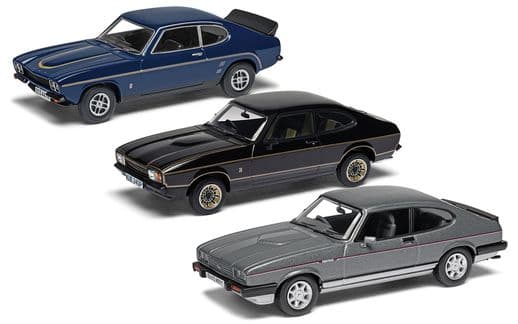
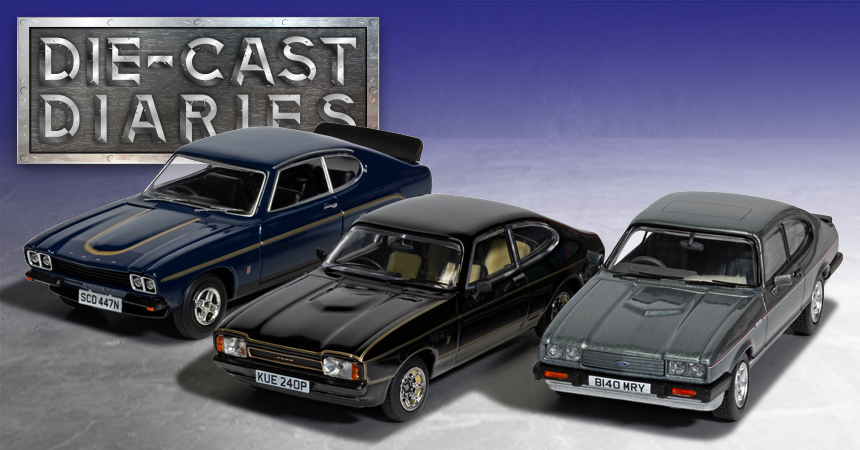
A trio of feisty Fords make up our new Ford Capri Sporting Trilogy Collection, starting with this Ford Capri Mk1 RS3100 in Marine Blue.
Ford Capri Mk2 3.0 GTS in Black.
Ford Capri Mk3 2.8 Injection Special Turbo Technics in Nimbus Grey and Strato Silver.
Another clever marketing move by Ford in those early days was to simply park Capris outside locations with heavy public footfall, just leaving the car there for all to admire. As the Capri was already the talk of the motoring world, they were of the opinion that allowing people to get close to the car without having to visit a showroom would only make people want it more.
Central to the success of the Capri was its distinctive styling, a sleek, sporty and capable looking car, with a growing range of powerful engine options which gave it something of a muscle car mystique. Exhilarating to drive and incredibly pleasing on the eye, perhaps the most appealing feature of the Capri was how it wasn’t out of reach for large sections of the population, and if you were fortunate enough to own one, you knew you would be attracting admiring glances wherever you went. Also going on to be widely used by Police Forces across the country, both in marked and unmarked versions, the Capri is undoubtedly a British motoring icon and one which still commands our attention if we see a pristine example to this day.
With widespread access to classic TV programming across multiple platforms these days, many of the shows we remember so fondly from years past are as familiar to younger people as they are to those who watched them live back in the day, well before the days of box sets and intelligent TV planners, you know, when you had to wait a week between episodes. That may go some way to explaining why the appeal of the Capri endures to this day, its appearance in classic TV programmes. No matter what the reason, a well turned-out Capri will attract as many admiring glances at a motor show as any modern supercar will.
Our latest scale model tribute to the Capri’s impressive legacy is a special collector’s set consisting of three different Capris, a set which could be described as featuring ‘An icon from each of the Capri’s three generations’, and it’s a real beauty. As we move on look at the supporting information which will accompany this appealing new set, can we take a moment to confirm that the model images we’re showing here are being published for the very first time, with Die-cast Diaries readers yet again being the first to see them, which is just the way we like it to be!
A model set of this calibre requires high quality, bespoke packaging, in keeping with the collectable nature of these beautiful models.
The Ford Mustang’s launch at the New York World’s Fair in April 1964 created a sensation and the Capri, originally codenamed Colt, was planned to emulate that success in Europe. Like the Mustang it was an attractive, aspirational but practical sports coupe that boosted Ford’s image by scoring numerous motorsport successes and was profitable as it shared components with higher-volume saloons. Revealed in 1969 and astutely marketed as ‘The Car You Always Promised Yourself’ the Capri was an immediate hit and could be ordered as an economical 1.3-litre or fire-breathing 3-litre. It continued in production over three generations and almost 1.9 million cars until 1986.
VA13315 - Ford Capri Mk1 RS3100 in Marine Blue
The RS3100 was conceived to homologate the Capri for the European Touring Car Championship and the racing machine developed from it won the 1974 Manufacturers' ETCC. A total of 250 RS3100s were produced during November 1973 at Ford’s Halewood plant and only the last ten were Marine Blue. This example was supplied by Ford dealers Endeavour Motor Company, Brighton, on August 1st, 1974, and has been cherished by the Security Officer of the Ford AVO Owners Club, Naz Khan, since October 2020. He’d spent years looking for an RS3100 in this colour before finding this one a mile away from his home in West London.
VA15403 - Ford Capri Mk2 3.0 GTS in Black
Just over 2,000 GTS Capris were produced, around 1,500 black and 500 white, and it’s known colloquially as the ‘JPS’ because its gold coachlines echoed those of contemporary JPS-Lotus F1 cars. Launched at the 1975 Geneva Show, all were built at Halewood between June and August 1975 and this example is one of ten 3-litre GTS automatics. In June 2009 it was purchased by Suffolk-based enthusiast Nick Carley who comprehensively restored it, completing it in 2012. Since December 2021 it’s been in the care of his widow, Lesley. In 2016 it was featured on ‘Stars in Their Cars’ with Paddy McGuinness and Neil Morrissey.
VA10823 - Ford Capri Mk3 2.8 Injection Special Turbo Technics in Nimbus Grey and Strato Silver
To keep the Mk3 Capri competitive it was substantially re-engineered by Rod Mansfield’s team at Ford’s Special Vehicle Engineering facility in Essex and the resulting car was launched in spring 1981 as the Capri 2.8i. The car modelled is an example of the third of four 2.8i generations and is unusual in featuring two-tone metallic paint and a dealer-fitted Turbo Technics conversion; so popular it was offered by Ford as a factory-approved kit that didn’t impact the warranty. In April 2022, showing 30,000 miles, it was purchased by renowned Capri authority and author Steve Saxty because of its rare specification and time-warp original condition.
A beautiful collector’s set no Capri fan will want to be without, these handsome models are presented on an attractive display plinth and feature bespoke packaging which really does set it apart as something that little bit special. As you can never have too many Capri models, if you are a committed Vanguards collector, or looking to start you collection with a trio of iconic Fords, you really can’t go wrong with this beautiful new 2024 release.
As our development team apply the final finishing touches to this very special release, we are looking a little deeper into the summer before our Ford Capri Sporting Trilogy Collection will be available, so please keep a lookout for further updates from us.
The evocative box artwork master which identifies this recent release as one of our D-Day 80th Anniversary collection of models.
As we currently find ourselves less than three weeks away from the series of international events planned to commemorate the 80th anniversary of D-Day, it’s probably about time that we featured an appropriately related new model which may well have featured in our first range launch of the year, but as of yet, has not had our blog spotlight placed upon it. Significantly, this model is not only available right now, but it has almost disappeared from our warehouse, so we really are on borrowed time with this one.
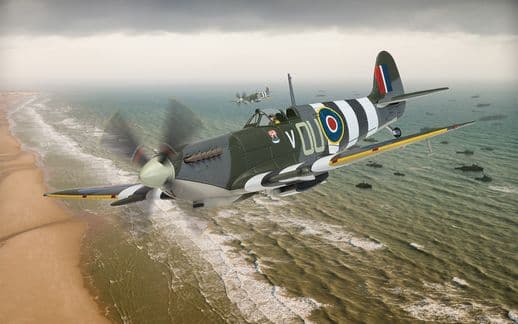
As far as D-Day related subject matter is concerned, we could hardly have picked a more appropriate aircraft to join the Aviation Archive model ranks than this one, an RAF Supermarine Spitfire which not only played a historic role on D-Day, but is an aircraft which is still flying in Britain’s skies to this day. Let’s take a closer look at why this model is proving to be such a popular addition to the range, using a selection of exclusive production model imagery to illustrate its story.
As unquestionably the world's most famous fighting aeroplane, the Supermarine Spitfire not only served in all its variant guises throughout the entire Second World War, but would also go on to enhance its enduring legacy in the years which followed, as it continued to fly both operationally and increasingly in the hands of civilian owners. For those fortunate people with the opportunity, skills and funds to do so, the chance to own and fly a wartime aircraft was so appealing it almost became an obsession and of course, the aircraft of choice just had to be a Spitfire. With well over 20,000 Spitfires built, quite a few would come into the hands of private owners after WWII, where they helped to establish the post war UK Airshow scene.
Fast, agile and incorporating the latest advances in aviation innovation, the Spitfire may well have been a beautiful thing to look at, but its distinctive styling was more a result of aerodynamic functionality than simple design aesthetics. This aircraft was not created to captivate the nation with its visual appeal, but to dominate the sky, a metal bird of prey claiming other aircraft as its victims. As such, as soon as the Spitfire entered Royal Air Force service, every boy, teenager and young man in the country wanted to fly one and from that day forward, for millions of people, the only aircraft for them was the Spitfire.
Created for war, but an aircraft which went on to be championed as a bringer of peace for the nation, the Spitfire is revered as much today as it was during the dark days of the Battle of Britain and if you are fortunate enough to see one displaying at an Airshow, it has to be described as an experience rather than just another aerial demonstration, as the unmistakable music of the Merlin engine, combined with the beautifully clean lines of this stunning aeroplane, simply overwhelming our senses in a way no other aircraft could ever hope to match.
All the Spitfire model images being shown here feature a production sample of this most famous of Spitfires, a model which at the date of publication is still available on the Corgi website.
Of all the privately owned Spitfires which have thrilled Airshow audiences over the past 40 years or so, there's one which not only boasts heritage as rich as any currently airworthy Spitfire, but also happens to possess genuine, documented combat provenance, an aircraft which has a unique D-Day claim to fame - Spitfire ML407. Constructed as a Mk IXc variant at the famous Castle Bromwich 'Shadow Factory' in early 1944, ML407 would go on to write her name in history as the first Allied fighter to claim a Luftwaffe aircraft shot down following the Allied amphibious landings on D-Day, not to mention going on to have an impressive post war flying career which continues to this day.
ML407 would fly operationally throughout the final months of the Second World War, serving with six different squadrons of the RAF's 2nd Tactical Air Force, and amassing 176 combat sorties and 319 hours of combat flying in the process. She was delivered to No.485 (New Zealand) Squadron on 29th April 1944, where she would become the aircraft assigned to Flying Officer Johnnie Houlton in preparation for operations covering the D-Day landings. No.485 Squadron would move to operate from the advanced landing airfield at RAF Selsey, as this was the closes UK mainland airfield to the landing beaches the squadron's aircraft would have to protect on 6th June 1944.
On D-Day itself, the squadron was tasked with flying 4 patrols to protect the Allied landings, however, Spitfire ML407 suffered damage to her propeller the day previously, so was unable to take part until the afternoon on D-Day. With Houlton at the controls, he and his wingman decided to patrol an area south of the Omaha beachhead, partly due to the sheer number of Allied aircraft operating in a relatively small piece of sky on the day, but also due to the complete lack of Luftwaffe opposition in their airspace.
A real looker – this Spitfire/pilot combination would earn historic recognition for their contribution to the Allied D-Day landings.
Almost immediately, Houlton caught sight of a Junkers Ju-88 bomber attempting to find cover in the clouds and having adjusted his new gyroscopic gunsight for a longer distance shot, gave the Luftwaffe aircraft an accurate short burst from around 500 yards. With bullets striking the aircraft's engine, the Ju-88 burst into flames, causing the crew to immediately take to their parachutes as their stricken aircraft plummeted earthwards - Houlton and Spitfire ML407 had just become the first Allied pilot/aircraft combination to shoot down an enemy aircraft following the D-Day landings.
The pair would almost immediately share in the destruction of a second Ju-88 and over the course of the next few days, would also account for two Messerschmitt Bf 109 fighters and the damaging of another, all at a time when the Luftwaffe rarely ventured up to challenge the overwhelming aerial superiority of the Allied air forces.
Having already secured its place in aviation history, ML407 appeared determined that her post war career would be equally significant as her wartime exploits and she would be one of the Spitfires bought back by Vickers Supermarine after the war for conversion to two seat T.9 configuration for the Irish Air Corps. Arriving in Ireland on 30th July 1951, she would go on to wear the fuselage identification number 162 in Irish Air Corps service, and amass a further 762 hours in the air, training IAC pilots how to fly this powerful and extremely capable piston engined aircraft.
With her airframe hours now almost expired, ML407 was later allocated for use by the apprentice training section at Baldonnel as a ground instructional airframe, however, she was still determined this would not be the end of her story.
Whether displayed on its stand, or on its undercarriage, this latest Spitfire release could take pride of place within any Corgi model collection.
No longer required by the school, the aircraft was made available for sale and shipped back to the UK for her new owner in March 1968, passing on to a famous Warbird collector two years later and subsequently on to engineer and pilot Nick Grace in 1979. Nick had always had a fascination with Spitfires and dreamt that he might one day own one, so once this famous aircraft was in his possession, he embarked on a painstaking restoration of ML407 to return her to flying condition, a project which would take five years to complete.
Spitfire ML407 triumphantly took to the skies once more on 16th April 1985, in her later two-seat trainer configuration, but with the rear cockpit sporting what would become known as the 'Grace canopy conversion', as Nick preferred a sleeker look to his Spitfire, as opposed to the rather more blown, or bulbous appearance of standard T.9 Spitfire rear canopies. Since that date, this incredibly historic aircraft has been a regular sight in Britain's skies, not to mention the star of many an Airshow, often with Nick's wife Carolyn at the controls, following her husband's tragic death in 1988.
The aircraft is now under the care of Nick and Carolyn's son Richard at Sywell Aerodrome and in addition to performing at Airshows across the country each year, this Spitfire also allows a lucky few to fly as passengers in this genuine D-Day veteran, a thrilling once in a lifetime flight opportunity for those fortunate enough to experience it. If you always dreamt of flying in a Spitfire, surely you would want to have the Spitfire which actually claimed the first Allied aerial combat victory of D-Day in your personal logbook.
Supermarine Spitfire ML407 continues to be airworthy to this day, a uniquely historic aircraft in the nation’s rich aviation heritage.
With its bespoke packaging presentation and rich D-Day heritage, this is one Spitfire model release not to be missed.
As mentioned earlier, this beautiful new model is available now, but with very few examples remaining in our warehouse, its days as a stock item are numbered and it may well have gone for good by the time the coming week is out. If the incredible story linked to this latest Spitfire release appeals to you, please don’t sit on the fence too long, get it in the crosshairs of your online basket and pull that trigger!
We’re afraid that's all we have for you in this latest edition, however, please join us again in two weeks’ time for another exclusive insight into the wonderful world of Corgi model collecting. Between editions, we are always interested to hear your views on all things Corgi, so if you feel like dropping us a line to comment on anything blog, collecting or Corgi model related, or perhaps to suggest a topic you might like to see us cover in a future edition, please do get in touch at diecastdiaries@corgi.co.uk.
If you can’t wait for the next blog, you will find plenty of Corgi model collecting discussions taking place on our official social media channels, access to which can be obtained by clicking on the respective links at the foot of the Corgi website homepage.
Link access to Corgi social media sites.
Thank you for continuing to support your Die-cast Diaries blog. Our next edition is scheduled for publication on Friday 31st May.