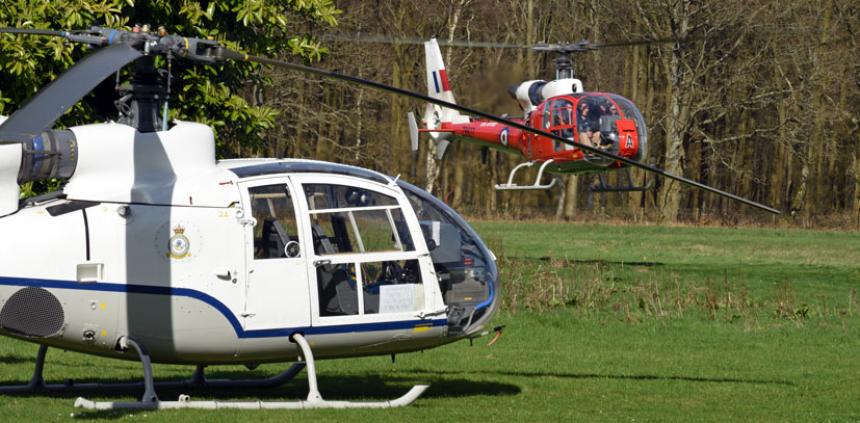
Welcome to this latest edition of Aerodrome and our regular look at the fascinating world of aviation. Since posting the previous edition of our blog, the Aerospatiale Gazelle helicopter has celebrated the 50th anniversary of its first flight and an impressive service career that continues to this day. With almost 1800 machines built in a production run that lasted almost thirty years, Gazelles continue to fly with many of the worlds air forces, with increasing numbers also flying with civilian operators. Our previous edition featured a review of the recent Gazelle Squadron Display Team training day, as they prepared for what looks like being their busiest Airshow season to date, and from the many responses we have received from Aerodrome readers since then it seems like many people are looking forward to catching up with the team this coming summer. As they bring the distinctive ‘whistling chicken leg’ to Airshow audiences all over the country, the Gazelle is about to capture a new army of admirers who are keen to enjoy a more engaging aviation experience and get a little closer to these handsome little helicopters.
In this latest edition of Aerodrome, we are pleased to return to helicopter heaven and Bourne Park airfield, home to the Gazelle Squadron Display Team, as we take you back for the final instalment of our training day review. We will be dropping in on the current home of the Wiltshire Air Ambulance, taking another thrilling trip over the beautiful North Wessex Downs and taking a closer look at the Gazelles that were on the airfield during our visit. In something of a rotary aviation scoop, we will also be taking a tour of the Bourne Park site and featuring some of the impressive machines that could be joining the fleet in the very near future and hopefully gracing an Airshow near you. With lots to fit in and a host of exclusive pictures to bring you, let’s head back to Hampshire and the recent Gazelle Squadron Display Team training day.

My second Gazelle flight would be in this beautiful HT.3 XZ934
In the previous instalment of this Gazelle Squadron review, we looked at how the Aerospatiale/Westland Gazelle has proved itself to be an extremely capable observation and reconnaissance platform over the years, with the Army Air Corps still operating successively upgraded versions of the aircraft almost 44 years after it entered service. Indeed, May 2017 marks the 35th anniversary of Gazelle operations during the Falklands War of 1982, where the aircraft was also adapted to perform offensive missions, even though it was never called upon to do so in anger. Although powered by just a single Turbomeca Astazou III engine, the lightweight and extremely agile Gazelle can carry up to five people and a respectable payload by virtue of the advanced technology adopted in the aircraft’s design. Utilising composite materials in the construction of the main rotor blades and adopting an enclosed fenestron tail unit (which improves handling in certain situations, is much safer and made the aircraft quieter to operate), all helped the performance of the aircraft, but perhaps the most valuable operational asset of this distinctive helicopter was the exceptional visibility afforded from the large, unobstructed cockpit canopy.
For anyone lucky enough to enjoy a flight in a Gazelle helicopter, they will undoubtedly be left with a great affection for this attractive machine. Although the rear seats of the aircraft could not exactly be described as opulent, the view of the outside world is exceptional and the stable handling of the Gazelle makes for an extremely enjoyable experience, although I am certain that the flying skill of the pilot may have quite a bit to do with this. If your pre-flight safety briefing is delivered by the same pair of former Army Air Corps ground crew we were lucky to have, you will be more than a little relieved to hear that the rear doors will not be being removed and you will not be facing outwards looking at the world below, with your feet on the landing skids. This configuration would be adopted regularly by Gazelles of the Army Air Corps and Royal Marines, when rapid troop deployment was necessary and often in hostile conditions. In truth, the gleeful way they described flying in this manner actually made me think that it was perhaps much more enjoyable than you might imagine, although I was rather glad that this was not on the itinerary for this training sortie.


View from the back seat, as we prepare for our second sortie of the day


Enigmatic Gazelle formation, flying high above the Wiltshire countryside
In what proved to be a whirlwind start to the day, no sooner had my very first flight in a helicopter taken place, I was invited to join the team on their next training sortie and to double my time in the Gazelle. This second flight would involve all three of the serviceable Gazelles at Bourne on this sunny Saturday morning and would be giving valuable flight time to more of the team’s pilots, as they build up their preparations for a busy Airshow season. I would be flying in former RAF No.32 Squadron Gazelle HT.3 XZ934 and the formation would be leaving the airfield and heading west north west towards Devizes, where we would be paying a visit to the Wiltshire Air Ambulance station and once again flying over the glorious English countryside, this time the Vale of Pewsey. Known as the ‘County of the White Horse’, Wiltshire can boast no fewer than thirteen white horse carvings in the hillsides of the local downs, although some have now been reclaimed by the countryside and are not as visible as they were. The chalk downs of central Wiltshire make this type of landmark extremely distinctive, although there can be few better ways of viewing them than from the lofty perch of a Gazelle helicopter – as our enigmatic formation flew past them, I was already planning a photo opportunity for the return journey.

Wiltshire Air Ambulance station was our destination

Coming in low over the field, the Gazelle formation caused quite a stir
Sitting in the back seat of the Gazelle, it was fascinating not only to see the beautiful scenery passing beneath us, but also to hear the teamwork between the pilot and co-pilot of the aircraft, as they constantly checked instrumentation, global positioning (particularly as we were leading the formation) and visual references, to ensure this latest flight was a successful one. This was particularly evident as we approached the Air Ambulance station at Devizes, which appeared to be positioned on the edge of the town and required some proficient flying to avoid overflying built up areas and must have needed some significant local knowledge. As the three Gazelles dropped into the field in line astern formation, hovering just feet above the ground, we had already attracted some interested onlookers, who were keen to grab some unusual pictures of these historic helicopters as they visited their town – perhaps this is what it feels like to be a celebrity. Skirting around the edge of the field, one of the helicopters flew off to another engagement, whilst the remaining two landed a safe distance away from the Air Ambulance and powered down.

Wiltshire Air Ambulance Bell 429 is a rare bird in the UK
Although the many Air Ambulances operating throughout the UK are now some of the most familiar sights in our skies, many will hope that they don’t have the misfortune to be in need of their services. Nevertheless, these angels on our shoulders are a welcome and reassuring sight for most people, with the men and women who operate them held in extremely high regard. The Wiltshire Air Ambulance was established in 1990 as a joint venture between the local ambulance service NHS Trust and the Wiltshire Constabulary, with their combined resources helping to keep operating costs down. Becoming increasingly busy, the service started operating as a dedicated air ambulance at the beginning of 2015 and as a registered charity, relies almost entirely on public donations to keep the service flying. In addition to fund raising activities attempting to raise the £3.25 million annual operating costs of the service, they will soon be moving to a more suitable home, which will allow all departments of the service to operate from the same building, but will require an additional £1.25 million in funding – for details on the project and how you can help their appeal, please check the Wiltshire Air Ambulance website.
The helicopter operated by the Wiltshire Air Ambulance Service is quite a rare bird in itself and is one of only a handful of similar machines currently operating in Europe. G-WLTS is a Bell 429 operating under the call sign Helimed22 and the first of its type to operate as an air ambulance in the UK. This advanced twin engined helicopter adopts all the latest technology and provides the service with a fast, reliable aircraft that is extremely cost effective to operate. Acting as an airborne A&E department, the aircraft is equipped with all the medical equipment you would expect, plus some significant additions, which make this one of the best equipped medical helicopters in Europe, all of which have been paid for by public donations. Flying up to nineteen hours each day, the aircraft is equipped with a moveable searchlight for night operations, whilst the crew also benefit from a night vision imaging system and night vision goggles, for when their expertise is required after dark.


Our tour of the aircraft was cut short by an emergency call
Keen to find out more about the aircraft, the duty pilot began to give us a guided tour of his helicopter, enthusiastically describing the qualities of this impressive machine and allowing the group to take pictures as we went. Less than five minutes into our visit, the scramble alarm began to ring and the crew sprang into action – we were immediately cleared from the area and the aircraft prepared for take off. Such an impressive sight and all done with the minimum of fuss and maximum efficiency – we all just hoped that this was either a false alarm, or that the patient was not too badly injured. Despite the lack of a helicopter, we were given an interesting tour of the current facilities by an off-duty pilot, who also gave us a fascinating insight into the life of an emergency helicopter pilot. It was also interesting to hear how this service is fully integrated into the local community, who are fiercely protective of their air ambulance and work hard to ensure its continued operation. With fund raising events taking place throughout the year, it is really heart warming to see how communities can be brought together in a project intended to come to the aid of others.

Westland Gazelle HT.3 XZ934 at Wiltshire Air Ambulance Station

Heading for home
It was time to bid farewell to the air ambulance station and head off on my third Gazelle helicopter flight of what was turning out to be an extremely memorable day. As we returned to our aircraft and the pilots ran through the departure procedure, I was asked if there was anything I would particularly like to achieve on the flight back to Bourne. Without too much thought, I asked if it would be possible to have the second helicopter approach on our port side, so that I could hopefully get some clear pictures from my position in XZ934. This was agreed, along with an additional challenge – the other Gazelle would take up its position as we approached one of the hillside white horses and the challenge was to nail the picture! I think the comment went something like this, ‘We will get you in position, but it is up to you not to mess it up!’ No pressure there then.

Former Royal Navy Gazelle HT.2 XX436 was once again my subject aircraft

The pilots ensured that I managed to get some memorable pictures

Wiltshire White Horse with the Westland Gazelle
I have to commend the pilots for their exceptional flying skills during my first ever flights in a helicopter. Far from having any trepidation about the situation, they made the occasion an absolute joy and whilst the flights themselves were as enjoyable as they were memorable, the pilots tried their utmost to help me get the pictures I could hardly have imagined I was going to get at the beginning of the day. It was certainly a pinch yourself moment as I found myself in the back of a former RAF Gazelle, being asked if they were in the right position to get the pictures I wanted – I could certainly get used to this. With the Wiltshire White Horse now behind us and the two aircraft separated for final approach to Bourne Park airfield, it was almost time to take stock of what had turned out to be one of the most memorable few hours in my life and to thank the people for making it happen. Significantly, it was still only early in the afternoon and there were still hours of rotary aviation fun ahead of us.
After a well-earned cup of tea and the chance to grab more of my photographic equipment from the boot of my car, I was asked what I would like to do during the remainder of the afternoon. The main purpose of the day was to run through the operational procedures the team already had in place, as they prepared for the busy Airshow season ahead and to allow the Squadron’s pilots some valuable flying time in the assembled Gazelles. Not wanting to be greedy and conscious of the fact that other members of the team would have to miss out if I took up a place in one of the aircraft, I asked if I would be able to take a position on the airfield itself and photograph the helicopters in the unique surroundings of Bourne Park, as they headed out for this final sortie of the day. This was granted and with the airfield safety briefing still fresh in my mind and suitably attired in a high visibility jacket, I headed out onto the airfield to inform the pilots where I was intending to stand as they departed on their training flight. With all the necessary notifications given, I set up position near the airfield windsock, in full view of the pilots, with the intention of taking some memorable pictures without adding to the workload of the pilots.

Preparations are underway for the last Gazelle sortie of the day

Gazelle ZB627 hugging the ground prior to its departure

The stunning white scheme on XZ934 really stands out against the trees
Having experienced the departure route during the two flights I was lucky enough to be involved with earlier in the day, I knew that the aircraft would stay low to the ground as they moved across the airfield for noise abatement reasons, before climbing away in a south easterly direction. I was hoping to use the beautiful tree lined backdrop of this delightful grass airfield to secure some impactful pictures of these classic helicopters, as they headed out for what would be the last training sortie of the day and took up my position. Forewarned of my presence, the pilots followed the same track as they had earlier in the day, keeping below the tree-line and allowing me the opportunity to take some interesting images – dare I say, this was almost as enjoyable as the flights I had been on earlier (but not quite). As the aircraft moved off into the distance, it was time to sample some of the other delights at Bourne Park.
Having enjoyed flights in two of the Gazelles in attendance during the Squadron training day, it is only polite to look at the histories behind these machines, particularly as they will most likely be delighting UK Airshow audiences in the coming months.

Westland Gazelle HT.3 ZB627 (G-CBSK) ‘Ginger’
‘Ginger’ was procured as an RAF training aircraft with the military serial ZB627. Flying for the first time on 18 May 1982, Ginger was delivered to the Royal Air Force on 13 July of the same year, and served primarily with 2FTS at RAF Shawbury, the RAF’s rotary training establishment in Shropshire. He also served with 7 Squadron based at RAF Odiham in Hampshire, used for night vision reconnaissance sorties, painted in an olive drab colour scheme - the only Gazelle to wear such a scheme.
He was flown back to RAF Shawbury on 17 September 1997, though not for continued service but for storage and onward sale to a military or civilian customer. Ginger was purchased by London Helicopter Centres Ltd at Redhill in Surrey and registered as G-CBSK on 6 June 2002. He was then sold to Knoland Aviation Ltd, before finally being purchased by Falcon Aviation at Bourne Park and registered to them on 2 November 2011. London Helicopter Centres repainted Ginger back in to his RAF 2FTS colour scheme, which he has retained throughout his civilian life. Ginger is operated by the Gazelle Squadron Display Team and is one of the primary flying display aircraft for the 2016 Airshow season.

Westland Gazelle HT.3 XZ934 (G-CBSI)
XZ934 was built as a Gazelle HT.3 for the Royal Air Force by Westland Helicopters Ltd at their Weston-Super-Mare factory in Somerset. Making its delivery flight from Weston to RNAY Wroughton for short term storage on 10 August 1978, she was to spend the next 8 months at Wroughton, before finally being delivered to RAF No.2 Flying Training School at Shawbury on 19 June 1979.
As with most of the RAF Gazelles the aircraft was to spend all its life training helicopter pilots at 2FTS and wore the squadron code ‘U’ during its service career. A new future beckoned and in June 2002, she was sold to the private sector and was allocated the CAA civilian registration G-CBSI. In 2014 XZ934 was repainted into an RAF No.32 Squadron VIP colour scheme worn by Gazelle HCC.4s whilst in service, colours which she retains to this day. Privately owned, the aircraft and owner will often represent the Gazelle Squadron on training days and at events throughout the summer.

Westland Gazelle HT.2 XX436 (G-ZZLE) ‘Gordon’
‘Gordon’ was born in 1976 as an SA.341C (Gazelle HT.2) machine, built by Westland Helicopters Ltd at their Factory in Yeovil, Somerset and allocated the manufacturer's construction number 1402. Making its first flight on 21 July 1976, Gordon was flown to RNAY Wroughton for short term storage on 19 February 1977, before being delivered to the Royal Navy at RNAS Culdrose on 25 July 1977. The aircraft went on to spend the next 26 years in a training role with No. 705 Naval Air Squadron (NAS), where he wore the squadron code CU/(5)39.
From 19 June 1978 to 28 July 1978, Gordon flew as part of The Tri-Service Helicopter Team in the British Helicopter Championships and in August of that year, both he and XX431 were scheduled to take part in the World Helicopter Championships to be held in Vitebsk in the Soviet Union. Both XX431 and Gordon received special markings for the occasion, with tri-service markings applied to the fenestron and the aircraft’s Royal Navy titles hidden behind some temporary white stickers. Unfortunately, neither aircraft left UK soil as the UK government withdrew their participation on political grounds shortly thereafter.
On 21 May 1997 Gordon was flown to RAF Shawbury for long term storage until being demobbed from military service on 16 May 2002 and sold by JCM Disposals Ltd and transported to Redhill in Surrey by road.
Sold to a new civilian owner, Gordon was painted in the grey and green camouflage colours of the Royal Marines, in which it operated until the 2015 season. During that winter’s maintenance schedule, Gordon underwent a complete rebuild and a smart new paint scheme, taking XX436 back to his original 705 NAS scheme of bright red and white, complete with Royal Navy "Sharks" display team markings. He is now one of the extremely popular aircraft of the Gazelle Squadron Fleet.

Westland Gazelle AH-1 XW885 (G-ZZEL)
This former Army Air Corps machine was sitting in the sun at Bourne Park during my visit, looking resplendent in its smart blue and silver livery. Constructed in 1972, the aircraft carried the military serial XW885 and saw extensive service with the British Army, before being sold to Military Helicopters Ltd in 2002. Given the registration G-ZZEL whilst operated by Tregenna Castle Hotel Ltd, the aircraft looks as if it is very close to flying condition, if it is not airworthy already, thanks to the attentions of the talented engineers at Falcon Aviation. Even though it still wears its distinctive civilian colour scheme, G-ZZEL is the latest addition to the growing fleet of Gazelle Squadron helicopters.

Westland Gazelle HT.3 XX406 (G-CBSH)
Built in 1975, this Gazelle HT.3 served with the Royal Air Force No.2 Flying Training School at Shawbury, operating with the military serial XX406. Transferring to civilian ownership in 2002, it is clear from the picture above that this machine has not faired quite as well as the other Gazelles at Bourne Park, but it is to be hoped that as she now resides at this haven for these beautiful helicopters, she will receive some much needed attention before too long. Still wearing her Royal Air Force colour scheme, the aircraft looks on enviously at her sister aircraft that are preparing to thrill Airshow audiences all over the country.
We will end our review with a photographic stroll around the main hanger and many outbuildings at Bourne Park Airfield, which are crammed with fascinating Gazelle components in various stages of completeness. Every inch of this wonderful place appears to be devoted to locating, securing and storing Gazelle components of all descriptions and it is absolutely clear that this enigmatic little airfield is destined to be a significant location with regard to historic helicopter restoration and operation. From the rows of crated Astazou engines in the main hangar, to the countless Gazelle tail booms seemingly everywhere on the site, Bourne Park will surely see the resurrection of a great many of these handsome little helicopters in the years to come and aviation enthusiasts will certainly benefit from the expertise of their engineering team.


A selection of Gazelle related images taken during my visit to Bourne Park Airfield
Perhaps one of the most interesting project and one which is fast nearing completion is the restoration to flying condition of Gazelle AH-1 XZ321 (G-CDNS), which is known as the ‘Gulf War Gazelle’ (or Gary, by team members). In this 50th anniversary year of the Gazelle’s first flight and wearing these distinctive Gulf War colours, this aircraft is certain to be an Airshow favourite throughout 2017, once she receives her permit to fly, which will hopefully be towards the end of this month.
This historic aircraft served with the Army Air Corps for 28 years, initially with 2 Flight, then 6 Flight, before moving on to No. 658 Squadron. It went on to serve with distinction during the Falklands War (Operation CORPORATE) with No. 656 Squadron.
‘Gary’ had just finished a Phase II Modification Programme at RNAS Fleetlands and was lodging with the Advanced Rotary Wing Training Squadron at Middle Wallop when No.656 Squadron received orders to deploy as part of 5 Infantry Brigade. After training with the Brigade at Sennybridge training area, the main body of the squadron flew direct to Southampton on 8 May 1982 and the squadron's Gazelles, including XZ321, were loaded on the Nordic Ferry. The ship sailed for the South Atlantic the next day, eventually anchoring off San Carlos settlement on 3 June – in extremely high winds and almost continuous rain, the Gazelles flew off the ship to land at Clam Valley.


The attractive ‘Gulf War Gazelle’ is close to returning to airworthy status
The Gazelles moved to Goose Green on 5th June and on 7th June they helped with the evacuation of casualties from RFA Sir Galahad and RFA Sir Tristram. The entire squadron moved to Fitzroy on 9th June, together with 5th Infantry Brigade's headquarters. By 10th June, all No.656 squadron Gazelles had been fitted with 68mm rockets and test firing of the weapons was conducted in Choiseul Sound. On 13th June 1982, 2nd Battalion the Scots Guards attacked Mount Tumbledown with No.656 Squadron in support, flying casualty evacuation (CASEVAC) sorties. The 14th June saw the squadron engaged in continuous calls for CASEVAC flights, urgent replenishment missions and liaison work in support of the Second Battalion the Parachute Regiment (2 PARA) who had moved off Wireless Ridge and were advancing on Stanley.
As British Forces entered Stanley, No.656 Squadron flew into Port Stanley racecourse where several Argentinian Huey helicopters were found abandoned and in flying condition - one was immediately pressed into service in support of 5th Infantry Brigade.
‘Gary’ (XZ321) remained in the Falkland Islands until December 1983, after which time he returned to the UK for a period of storage. He next saw service with the AAC in Northern Ireland during 1989 and remained there for most of his remaining service life. The aircraft has been restored in the desert colours of 4 Regiment who supported the Desert Rats amongst other brigades in the first Gulf War.

The Airfix 1/72nd scale kit of the Westland AH-1 Gazelle
After reading the first instalment of our Gazelle Squadron training day review, Bruce Stuart, the leader of the team, contacted me with a couple of interesting little stories related to the Gazelle and its inclusion in the Airfix model range. Apparently, when Airfix produced the Army Air Corps AH-1 version of the Gazelle, it included the markings for an aircraft with the serial XW911 – this aircraft was lost in a night flying accident in New York in 2002, with the coincidence of it being in the US and the tail code 911 (emergency call number) being significant.
When Bruce was serving as the AAC ‘Blue Eagles’ display pilot flying the Gazelle during the late 1980s, he was offered a choice of airframes as his display aircraft for the season. He chose ‘Alpha’, which carried the serial number XZ333, simply because 3 was his lucky number – these are the markings that were included with the most recent release of the Airfix Westland Gazelle AH-1 and will be familiar to many of our modelling readers. Two rather interesting stories about the Airfix version of the aircraft, from the people responsible for bringing these delightful little helicopters to the UK Airshow circuit.

The Gazelle Squadron Display Team will be coming to an Airshow near you soon
It was an absolute privilege to be allowed to join the Gazelle Squadron Display Team for their March 2017 training day and I would like to sincerely thank every member for their hospitality and friendliness during my visit. I would especially like to thank Craig Davies, who was my contact in the weeks leading up to the day, my entertaining chaperone on the day itself and an absolute mine of information in our dealings since meeting him in person. Thank you so much for this opportunity – I only hope that my reviews have done your impressive display team justice and allowed our readers to share in what must surely be regarded as one of the most interesting recent developments in the UK historic aviation movement. If you have the chance to meet members of the team during the coming Airshow season, or better still catch one of their thrilling Gazelle displays, please go and say hello, as I am sure you will be afforded the same warm welcome I was lucky enough to receive. Thank you very much guys and good luck for the 2017 season.
I am afraid that is all we have for you in this latest edition of Aerodrome, but we sincerely hope you found it an interesting read. As usual, if you would like to join in with all the latest social media discussions regarding Aerodrome and aviation matters in general, please head for either the Airfix Aerodrome Forum or our Corgi Aerodrome Forum and have your say. If you have any specific comments, questions or suggestions for future editions of Aerodrome, please do feel free to let us know by using either the Airfix Facebook or Corgi Facebook pages, or our Airfix Twitter or Corgi Twitter accounts, using #aerodrome – if you are Twitter regulars, you will know what this means! If good old fashioned e-mail is more your style, please use our usual addresses at aerodrome@airfix.com or aerodrome@corgi.co.uk where we will be only too pleased to hear from you.
Finally, we would like to thank all our readers for your continued support. We will have more from the world of aviation in the next edition of our blog, which is scheduled for publication on 5th May.
Michael
© Hornby Hobbies Ltd. All rights reserved