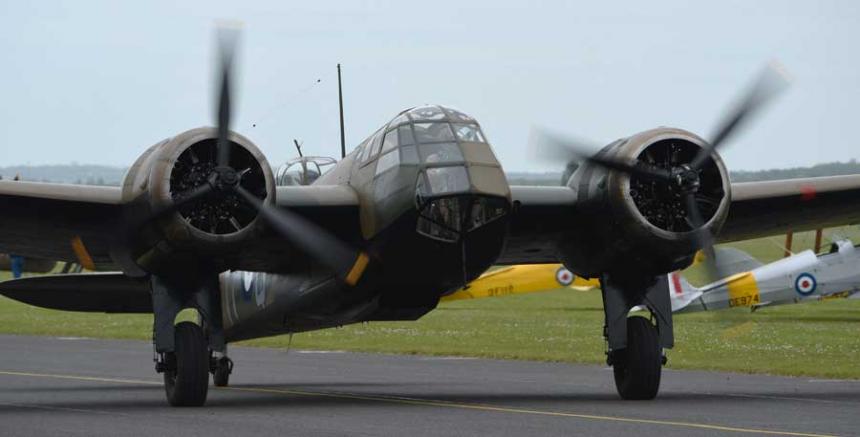
The recent VE Day Anniversary Airshow at Duxford airfield was significant on two counts - it was the first major airshow of the 2015 season and also marked the return to public displays of one of the world’s rarest historic aircraft. In the latest edition of Aerodrome, we are going to focus on this very special aeroplane and its triumphant return to the skies.
Aviation enthusiasts in the UK really must count themselves extremely fortunate. Over the years, the historic aviation scene in Britain has been the envy of the world and some of the most valuable aircraft in existence have been restored and displayed for our enjoyment. These magnificent aeroplanes can certainly not be taken for granted and for a number of specific reasons, you really do have to fill your senses with these aviation experiences at every available opportunity, before they are lost to us forever. This is the main reason why I was always going to be heading down to Duxford at some ungodly hour, to ensure that I was present when Bristol Blenheim G-BPIV made its long awaited return to the UK Airshow scene.
The Bristol Blenheim was an extremely important aircraft for Britain at the outbreak of WWII, but it was very much a victim of the huge technological advances in aviation design in the late 1930s. At the time the aircraft first flew it was faster than the current RAF fighters of the day, but by the time war broke out it had been seriously outclassed by the modern fighters in service with the feared Luftwaffe. Importantly, at the beginning of WWII, the RAF had more Blenheims than any other aircraft type in service and it would have to endure some difficult days, as Britain stood alone.
As we have already noted, when the Blenheim made its first flight in 1935, it was one of the most advanced aircraft in the world. Featuring such ground breaking technologies as all metal stressed skin construction, retractable undercarriage and flaps, a powered dorsal turret and variable pitch propellers, the Blenheim was at the forefront of aviation design. Interestingly, the aircraft was actually developed as a private venture, funded by Lord Rothermere, who was the owner of the Daily Mail newspaper. Frustrated at the numerous record-breaking aircraft being produced in Germany, he was determined to recapture the record for the fastest civilian aircraft in Europe and have Britain hold this title. He was successful in his desire and the aircraft, which he named ‘Britain First’ was a huge success, posting speeds well in excess of all current RAF fighter aircraft – he allowed the RAF to use the aircraft in flight trials, as they were interested in assessing how they could benefit from this new design. They were so impressed that the RAF immediately ordered a light-bomber version of the aircraft, straight off the drawing board.
The first Bristol Blenheim Mk.I light bombers entered service in March 1937, with RAF No.114 squadron, based at Wyton, in Cambridgeshire. At that time, they replaced the squadrons Hawker Hind bi-plane bombers and instantly gave the RAF a massive increase in capability – it was over 100 mph faster than the Hind and was actually the fastest light/medium bomber in the world. This was now the aircraft against all others would be judged, but this fact was to work against the Blenheim over the next few years, as every aircraft that would potentially be sent against it in combat, would have assessed its capabilities and ensured that they could overcome it. It was, however, the aircraft that was available to the Royal Air Force in most numbers, at the outset of WWII and therefore has a particularly significant historical importance.
The Bristol Blenheim was such an important aircraft in the history of the RAF in WWII that it only seems right that an example of the type should be available on the UK Airshow circuit. Driven by a committed group of enthusiasts, engineers and former aircrew, the project to return a Blenheim to the air has been something of an epic story in its own right, but thanks to the steadfast dedication of this determined group they have overcome setbacks and disappointments to ensure that an example of the famous Bristol Blenheim will continue to fly in the UK. Let us take a quick look at the colourful history of this unique project.
Even though there were some 4,400 Bristol Blenheims produced, very few airframes survive to this day. Many of the aircraft were simply destroyed in operation and as the aircraft was quite simply outclassed during the course of the conflict, ensuring that a number of airframes were preserved for posterity was not high on the priority list. In the early 1970s, a team of engineers and enthusiasts got together in the UK with the intention of returning a Blenheim to the sky. The more they looked into the possibility, the more difficult their project became. The search for a suitable base airframe led them to a scrap yard in Canada and an aircraft that was in little better than a derelict state – this was obviously going to be a long-term project. Having had the aircraft transported to the UK, the team got to work, the historic aviation world started to get excited and then everything went quiet – for many years!
After a monumental restoration project lasting almost twelve years, the Blenheim project team proudly unveiled their magnificent new aircraft to an excited historic aviation world – this truly was a magnificent achievement. The only flying Blenheim in the world, G-MKIV was actually based on a Canadian built Fairchild Bolingbroke, which was a licence built version of the Blenheim Mk.IV bomber, but to anyone who was lucky enough to see this unique aircraft, it was to all intents and purposes, a genuine RAF Blenheim, from the Second World War.
First flying in May 1987, this beautiful aircraft instantly became one of the most requested historic aircraft on the UK Airshow circuit and enthusiasts all over the country were hoping to catch a glimpse of this rare bird over the course of the display season. Unfortunately, tragedy was to strike the aircraft and just four short weeks after the first flight, it was involved in a crash landing incident which saw it sustain significant damage. Whilst performing at an Airshow at Denham airfield, the Blenheim attempted a touch and go manoeuvre for the gathered crowds but got into some difficulties when trying to power away from the runway. As the pilot increased the power, the engines were slow to respond and as it began to gain height, the left wing dipped and caught some trees on the airfield boundary, causing the aircraft to cartwheel across a nearby golf course. The damage sustained was significant – the fuselage broke in two, both engines were ripped from their mountings and both wings were severely damaged. More importantly, all three crew members aboard the aircraft were fortunate to survive this terrifying experience.
After just four glorious weeks, this was a spectacularly ignominious end to this high profile project. The aircraft was wrecked and all the work of the last twelve years was for nothing – or was it? The team were in no mood to accept defeat easily and they began to assess what was left of their aeroplane. It was severely damaged and although they would be able to use components, it was clear that they were going to need another airframe to base any new restoration on and yet another scrapped Canadian airframe would be required.
With the majority of the restoration team staying together for this new project, the team managed to utilise all the skills and knowledge they had gained throughout the duration of the original project and this second Blenheim was restored in super fast time - just five years after starting the project, Bristol Blenheim Mk.IV G-BPIV took to the skies. Britain had her Blenheim again and thankfully this time, she would manage to perform regularly at air displays all over the UK, for a good number of years. The world of historic aviation can be quite volatile and just as enthusiasts accepted that the Duxford Blenheim was going to be present at the majority of the Airshow events at this famous Cambridgeshire airfield, fate dictated that things were about to change once again.
Following a performance at an airshow on 19th August 2003, the Blenheim was returning to Duxford when it had an accident whilst on landing approach. As the aircraft was on landing finals, the undercarriage legs struck the bank of the M11 motorway, which tore one of the units clean away and pushed the other into the wing structure. The aircraft slid to a halt on the grass at Duxford, with both crew members thankfully walking away from the experience. Anyone who saw pictures of the incident would have said that the aircraft only suffered superficial damage, but a thorough examination revealed that things were much more significant than had first been thought – it was quite possible that the aircraft was damaged beyond repair. The team behind the magnificent Bristol Blenheim had been dealt yet another cruel blow and surely this would put an end to their dream of having an airworthy example of the Blenheim in Britain’s skies.

Historic aviation enthusiasts in the UK are definitely amongst the most fortunate in the world. We are lucky to have people involved in this industry, who simply do not know when to quit and the more difficult you make a situation for them, the more determined they are to succeed. The damage to G-BPIV was certainly significant, but it was not damaged beyond repair – this was all the encouragement that the Blenheim team needed. They were absolutely determined that their aircraft would take to the skies once more and they immediately began drawing up plans to achieve this.
To keep the project on a high profile, professional footing, Blenheim Duxford Limited was formed to oversee everything and they immediately engaged the services of well known Warbird engineers and restorers the Aircraft Restoration Company. Also based at Duxford, ARCo would lead the latest restoration and provide two full-time engineers to the project, to ensure that progress would be consistent and in the main, quite high profile. It was intended that much of the work would be completed in full view of the public and visitors to Duxford would be able to regularly chart the progress of this project, as she would be sited in one of the public hangars.
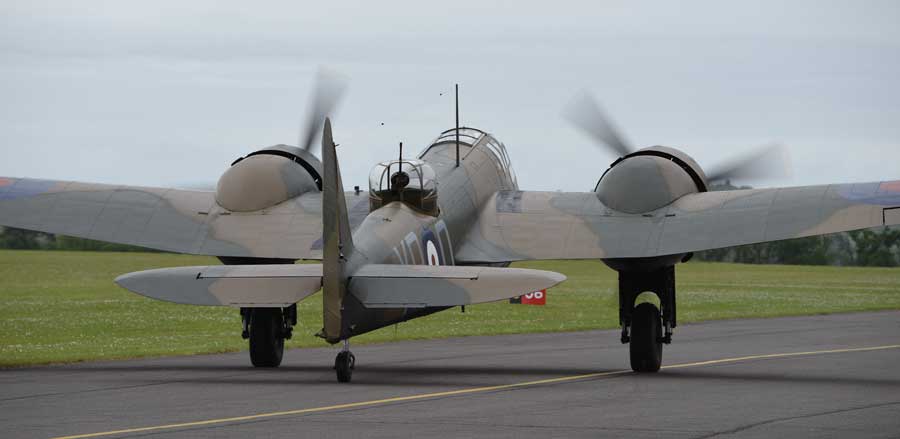
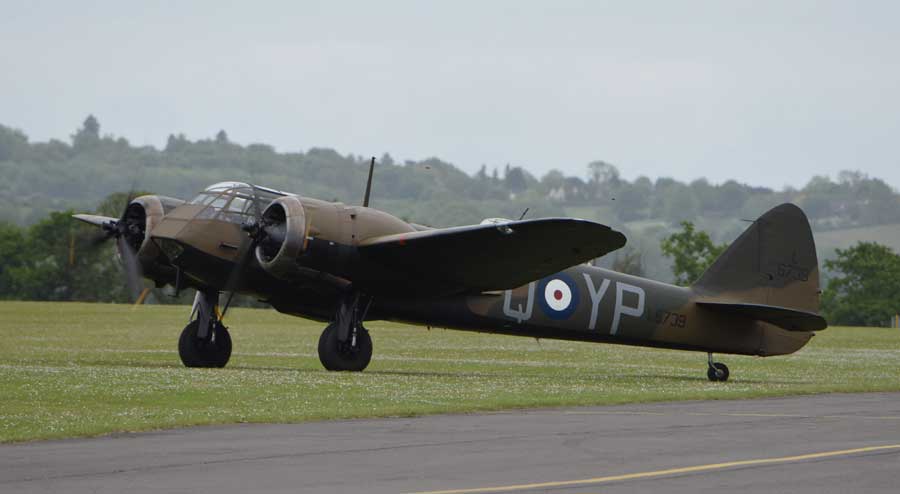
The latest Blenheim restoration project would be completed with an extremely interesting twist for the aviation enthusiast – whilst the previous two aircraft had been completed as long-nosed mark IV versions of the aircraft, the latest restoration would produce an aircraft as an early, short-nosed mark I version. This would make the aircraft look dramatically different to how it appeared previously and immediately gave this already interesting project an even more exciting edge for the enthusiast – this would be a very special aeroplane indeed.
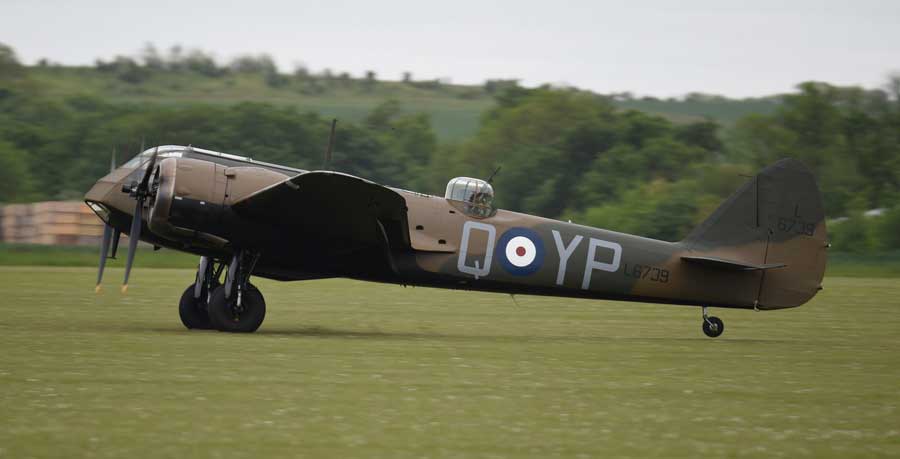
The early ‘short nose’ is a very interesting story in its own right and is definitely worthy of discussion. The nose section of Bristol Blenheim Mk.I L6739 ended up being stored at the Bristol works at Filton, where company employee Ralph Nelson bought it in 1946. He adapted the nose section and attached it to the chassis of an Austin 7 car and apparently drove it in this state on many occasions. It was later donated to the Imperial War Museum, Duxford and a number of photographs exist, which show it in this unusual bubble car state, with some showing it stored next to the wrecked Blenheim fuselage.
The engineers at ARCo removed the Blenheim nose from the car chassis and began a concerted restoration project, with the intention of using the fighter nose on the Blenheim restoration. The history of L6739 is that it was used on a Blenheim Mk.I night fighter, which saw action during the Battle of Britain, which immediately gave this already exciting project a new significance. UK aviation enthusiasts were enthralled with the Blenheim project and waited patiently for any information regarding a potential first flight of this magnificent aeroplane. In early 2014, tantalising glimpses of an almost complete aircraft began to emerge from the ARCo hangar and enthusiasts hoped that it might be able to perform at one of the Duxford organised Airshows, later in the year. Unfortunately, this was not to be and we were made to wait another year for this treat, although 2014 ended in triumph for the Blenheim team. On Thursday 20th November 2014, Bristol Blenheim Mk.I L6739 taxied out to the runway at Duxford and ran the engines at take off power – seconds later, this very rare aeroplane took to the skies once more and immediately became one of the most important airworthy historic aircraft in the world. Surely, 2015 and the 75th anniversary of the Battle of Britain, would be a significant year for the Blenheim team. Everyone would be wishing the aircraft and the team behind it, much better luck than they had experienced in the past.
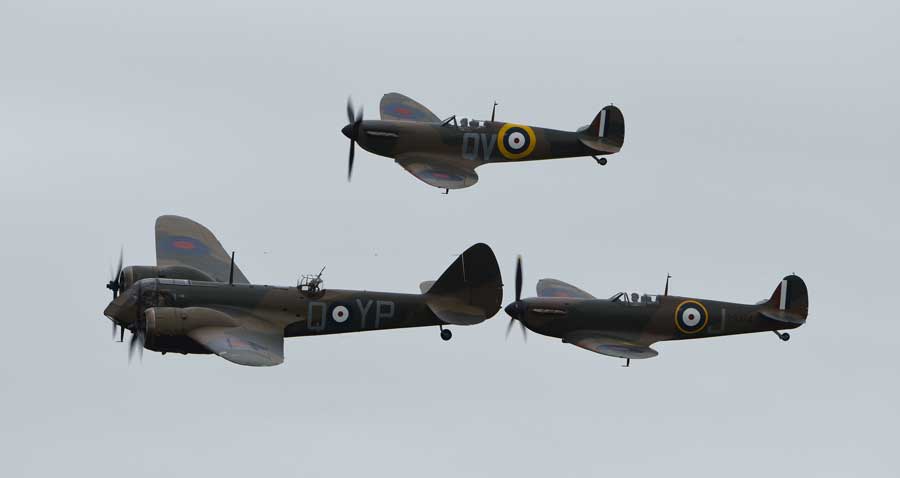
For many aviation enthusiasts, the recent VE Day Anniversary Airshow at Duxford was a must attend event for one specific reason - the first post restoration Airshow appearance of Bristol Blenheim Mk.I L6739. This much anticipated event was clearly one of the most significant developments in the world of historic aviation for a number of years and for many people, would be the first time that they will have ever seen a fighter version of the Blenheim. Add to this the tantalising prospect of seeing the aircraft flying whilst flanked by a pair of Spitfire Mk.I’s and you have a spectacle that was simply too irresistible to miss.
Like many other enthusiasts, I made the early morning pilgrimage to Cambridgeshire, to take my place on the crowd line, hoping that I would be lucky enough to see the Blenheim fly. As you can see from the pictures attached to this article, we were extremely lucky and were rewarded with this unique aviation sight – even the grey skies could not take the gloss off what was a fantastic occasion. I expect the Blenheim to be one of the display highlights of 2015 and if you have the opportunity to see it, please do so, as you will definitely not be disappointed.
Corgi Aviation Archive releases have been a little thin on the ground over the past few months, so news of a new Bristol Blenheim release has obviously been very well received by die-cast collectors. This is the seventh release in this highly successful series, with all previous models having long since sold out – this latest model looks highly likely to follow that same pattern of success, in just a few short weeks.

AA38407 is a Bristol Blenheim Mk.IV bomber (V6028), in the colours of RAF No.105 Squadron, which took part in one of the most daring low-level bombing raids of WWII. Piloted by Wing Commander Hughie Edwards, this aircraft led a raid against industrial targets in Bremen, which was codenamed ‘Operation Wreckage’, requiring the aircraft to fly at extremely low level. Fifteen Blenheims took off on the raid, with three having to turn back shortly after take off, leaving the remaining aircraft to complete the mission against this extremely heavily defended target. Flying at heights below 50 feet at times, the aircraft were peppered with anti aircraft fire and were forced to dodge such hazards as barrage balloons, power lines and telegraph wires, on the way to effectively bombing the target.
Once Edwards had made his attack run, he circled the area, trying to assess the effectiveness of the attack and drawing defensive fire away from the remaining attacking force. Once all the aircraft had made their attacks, it was every man for himself and each aircraft attempted to negotiate their own way back to base. Unfortunately, although the bombers successfully attacked the target, four of the Blenheims were sadly lost over the area, each succumbing to the murderous defensive fire put up by the defenders.
The last aircraft to land back at RAF Swanton Morley was the Blenheim flown by Wg. Cdr. Edwards. Once the aircraft came to rest, the dorsal gunner had to be cut from the turret and rushed to hospital. The aircraft had much of the port wing-tip missing, had no port aileron, had telegraph wires hanging from the tail wheel and there were more than twenty separate shell holes in the underside of the Blenheim. Many of the airmen taking part in the raid were given bravery awards, but for his extreme display of gallantry and determination, in the face of withering enemy fire, Wing Commander Hughie Idwal Edwards was awarded the Victoria Cross.
Following his retirement from the Royal Air Force in 1963, Edwards returned to his native Australia, where he continued to receive the admiration of his nation. He was to become Australia’s most decorated airman.
This Limited Edition release of just 1000 certificated models is in the shops now, but selling out fast. It has been receiving some extremely positive comments from die-cast aviation collectors who have already received their example and as you can see from this actual product image, which was taken on my own diorama, it is a little cracker. If you are struggling to get hold of the latest Blenheim, you can click here and secure your example, before they disappear once and for all.
I hope that you have enjoyed our look at the beautiful new Duxford based Blenheim Mk.I this week. Don’t forget that the New Corgi Catalogue has gone live this week and there are some fantastic new models for you to inspect. Please click here to be taken straight to the new models, all of which can be pre-ordered now.
Thank you for reading the latest Corgi Aerodrome. If you have any comments, questions or suggestions for future editions, please feel free to let us know on the Aerodrome Forum, or on Corgi Twitter feed using #corgiaerodrome.
Michael

