
Welcome to this latest edition of Aerodrome and our regular look at the fascinating world of aeroplanes and the historic aviation scene around the UK.
As you will be expecting, this latest edition will see us paying our second review visit to this summer’s Sywell Airshow weekend, where this time, we will be getting ourselves airborne. Our previous review looked at both the history of the airfield at Sywell and how this latest event to be held there was an exciting development for both British Airshows and the nation’s aviation enthusiast community. We also took that opportunity to review the show’s static aircraft display and how this was both extensive and innovative.
For this second visit, our attentions will be directed very much towards the flying display element of the show, as we not only review the display, but focus our attentions on several of the more unusual aircraft which took part over show weekend. As always, we’ll be bringing you a large selection of images taken during the weekend of the show, as we attempt to provide an overview of what turned out to be an incredibly successful event, one which many in attendance would surely consider to be arguably the most enjoyable of the year.
It's destination Sywell once again in this latest edition of Aerodrome, as we review the flying element of this year’s hugely successful Airshow.
Since posting our previous review, we received the terrible news that Richard Grace, the driving force behind this magnificent event, tragically lost his battle against serious illness. Although this will come as a real shock to those in the UK aviation enthusiast community, it’s difficult to imagine just how devastating this must be for Richard’s family, friends and work colleagues, and on behalf of every Aerodrome reader, could I please extend our most sincere condolences to all of those people.
I never had the good fortune to meet Richard in person, but was aware of his dive, passion and talent for aviation over several years. I think the first time I saw him fly was when the commentator at a Duxford show prepared the crowd for his arrival in the potent and recently refurbished and repainted Hawker Fury (FB.11), by explaining how Richard was a young pilot making his debut on the Warbird flying scene. Like many hearing this introduction, I was expecting a sedate and rather tentative first display appearance by Richard, however, he had other ideas. He blasted into the display circuit in this beast of an aeroplane, announcing his arrival in style. This was not the debut of a pilot feeling his way into displaying Warbird aircraft, but an extremely gifted airman who knew this is where he belonged.
Since then, Richard became a leading exponent of the UK Warbird scene, with the aircraft he was associated with being some of the most exciting and best loved display acts on the display circuit. You will also find on many an aviation related YouTube video, where his passion for aviation is clearly evident and his knowledge and enthusiasm for historic aeroplanes is both engaging and infectious. I also remember the podcast I listed to at the beginning of this year, where Richard shared his plans for the upcoming show at Sywell and had me captivated for the entire edition, with an hour passing in what seemed like five minutes to me. If we had any reservations about attending back then, I’m sure many listeners would have been straight onto the Sywell site to secure our tickets after listening to Richard that day.
Richard Grace was passionate about Warbirds and historic aviation. He was not only a talented pilot, but also an exceptional engineer, with his drive and enthusiasm for the subject ultimately allowed hundreds of thousands of people to enjoy the incredible aircraft he had associations with.
In situations such as these, words seem totally inadequate, particularly for those of us not fortunate enough to have known Richard personally, however, I would simply like to say “Thank you” to him for everything he did, and for allowing us to be a small part of his world.
The Flying Bulls B-25 Mitchell was performing an airfield familiarisation flight when we arrived in the area.
One thing I forgot to mention in our previous review was how my travelling companions and I arrived in Northamptonshire during the afternoon of the Friday before the show and despite the fact that Friday was not a public day, we decided to embark on something of a reconnaissance mission for the coming weekend. As I had not previously attended an Airshow event at Sywell, I was completely out of my depth when it came to suggesting a suitable vantage point from where to view whatever aircraft were arriving or completing display validations on the day. This resulted in us driving down endless country lanes, as the hedgerows were masking the airfield and only managing to get a reasonable fix thanks to the Flying Bulls B-25J Mitchell, which appeared to be completing an airfield familiarisation flight.
With the B-25 in the overhead, we parked in a layby and quickly grabbed the cameras. Although the airfield was still out of sight and most of the aircraft we saw over the next 45 minutes or so were actually quite far away, we did get quite lucky with both the Flying Bulls B-25 and the French F4U-5N Corsair, both of which overflew our position, offering some interesting photographic angles we thought you might like to see.
A bent-winged bird from an unusual angle. The French based F4U-5N Corsair is a real muscle plane and was one enthusiasts were really looking forward to seeing at Sywell.
After the usual early start on Saturday morning, I took up my position on the crowd-line at Sywell and prepared for a busy day of Airshow action. Having not been to a show here previously, I didn’t have a preferred position from which to photograph the show, so looking at the layout, taking the wind direction into consideration and hoping that many of the Warbirds would be operating from the grass runway, I opted for a position towards the eastern end of the runway. Whilst this did prove to be a great spot, with excellent views as the aircraft taxied past us, the vast majority of the aircraft used the hard runway during the show, which was just too far away for photography, so it wasn’t exactly as I’d hoped. As it was, on Sunday, I elected to go to the opposite end of the airfield, which I have to say I did enjoy more, feeling even closer to all the action than the previous day.
As the first aircraft fired up their engines and made for the hard runway, the start of the show offered something really special for those in attendance, not only the sight of a beautifully presented pair of WWII era single engined fighter aircraft, but also an example of an aircraft which could be described as their contemporary. For one day only, the organisers had pulled off something of a coup and arranged for a USAF F-35A Lightning II to grace the skies above Sywell, both for a series of flypasts in formation with the Thunderbolt and Mustang, but also performing its own dynamic demonstration, just to make sure we were all paying attention.
US Air Force heritage spanning 80 years. Classic P-47 Thunderbolt and P-51 Mustang were joined by a cutting-edge Lockheed Martin F-35A Lightning II from RAF Lakenheath.
‘What the heck was that!’ A crow photobombed by an F-35A at speed.
The aircraft made a spirited departure at the end of its solo tribute pass.
‘Sally B’ is heading for a rather important anniversary year in 2025.
The aircraft was one of the machines operated by the 495th FS ‘Valkyries’ at Lakenheath, a unit which holds the distinction of being the first overseas USAF squadron to operate the F-35A. Very different to the aircraft purchased by Britain, the F-35A is the major operational variant of the aircraft and the one always intended for use by the US Air Force. This variant operates from conventional runways and will be by far and away the most numerous variant of this extremely capable aircraft. Already securing sizeable export orders, it could be argued that this is the variant which is most closely aligned to being considered the F-16 Fighting Falcon replacement.
As we were all marvelling at this opening act spectacle, several other aircraft were preparing to join the aviation party, as the show started with a definite Warbird theme. As we saw in the previous edition, Britain’s beloved Boeing B-17G Flying Fortress ‘Sally B’ has a big year ahead of her next year, as it will not only be her 80th birthday, but she will also be marking 50 years since her arrival here in the UK, both occasions the UK Airshow going public will be wanting to celebrate with her. As always, she proved to be a star on the ground and in the air at Sywell Airshow, where her very presence serves to commemorate the significant contribution made by USAAF aircrews flying from bases in Britain made during the Second World War.
With aircraft activity both on the ground and in the air, Sywell Airshow 2024 was well and truly underway!
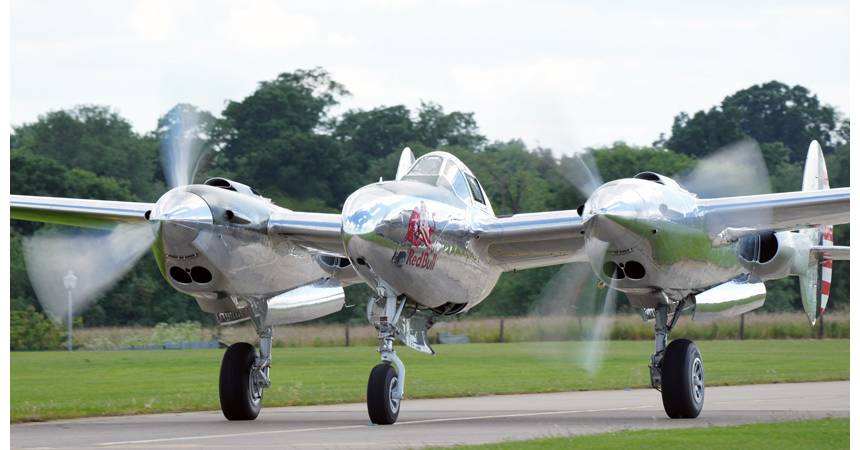
The Flying Bull’s Lockheed P-38 Lightning is the only airworthy example of this twin boom fighter in Europe.
One of the undoubted highlight acts of the show and a collection of aircraft which rarely perform at UK events these days, the Austrian based Flying Bulls are the glamour act of the historic aviation world and can always rely on plenty of attention wherever they attend and for good reason. Operating a fleet of aircraft which includes a selection of classic WWII era Warbird types, the team are famous for presenting several of their aircraft in gleaming, highly polished natural metal finishes, ensuring these aircraft are always the centre of attention.
The largest aircraft the team brought over from Salzburg was their North American B-25 Mitchell, an example of one of the most capable medium bombers of the Second World War and an aircraft made famous by its incredible use during the Doolittle Raid against Tokyo, at the start of America’s involvement in WWII. To say this aircraft is well turned out would probably be the understatement of the year, as you really could eat your dinner off this immaculate machine, although why you would want to abuse this beauty with such a heinous act is beyond me.
Polished to within an inch of her life, this aircraft wasn’t always the recipient of such attention, being originally constructed in 1945 for the USAAF, but too late to see service during the Second World War. She would go on to serve with Air Transport Command, undergo significant modification for service as an airborne electronics testing aircraft, before being retired in 1957. She would later be converted to become a fire bomber, before many years later, coming into the hands of The Flying Bulls.
Although her presentation may not be to everyone’s liking, there is no doubting her stunning good looks, with her polished finish allowing her to slip through the air at a fair rate of knots – this bomber really is a spritely performer.
This magnificent collection of WWII era USAAF aircraft was one of the undoubted highlights of the Sywell show.
The most captivating of the Flying Bulls aircraft to make the trip over from Austria, their stunning Lockheed P-38 Lightning is an aircraft type which offered wartime pilots the reassurance of a fighter with two engines, without compromising on performance. One of the more interesting aircraft types of the Second World War, the P-38 Lightning is now an extremely rare bird in this part of the world and as a consequence, is the Flying Bulls superstar aircraft. Another of their highly polished beauties, this is the only airworthy example of this famous aircraft type in Europe and can actually boast quite the colourful history.
Built by Lockheed in 1944, she was taken on strength by the USAAF the following year, where she was converted to a Photo Reconnaissance variant. She was sold into the civilian market in 1946, where she would embark on a lengthy career on the vibrant US air racing circuit, first wearing the name ‘Sky Ranger’ and later ‘White Lightnin’, until being involved in a landing accident in 2001.
Immediately undergoing restoration to flying condition once more, the aircraft was offered for sale during the restoration process and was purchased by Flying Bulls in 2004. The restoration was completed in America, with its first post restoration flight taking place in Texas in June 2008. The aircraft was subsequently transported to Europe by ship, where she took her place as the most distinctive of the Flying Bulls fleet, and arguably the most exciting.
With her highly polished propeller blades turning and glinting in the sun, is there a more attractive sight in the historic aviation world? She really is a stunner.
After the B-25 had shown just how agile a performer this medium bomber was, it was the turn of the fighters to captivate the Sywell audience.
The third of the polished Warbirds in this gathering of Flying Bulls was a North American P-51D Mustang named ‘Nooky Booky IV’, an aircraft which will be rather familiar to enthusiasts who have attended Airshows in France in the not to distant past. Previously owned by the Salis Foundation, this aircraft was operated successfully in France for many years wearing this scheme (or one very close to it), but would become the latest Warbird acquisition of The Flying Bulls in 2021, when she made the ferry flight from Paris to Salzburg. She now takes her place within this impressive organisation and can be seen flying in formation with other classic US aircraft types at Airshows right across Europe.
The only aircraft of this magnificent quartet resident at Sywell for the weekend not wearing a highly polished natural metal finish, their Vought F4U-4 Corsair is a real muscle aeroplane and one which has the distinction of being the founder aircraft of this impressive collection. Delivered to the US Navy too late to see action during the Second World War, the aircraft would go on to see extensive service with the Honduran Air Force, before returning to the US and their civilian aviation scene.
Another former US fighter aircraft which flew as part of the popular US air racing circuit, this Corsair was finally acquired by talented warbird pilot Sigi Angerer, who flew the aircraft successfully on the European Airshow scene during the 1990s, and where one of his displays was admired by the owner of the Red Bull drinks business. As the Corsair taxied back after its display and folded up its wings, the Red Bull boss made the association with his product’s catchphrase and the rest, as they say, is history.
Discussions were had and the result is what we see today as The Flying Bulls.
Such beautiful aeroplanes, The Flying Bulls are a class act, and a welcome addition to any Airshow display programme.
As these aircraft started their engines and made their way to the runway prior to their display slot, the crowd line arrangement at Sywell meant that the pilots could take the adoration of the crowd even before they had displayed, and were probably left in no doubt just how much we were all looking forward to the next few minutes.
The mighty B-25 Mitchell blasted down the runway first, with the fighters following in quick succession and once they were all airborne, the fighters all rushed to formate on the Mitchell, as if she was a mighty metal hen gathering her chicks in for safe keeping. Once all together, the aircraft returned to the airfield to perform a series of impressive formation passes, before the B-25 broke away to give her rather spritely solo display, prior to leaving the skies above the airfield clear for something truly spectacular.
An aviation spectacle rarely seen here in the UK, this trio of WWII American fighters performed an impeccably choreographed routine of close formation aerobatics that was simply breathtaking and at times, it appeared as if all three aircraft were connected together by invisible wire, so precise was this flying. With the Lightning taking the lead and with smoke streaming from its engines, the trio performed graceful aerobatics and sweeping passes, before breaking off into a dynamic tail chase – all really rather spectacular.
This exceptional performance was one of the undoubted highlights of the 2024 Airshow season for many and a spectacle well worth the entrance fee alone. Is it any wonder we love aeroplanes when you can experience sights such as this!
The largest aircraft on the display program at Sywell this year was this Oil Spill Response Boeing 727, a former air freight carrier turned environmental support aircraft.
Although the life blood of any successful Airshow event is the enthusiast community, if a show is to prove commercially successful for its organisers, it has to also attract casual and family patronage, those people who just enjoy an interesting and exciting day out. For those people, it most definitely isn’t all about Warbirds and something a little out of the ordinary is required. For those people, Sywell had us covered, both on the ground and in the air, with a varied flying display schedule backed up with ground displays which included the opportunity to get close to most of the aeroplanes taking part, to a collection of classic Formula 1 cars.
As far as interesting aircraft taking part in the display are concerned, by far the largest and most unusual machine flying at the show was one which was only confirmed in the days leading up to the event, and whilst it is now a specialist aircraft, is still every inch the classic airliner. Also qualifying as one of the most distinctive aircraft at the show, the 2Excel Aviation Group sent their impressive Boeing 727-200 jet, one which has been specially modified to deliver dispersant chemicals in the event of ocean oil spills.
Having initially conducted viability studies into the suitability of different aircraft for this role, the 727 was highlighted as their aircraft of choice due to a number of factors, which included range, load carrying capability, payload and transit speed. The general configuration of the aircraft also lent itself to the proposed change of use and as a result, two former FedEx 727-200 freighters were secured, with one being fitted with the TERSUS Dispersant Delivery System, which at the time, was the first time a pure jet aircraft had been used for such a purpose.
Flying in from its new home at London Southend Airport, as the aircraft’s arrival was expected and the crowd scoured the skies of their first glimpse of it, suitably sinister music was played over the PA speakers, which really did add to the drama of the moment. When the aircraft finally came into view, appearing from over the trees at the airfield boundary like some flying leviathan, it really was an impressive sight, with this graceful beast serving up several flypasts, before heading off back to its home airfield. Overflying the replica Great War fighters due to take their place in the flying display a little later, could the different eras of flight have been more starkly illustrated than this?
The red and white Boeing 727 was so big and so distinctive, that we could all see it for many minutes as it gracefully headed back to Southend in the clear blue Northamptonshire skies.
One of the real joys of attending a good Airshow is how you also have access to some of the personalities involved in the show itself, be they pilots, organisers or re-enactors, many of whom are more than happy to stop and chat with you for a while. Having spoken to them on the ground, you have even more admiration for them when you see them in control of a classic aircraft in the sky and how these pleasant and often unassuming people really are a cut above.
Husband and wife team Danielle and Emiliano Del Buono taxi out for their display – Danielle wouldn’t be staying in the cockpit for long!
That is, of course unless you had the chance to speak with a certain lady at this year’s show, who in my opinion is an absolute nutter, and has a habit of climbing out of a perfectly good aeroplane and standing on its wing! Daniel Del Buono is an incredibly talented and extremely brave wing walker and for the past eight years, has been flying a dynamic display routine with her husband pilot as 46 Aviation Classics, however, her wing walking days began in 2007 and at an aerodrome in Gloucestershire.
Joining the UK based AeroSuperBatics team when she was just 18 years old, Danielle has many UK Airshow appearances to her name, performing on Boeing Stearman biplanes presented wearing various sponsors liveries, such as Utterly Butterly and Guinot, but always under the banner of the AeroSuperBatics operation.
Whilst performing a display in Switzerland, she met the chap who is now her husband and pilot of the display aircraft she now performs on, and the pair have become regulars across the European Airshow circuit, but were making their UK debut at this year’s Sywell show.
Once the pair have taxied along the crowd line and introduced themselves and their beautifully presented, modified Boeing Stearman to their adoring public, they get into the air, which is where the fun begins. Once checks have been completed, Danielle climbs out of the forward cockpit and onto the top wing of the Stearman, where she remains whilst her husband goes through a dramatic routine of aerobatics, many of which are performed upside down. Not content with this, once the aircraft begins flying in a slightly less enthusiastic manner, she climbs down from the top wing and makes her way along to the outer edge of the Stearman’s lower port wing.
Although this appeared dangerous enough to the crowd, Danielle wasn’t finished and had something even more breathtaking up her sleeve.
After standing on the wing to wave enthusiastically at the crowd, this only serves as a precursor to her next incredible feat of courage and agility. Moving right out to the wing bracing struts, she hangs down from the wing by her legs, with her arms waving in the same enthusiastic manner, as her body is battered by the slipstream – all in a day’s work for Danielle. Now all she has to do is make her way back to the front cockpit prior to landing, before the pair take the applause of the crowd and can chalk up another successful display completed.
This really was a death-defying display of agility and flying excellence and despite the fact that Danielle has many years of wing walking experience to call upon, you have to wonder if she’s a confirmed thrill seeker, or just a bit mad! What she does would petrify the rest of us, and she does it for fun. The commentator even said that the couple’s children were in the audience watching the display, which scared me even more, but something tells me they’re probably used to seeing mum and dad in the air by now, and may even have ideas of becoming future wing walkers themselves.
A truly fantastic display, the 46 Aviation Classics were a huge hit at this year’s Sywell show and had everyone on their feet clapping once they landed back at the airfield.
The mighty P-47 'Jug' prepares for its display slot at Sywell.
Although Airshows have been held at Sywell previously, they haven’t been for many years now and never organised by the team led by Richard Grace. This must have involved many months of hard work and planning, and I’m sure that as the last visitors made their way off site on the Sunday evening, everyone behind the event would have been delighted with how everything went, but totally exhausted.
From an attendee’s perspective, the show was excellent, not a copy of other shows which had proved popular across the industry in years past, but one which had its own identity from the moment you set foot on the airfield. Those of us who kept an eye on the shows excellent social media updates and listened to Richard’s podcasts where his enthusiasm for the event proved incredibly infectious were glad that we secured our tickets early and were able to experience show weekend. For those who sat on the fence a little too long, you missed a cracker, where even the weather performed as planned.
We all hope that the Sywell Airshow will take a regular spot within the UK Airshow calendar, although after the tragic news shared just last month, many would understand if that proved not to be the case this coming year. As for this year’s show, all we can do is say, ‘Thank you Richard, you served up a real aviation treat’.
Here is a final selection of Sywell 2024 images
The famous ‘Grace Spitfire’ was wearing new artwork and D-Day identification markings at this year’s show.
She also took part in the Spitfire formation flypast.
Adding to the art deco atmosphere at Sywell, this Lockheed Electra Junior proved to be a graceful performer.
Arguably the greatest fighter aircraft of the Great War, this beautiful replica Fokker D.VII provided the early aviation era entertainment over show weekend.
Representing the 'Baddies', this was one of two Hispano HA-1112 Buchons chasing Spitfires and Mustangs at Sywell 2024.
Celebrating their 60th display season, the Red Arrows closed the show on Sunday at Sywell.
I’m afraid that’s all we have for you this time, but we will be back again in four weeks’ time with more news and pictures from the world of aviation. Thank you for your continued support and as always, if you would like to comment on anything blog related or suggest a subject you would like to see covered in a future edition of Aerodrome, please do drop us a line at aerodrome@airfix.com, where we would be delighted to hear from you.
Should you wish to continue the aviation discussions between editions, you will always find something of interest over on the Airfix Aerodrome Forum and if social media is more your thing, please use the respective official social media icon links at the foot of the main Airfix and Corgi website homepages to access our official sites.
The next edition of Aerodrome is scheduled to be published on Friday 6th December, when we will be bringing you more news from the world of aeroplanes and aviation.
I hope to see you all back here then.
Michael

