


Welcome to this latest edition of Aerodrome and our regular look at the fascinating world of aeroplanes and the historic aviation scene in the UK.
This latest edition of Aerodrome marks the end of another unusual year for aviation enthusiasts and a second where many Airshow events fell victim to the continuing nationwide struggle against the Covid virus. That being said, both enthusiasts and event organisers have risen to the restriction challenge as we knew they would and even though the majority of the larger, traditional Airshow events were still proving to be a little thinner on the ground than usual for this second consecutive year, it has still been possible to find an interesting and enjoyable event to attend if you just look hard enough. As our Christmas blog treat for 2021, this festive edition of Aerodrome will be reporting from one such event, one held towards the end of last month and one which offered the opportunity to spend a little time at RAF Museum Hendon after dark. This specially arranged photographic event promised the aircraft of the Great War as its subject matter and for one night only, one of the star aviation attractions on display inside Hendon’s historic Hangar 2 was to be wheeled outside, to the delight of the gathered photographers.
Before we get started, as this is the final Aerodrome blog of 2021, could I please just take this opportunity to wish each and every one of our readers a safe, happy and peaceful Christmas and New Year holiday period and to thank you once again for the unbelievably loyal support you continued to give Aerodrome over the past twelve months. Many of the blogs published on the Corgi and Airfix websites have been going through a period of transition during the past year and whilst they have increased publication frequency, Aerodrome had initially had to step back to a four weekly publication schedule. It would be interesting to gauge reader opinion on this matter, whether you think once every four weeks is fine, or if you would like slightly more frequent blogs in future. If you do have a spare moment over the next couple of weeks, please do let us have your thoughts, dropping us a quick line at our usual aerodrome@airfix.com address.
A beautiful aeroplane in front of a historic hangar at night - what is there not to like?
I don’t know if it is just because I’m getting a little older (and probably a bit more miserable), but the past couple of years of not being able to attend Airshows in anything like the numbers I was used to doing has made me look elsewhere to obtain my little aviation photography fixes and I have to say, I am actually really enjoying it. Whether that be a day spend around the perimeter of an RAF airfield, just me, my camera and the thrill of taking what the aviation gods serve up, or joining an organised, slightly more intimate photographic event where just one or two aircraft are on offer, the more relaxed pace of such occasions has proved to be really enjoyable. Goodness knows how I’m going to cope with the hustle and bustle of next year’s Royal International Air Tattoo after spending a relatively anti-social couple of years with my camera - the thought of all those people!
With the smaller, slightly more intimate aviation events appealing to me all the more over recent months, I am always on the lookout for anything which may offer that little something different from a photography perspective, so when I saw that Threshold Aero were running an after-hours nightshoot event at the RAF Museum Hendon, it immediately captured my attention. On further inspection, the prospect of seeing the Museum’s beautiful Albatros D.Va displayed without barriers outside the famous Grahame-White Factory Hangar and illuminated by LED lighting immediately had me clicking on the buy button and entering my payment details - how could I possibly miss this opportunity?
The aerodrome at Hendon has clear historical significance for the Royal Air Force, but can actually trace its origins to the days prior to the formation of the force. A local company built an aeroplane on the site as far back as 1909, building a new flight shed to house their primitive design and the following year, the land surrounding the building was also acquired, as interest in aviation was really beginning to gain traction, with the site earmarked for anticipated future development. In 1911, Claude Grahame-White, a true British aviation pioneer, bought the site and almost immediately began promoting it as London’s aerodrome. From this point on, Hendon became a pivotal site in the history of British aviation, introducing the public to the thrill of flying and providing a spiritual home for the Royal Air Force.
The Hendon site went on to post a number of significant aviation ‘firsts’, but perhaps none quite as noteworthy as the first ‘Aerial Derby’ event held in 1912. On this day, aircraft took off from Hendon to fly a course around London, returning to Hendon and the adulation of a sizeable crowd, estimated to be in the region of half a million people. What makes this even more amazing is that it was reported at the time that three million Londoners formed a human circuit around the course for the airmen to follow, but perhaps of even greater significance than this, the vast majority of that crowd were seeing aircraft in the sky for the very first time - Hendon was quite literally putting aviation on the map.
Becoming an aviation phenomenon in its own right, Airshows and pageants would go on to become an annual feature of Hendon’s calendar and would regularly attract huge crowds eager to experience this aviation spectacle. In fact, these events became so popular that they rivalled the nations major sporting events for popularity, with visitor numbers and the resultant congestion causing a real problem for city officials, unless they had their own aeroplane, of course. With aircraft construction and pilot training all now gathering momentum at Hendon, the start of the First World War would only increase activity at the airfield, as an aircraft acceptance park for locally built machines destined for military service was established on the site. It would also be used to train military pilots, with some of the most famous British RFC and RNAS ace pilots gaining their early military flying experience at this important site.
First Albatros shot of the night, before the LED lighting had been positioned.
There is actually quite a lot of light pollution about at Hendon, so you have to look for the right composition to ensure you come away with something pleasing.
Following the end of WWI, military flying activity at Hendon declined dramatically, although the airfield’s proximity to the nation’s capital saw it hosting flights for dignitaries and military officials attending engagements on the continent. This lack of flying activity did not encourage the RAF to return Hendon to the care of its former owners, who at that time were still manufacturing aircraft at the site, but later diversifying into motor car production. In 1920, the RAF Pageant was held at Hendon for the first time and by 1927, the Royal Air Force had been granted official control of Hendon aerodrome. After agreeing suitable compensation with its previous owner, the airfield was handed over to the Royal Air Force in 1925, becoming RAF Hendon and home to the Volunteer Auxiliary Air Force.
Even though display events and general flying activity continued at the airfield, though admittedly sporadically, after the end of the Second World War, the RAF were beginning to discuss the possibility of creating something to preserve the legacy of both the site and the service as a whole. With the 50th Anniversary of the formation of the RAF due to take place in 1968, officials began acquiring suitable exhibits for future public display, slowly moving them to space allocated to them at Hendon. In 1968, a museum founders day was held at the site, where a fund raising initiative was announced to enable the establishment of a permanent Royal Air Force Museum at Hendon and on 15th November 1972, the new RAF Museum was finally opened by Her Majesty the Queen, in a blaze of publicity.
Further Hendon expansion was unveiled in 1978, with the opening of the Battle of Britain Hall and later still, the creation of the Bomber Command Hall, both housing major new exhibitions at this hugely historic site. The RAF Museum is now a major national attraction and destination place of interest, the spiritual home of the Royal Air Force and home to a world class collection of aircraft and aviation artefacts.
The Grahame-White display inside Hangar 2 is magnificent and a real haven for Great War aviation types. This image was taken the morning after the nightshoot, with the Albatros back in its hangar display position.
The original Grahame-White Company Limited factory hangar (which is now Hangar 2 at the RAF Museum) was built between 1915 and 1918, marking this as a building of huge national importance, from an aviation perspective. This historic building was carefully dismantled from its original location near to Aerodrome Road and re-erected on the same orientation within the new RAF Museum site in 2003, specifically as the land on which was originally situated had been allocated for housing development. The distinctive Grahame-White ‘Watch Office’ and factory office block were also built originally at the same time as the factory and were again dismantled and re-erected in the same section of the RAF Museum, but some eight years after the initial re-location project. A truly striking building, it is fascinating to inspect the huge wall pictures on display in the Watch Office, which show it in all its glory on the original Hendon aerodrome site during the early years of British aviation.
As part of this ambitious 2011 re-location project, the work also included producing an exact re-creation of Claude Grahame-White’s first floor offices and although it now looks out onto the RAF Museum and not the pioneering facilities he would have gazed upon in the years prior to the Great War, this is a truly atmospheric experience and one which is a fascinating link back to the early years of British aviation. This building and the magnificent exhibits it protects is without doubt one of the most treasured highlights of the museum and is rightly positioned at the front of the Hendon site, the first outbuilding complex you come across when leaving the entrance display hangar.
As Europe erupted into conflict during the summer of 1914, the use of aeroplanes as a military asset was still very much in its infancy. It is sobering to realise that as the opposing forces established their respective trench fortifications, it was less than twelve years since the Wright Brothers had made their historic flights from Kill Devil Hills in North Carolina. As accurate mapping of enemy positions was absolutely crucial to military planning, the chance to secure a bird’s-eye view of the combat area became of paramount importance, with static balloon squadrons stationed close to the front lines initially providing this service. Before long, denying your enemy this visual ability became of equal importance, but as balloons were notoriously immobile, it didn’t take long before primitive aeroplane designs began to be used for both reconnaissance and reconnaissance denial operations.
As entrenched armies on the ground fought a bloody war of attrition, a new type of warfare was starting to unfold in the skies above them, a struggle for aerial supremacy and control of the air. Initially, crews engaged in obtaining reconnaissance imagery would take pot shots at any enemy aircraft they encountered using rifles they had taken into the air with them, but this rather personal form of combat was about to get serious. Incorporating all the latest aviation technologies available at the time, Dutch aircraft designer Anthony Fokker was instrumental in developing the first dedicated fighter aircraft in history, the Fokker Eindecker. The aircraft incorporated either one or two forward firing machine guns, utilising a new interrupter gear synchronisation mechanism, which allowed the guns to fire through the arc of the aircraft’s propeller without hitting it and crucially, following the pilot’s direct line of sight.
Referred to colloquially as Germany’s ‘flying gun’, the Fokker Eindecker was to earn a fearsome reputation in the skies above the trenches, claiming the lives of many brave Allied pilots during 1916. Providing Luftstreitfrafte pilots with a huge tactical advantage, their introduction led to a dramatic period of air superiority for the Germans over the Western Front, a period which Allied pilots referred to as ‘The Fokker Scourge’ and caused them to be so dismissive of the capabilities of their own aircraft that they described them as being nothing more than Fokker fodder! Thankfully, the Allies were working on their own new aircraft designs which would put an end to the Eindecker’s dominance.
By day and by night, this beautiful WWI Albatros is a real highlight of any trip to Hendon.
During a period when new aircraft types on both sides started to appear over the Western Front with increasing regularity, arguably the most important series of German fighting scouts of the entire war were those produced by Albatros Flugzeugwerke, aircraft which saw almost constant use between 1916 and 1918. They were also flown by many of the great German aces to score multiple aerial victories during this time. In August 1916, the new Albatros D.1 fighter began to arrive on the Western Front and proved to be an instant success. With a powerful 160hp Mercedes engine and twin 7.92mm Spandau machine-guns, the Albatros had an exceptional climb rate and could cruise at high speeds. Over the next two years, Albatros Flugzeugwerke continuously developed the aircraft, culminating in the introduction of the excellent D.Va version of the original design, an aircraft which proved to be the workhorse of the Luftstreitkräfte. Unfortunately for the German pilots operating the aircraft, by this time, both the British and French air services had introduced much more capable fighters of their own.
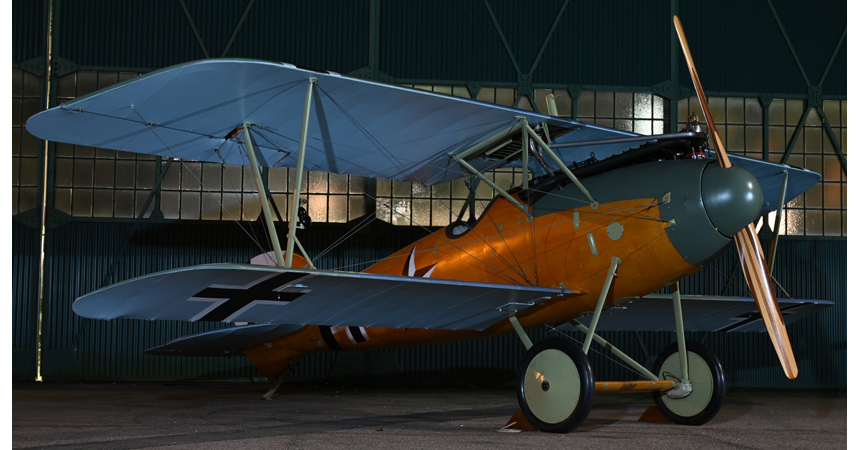
An excellent fighting aeroplane, the Albatros D.Va has the distinctive rounded fuselage profile which identifies this later variant from its slab sided predecessors, with its graceful curves helping to mask its deadly fighting qualities. These magnificent aircraft also benefitted from some of the most flamboyant decoration ever applied to fighting aeroplanes, something which only ensures their fascination to this day. In this struggle for supremacy of the air, the German Jastas wanted Allied pilots to see who they were facing in combat and which individual aircraft had brought them down.
A thing of aviation beauty. The craftsmanship displayed in the construction of this ‘new build’ Albatros is quite astonishing and has allowed us all to admire the clean lines of this historic aeroplane.
From a purely personal perspective, I have to say that I think the Albatros is the best looking fighting aeroplane from the Great Air War and as soon as I saw the Hendon event was offering the opportunity to photograph this beautiful aeroplane at night and outside Hendon’s historic Hangar 2, I knew this was an event I had to attend. I also have to come clean and say that the RAF Museum at Hendon is not a place I have visited too many times over the years for one reason or another, with this latest one possibly only being my forth visit. One thing that is absolutely certain is that I had never seen Albatros D.7343/17 displayed at Hendon since its arrival in 2012, although I had seen it flying on one previous occasion. For those reasons alone, you can see why I was keen to reacquaint myself with this beautiful aeroplane, even though it was a former enemy aircraft at the spiritual home of the Royal Air Force.
During the early months of 2012, British aviation enthusiasts were alerted to a development which was of huge interest to anyone with a fascination for classic aircraft of the Great War. The RAF Museum had negotiated a deal to acquire three WWI aircraft types from Peter Jackson’s The Vintage Aviator Limited company in New Zealand, an Albatros D.Va, a Royal Aircraft Factory R.E.8 and a Sopwith Snipe. What made this of even greater interest was that two of the aircraft would be airworthy and we may well have the opportunity to see them fly at a UK Airshow event.
Having a fascination for all things Great War, Peter Jackson went to significant expense in establishing a manufacturing company to produce ‘new build’ WWI aircraft, employing talented engineers and working from historic factory drawings, adopting reverse engineering techniques as and when required. Built to the most meticulous of standards, these machines really are works of art and magnificent examples of these Great War aeroplanes – fighting aircraft from over 100 years ago!
Albatros D.Va D.7343/17 is a stunning example of this famous fighting aeroplane, with its varnished plywood fuselage wearing the distinctive markings of Jasta 61 seven victory ace Vizefeldwebel Karl Friedrich Kurt Jentsch, flown during the summer of 1918. The deal secured by the RAF Museum saw the three WWI aircraft crated and shipped to the Shuttleworth Collection at Old Warden in Bedfordshire, so that their experienced engineers could assemble the aircraft prior to delivery to Hendon. Interestingly, it was also rumoured at the time that the two airworthy aircraft would be air tested once assembled at Old Warden and may even be allowed to perform at one of the popular Airshows arranged by the Shuttleworth Collection. As it later transpired, two aviation celebrities were fortunate enough to fly the aircraft whilst they were based at Old Warden, with Kermit Weeks flying the Albatros and his friend Gene DeMarco taking control of the Royal Aircraft Factory R.E.8. They also turned out to be the dual star attractions at the Shuttleworth Pageant Air Show at the beginning of September and the Duxford Airshow the following week, as Britain went Great War aviation crazy for a few memorable weeks.
By the end of October 2012, the three aircraft were dismantled once again in advance of a road trip to their new home at the RAF Museum Hendon, where they were reassembled for public display in the Grahame-White hangar, along with other fascinating Great War artifacts. Taking their place amongst this world class collection of preserved aircraft, these may be new built examples of these classic fighting aeroplanes, but they offer museum visitors the opportunity to take a fascinating look back to the early days of military aviation and the machines which gave rise of the air ace.
There may have only been one aircraft positioned outside for this special nightshoot event, but what a stunning machine it was.
Desperate to renew my acquaintance with this magnificent aeroplane, my plan was to try and get down to Hendon by mid-afternoon, perform a little reconnaissance mission of the nightshoot arrangements and perhaps take a quick spin around the RAF Museum itself. After attending the event that evening, I had a room booked locally, with the intention of gathering a day of content from the RAF Museum on Saturday, details which may well be used in several blogs over the next year or so. Sounds like a plan? Unfortunately, the motorway gods decreed that my rare day away from the computer would be an opportunity for them to show who was boss and with the M1 closed due to an incident, I thought I was being clever in heading straight for the A1, so as not to get caught in all the congestion - the only thing was, everybody else had the same idea and all we found was congestion!
Time for plan B - just access the event early and try to get some pictures as the aircraft was being moved into position for the nightshoot. Unfortunately, as the museum was still open at that point, even though the Albatros had been brought out of the hangar, the area was surrounded by barriers to keep the aircraft safe and it was clear that preparations were only going to be finalised once the museum had closed to non-event public. There was nothing else for it only to wait and try to remember all my camera’s night photography settings.
This might turn out to be the only time I get to photograph Albatros D.Va D.7343/17 at night, so I made sure I did the opportunity justice.
Once all the ticket holders had arrived and the preparatory works completed, it was the obligatory safety briefing and we were off, photographer and camera in perfect harmony. The team behind the event had some issues with one of the doors of Hangar 2 and whilst they did manage to bring the Albatros outside, their plan to have the R.E.8 join it was thwarted. Even though we only had one aircraft to shoot outside this historic hangar, what an aircraft it was and it looked simply magnificent. We did also have access to the Great War displays inside Hangar 2, however it was extremely dark in there and with only limited LED lighting available, it gave us an opportunity to be creative.
In my opinion, the evening was a huge success and it is events like these which have really rekindled my enthusiasm for aviation photography, so full marks to the RAF Museum and the Threshold Aero team for a job well done. As mentioned earlier, I did venture back the following morning to complete a full museum tour, making Hangar 2 my first stop, which looked very different in daylight. Amongst the embarrassment of aviation riches at Hendon, Hangar 2 and the Grahame-White display is truly fantastic and a real highlight of any visit, especially when considering its important links to the history of the actual Hendon aerodrome site. With some unique exhibits to admire, you could easily find yourselves spending half of your day in this part of the museum, spending some quality time immersed in this engaging time capsule from the birth of fixed wing military air power.
Here is a final selection of images taken during my latest visit to the RAF Museum Hendon and their Great War aviation displays.
Photography inside the hangar on the night was quite challenging, however, it could be argued that the resultant images were some of the most interesting I managed to take all year.
The Royal Aircraft Factory R.E.8 which arrived at the RAF Museum as part of the deal to also secure the Albatros and a Sopwith Snipe new builds.
The Royal Aircraft Factory SE5a fighter was one of the Allied aircraft which helped to wrestle air supremacy from the Luftstreitkräfte during the Great War.
Sopwith Camel at night, something which is quite apt as these aircraft defended the capital against nocturnal raiders during WWI.
Arguably the finest fighting aeroplane of the First World War, the Fokker D.VII was fast, agile and heavily armed, the nemesis of Allied air forces.
One of the stunning exhibits in the Grahame-White hangar, the Royal Aircraft Factory F.E.2b is a fascinating combination of bombs and guns, clearly displaying how these early aircraft made extensive use of wood in their construction.
The Sopwith Triplane was the aircraft which inspired the introduction of the Fokker Dr.1, one of the most famous aircraft of WWI, but one which was nowhere near the most effective German fighter of the Great War.
More impressive woodwork, this Bristol F.2B Fighter is displayed in a partly constructed state, clearly illustrating the craftsmanship involved in producing these early aircraft.
The Grahame-White display has an impressive mix of ground and suspended aircraft to admire.
Beautifully atmospheric, here is a final look at the new build Royal Aircraft Factory R.E.8, one of the many highlights of a visit to the Grahame-White hangar display.
There really could be only one way to end this feature, with the star of the show - Albatros D.Va D.7343/17.
Well, that’s it for another year of Aerodrome blogs and I would like to take this opportunity to thank all our readers for their continued support. I would also like to wish each and every one of you a safe and happy Christmas and a prosperous New Year to come and whatever happens in 2022, we will be back here from early January attempting to bring you more interesting aviation content, with features both nostalgic and contemporary. If you have your own interesting aviation story to tell, or perhaps have an interesting restoration project taking place close by, why not send us details and let us share them with our worldwide blog audience, who I am sure would be delighted to hear about them.
To send us details, or to simply open the lines of communication, please use our aerodrome@airfix.com address when getting in touch.
Between editions of our blog, you will always find interesting aviation discussions taking place on the Airfix Aerodrome Forum and if social media is your thing, the bottom of both the Airfix and Corgi home pages have all the access links you will need.
The next edition of Aerodrome is scheduled to be published on Friday 7th January, where we will be featuring one of the Airshow events we attended during 2021.
Thank you, as always, for continuing to support our Aerodrome blog.
Michael

