
Welcome to this latest edition of Aerodrome and our regular look at the fascinating world of aeroplanes and the historic aviation scene around the UK.
Having spent a great many years pursuing my passion for aviation photography, I’m proud to say that I’ve probably photographed most aircraft types to have flown in British skies and visited most aviation venues in the country over the past 45 years or so, and enjoyed every minute doing so. That being the case though, it can be difficult these days to find an event which really gets those enthusiast juices flowing, something which has me immediately securing my place and getting my camera ready for what will hopefully be a memorable occasion. Thankfully, such an event was advertised late last year, and I made sure that I was one of around 50 aviation photographers heading to a former RAF station in Lincolnshire, the home of arguably the most exciting aircraft ever to see service with the Royal Air Force.
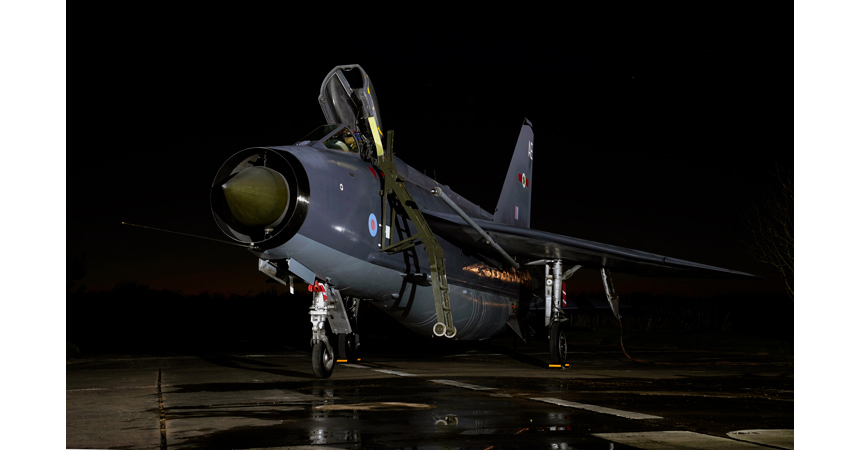
The subject of this latest edition of Aerodrome is my review of a very special event held on the site of the former RAF Binbrook and the first ever nightshoot event with The Lightning Association’s magnificent English Electric Lightning F.6, an aircraft which benefits from the time and attention lavished on it by a dedicated group of volunteers, all of whom are determined to preserve this incredible living piece of Britain’s aviation history for the benefit of the nation.
You can look forward to seeing a selection of photographs taken during the event, featuring a beautifully maintained and presented English Electric Lightning at a location many regard as the home of the Lightning. This was a truly memorable event an Aerodrome was there to record it.
We might be on a former military airfield at night, but there’s definitely no frightening taking place in this review.
All the images used to illustrate this edition all feature English Electric Lightning F.6 XR724 of The Lightning Association, taken during a photoshoot event at RAF Binbrook earlier this month.
There are few aircraft that can claim to occupy the same historic aviation acclaim as the magnificent English Electric Lightning, a spectacular aircraft which has the honour of being the nation’s first and only all-British supersonic fighter aircraft, an aviation thoroughbred which served with distinction throughout the Cold War years. Representing a huge leap forward in terms of aviation technology when the Lightning first entered RAF service in 1960, its introduction presented Britain with one of the most capable fighting aircraft the world had ever seen, one which was the envy of all the world’s air forces at that time.
The Lightning’s blistering performance and climbing/acceleration capabilities gave the aircraft an unequalled reputation as an interceptor and with it, a reputation for being quite simply the most thrilling ride a pilot could ever hope to experience – no wonder the Lightning was and is still held in such overwhelming affection by anyone who was lucky enough to have flown, worked with, or see one displaying at an Airshow event.
The ultimate variant of this flying hotrod was the Lightning F.6, an aircraft which took all the impressive attributes its predecessors could boast, and present the aircraft with more speed, greater range and better handling. This all enabled this magnificent aircraft to post a stellar 28 year service career with the Royal Air Force, through some of the most volatile periods in world history and throughout a significant period of continued development across the aviation world.
The F.6 variant saw the return of guns to the Lightning, following their omission on its F.3 variant predecessor, which augmented a pair of Red Top air to air missiles in an offensive role and was very much welcomed by RAF pilots. Although speed was always a word used when talking about the Lightning, pilots were always of the opinion that the aircraft was more than capable of engaging in dogfighting if required, so the return of its cannon armament was seen as essential. Perhaps the most significant improvement was a welcome increase in operational range, with additional fuel carried in a large belly tank and the ability to carry two additional over-wing fuel tanks.
History has since gone on to describe the Lightning’s perceived lack of range as something of the aircraft’s Achilles heel, however, this isn’t an entirely fair reflection of the situation. The Lightning was designed to be an incredibly fast, quick reaction interceptor, protecting Britain and her V-Bomber airfields throughout the Cold War period by racing to any potential threat, dealing with it, and returning to base to re-fuel and re-arm. In this regard, the Lightning excelled in every respect and could hardly have been more effective in the role for which it was intended.
Although Lightning pilots were always keen to promote its capabilities as a gunslinger, this aircraft’s most impressive attribute was raw power, and two mighty Rolls Royce Avon 301R turbojets which provided this piloted missile with thrust in excess of 32,000lb in afterburner and gave the lightning to accelerate when climbing vertically. Racing at speeds approaching Mach 2.2 towards any potential threat, it was designed to blast that threat out of the sky over the North Sea and well away from the British mainland, and in this scenario, the Lightning reigned supreme.
The English Electric/BAe factory at Samlesbury, between Preston and Blackburn, would prove to be an important location for the production of aircraft during the Second World War and onwards into the post war years, with the English Electric company producing two of the most significant jet powered aircraft in the history of British aviation, the Canberra and the Lightning. Producing many of the original Lightnings destined for RAF service, the relatively short runway at Samlesbury, combined with the close proximity of farms and homes to the airfield, required that many aircraft made their first flights from Samlesbury beginning with something of a ‘performance’ take off. In order to safely use the short(ish) runway, and to reduce the impact of operations on local communities, newly completed aircraft would make the short hop to nearby Warton, where their flight test programme could begin in earnest, as facilities there were much more suitable for that type of work.
Interestingly, Lightning has struck twice at Samlesbury, as the site is also now involved in the construction of major sections for the new Lockheed Martin F-35 Lightning II, another cutting edge jet powered aircraft which is thrilling the aviation world. Indeed, Samlesbury can boast full size replica examples of both a Lightning F.6 and an F-35 Lightning II serving as gate guardians at the site, a proud representation of their continuing contribution to aviation.
Unfortunately, despite the dramatic impact the English Electric Lightning had on the world of aviation, there are currently no airworthy examples of these aircraft to be found anywhere in the world and due to the complexity of the Lightning’s systems, its probably unlikely that we will ever see one flying in British skies ever again. Nevertheless, the country does boast an impressive collection of preserved Lightnings, covering all marks and even test/prototype airframes, but if you are going to admire one of these magnificent aeroplanes, surely it should be on an airfield which was once synonymous with their operation.
An impressive organisation dedicated to the preservation of the Lightning and the unique position it holds in the annals of not only British, but world aviation history, the story behind their establishment is best told by their own members, so the following details are taken from their Lightning Association website.
The Lightning Association was formed in the year following the aircraft’s retirement from RAF service in the spring of 1988, when a 'Lightning Rally' for all Lightning enthusiasts, air and ground crews was organised at Binbrook on 2nd July 1989. It proved to be a great success and out of it, the Lightning Association was born, with a Rally subsequently being held every summer. Although the Rally has not been held for several years of late, it’s hoped that we may be able to resurrect them again in future, as they were always regarded as an excellent day out and an opportunity for enthusiasts from all over the country to come and talk Lightnings.
The original aims of the Lightning Association were to 1) To provide a platform for promoting the cause of Lightning preservation and informing members and the air-minded public of developments and 2) To foster communication and a spirit of goodwill between enthusiast groups who are the custodians of preserved airframes.
The Association originally had no intention of actually becoming involved with airframes themselves, however, that changed when Lightning F.6 XR724 was put up for tender by MoD in 1991. This aircraft was the first of the five Lightning's allocated to British Aerospace at Warton as chase aircraft in the Tornado Foxhunter radar development trials, to be retired and flown into storage at RAF Shawbury. She was subsequently secured by the Lightning Association.
The aircraft is owned by a group of shareholders who have put money into the project to purchase shares in her. The XR724 Project has expanded to own a variety of equipment and spares, including three engines with documented air-life remaining on them. The Lightning Association holds several shares and holds the ultimate right of veto if there should be an attempt to manage the project in a manner unacceptable to members, or in the event an attempt to dispose of the airframe should be made for any reason. The story of the purchase of XR724, its recovery for flight and its eventual final flight back to Binbrook will be told below.
Anyway, having set out to act as a focal point for the spread of information, it was decided that the best means of direct communication was via a magazine, and the Lightning Review was launched. From the first photocopied twelve-page issue, the Lightning Review grew to 32 pages in the second issue and by the third issue was being properly printed on glossy paper. It acquired a twelve-page technical supplement and helped the membership grow to 500 at its highest point. This is just some of the contents list from previous issues, many of the articles being accompanied by previously unseen photographs from members' collections.
That being the case, everything is subject to change, and the Lightning Association was no exception. It became increasingly difficult to obtain enough material to maintain the high standards of production which members had come to expect from the magazine. Rather than let it wither slowly, the decision was taken to have a final 100-page bumper issue in September 1995, using all the remaining material available, calling it a day on something of a high note. However, under considerable pressure from the membership and with new Lightning related articles and stories subsequently being submitted to the editor, Charles had his arm well and truly twisted, and the Review was brought back to life, with the Phoenix edition coming out in July 1996.
Unfortunately, with print costs rising and new, previously unpublished stories drying up, a decision on future production had to be made, and the final print issue of the Lightning Review (Volume 7, Edition No.3) was published in January 2004.
Since that date, Charles has collected, and continues to gather, stories from anyone connected to Lightning's and their operation, from former RAF personnel to members of the public who may have seen something like an ejection, for instance. Following the reconstruction of this website in 2011 (and again in 2023), the old SOTM (Story of the Month) feature on the site will become Lightning Tales and will continue the already published list of Lightning stories, with a combination of new stories and archived articles from the Lightning Review and other publications.
Over the past several years, the pace of not only the Association itself, but also the work on the aircraft we maintain has slow gathered pace. While the Association itself finally entered the world of social media in 2017, the Engineering Team has also been expanded to cover the ever-increasing workload experienced. All this, coupled with a new-look website, now places both the Lightning Association itself and the aircraft we care for back firmly in the public domain, safeguarding the commitments and ideals we started out with all those years ago.
English Electric Lightning F.6 XR724 was the first of the five Lightnings allocated by the MoD to British Aerospace at Warton as chase aircraft in the Tornado Foxhunter radar development trials to be retired. Her Fatigue Index (FI) was coming perilously close to zero, so she was flown to RAF Shawbury for storage whilst she still had some fatigue life left on her airframe. If that figure had passed below zero, she would not have been able to fly again under any circumstances.
Some enthusiasts probably know the story of the two Lightnings allocated to Leuchars and Lossiemouth for Battle Damage Repair (BDR) practice when they were reaching the end of their operational lives. The first aircraft was flown to Leuchars, and the pilot went back to collect the second. As this was going to be the last flight, he decided that he was going to undertake some interesting aeros on the way, but had to put into Leuchars for fuel - whether this had been planned or whether he'd used more fuel than he intended, it’s still not known. Anyway, on landing, the engineers checked the G-meter readings and informed the pilot that he'd pulled so many G during the flight that the aircraft now had to be grounded. Even the short remaining onward flight to Lossiemouth was therefore forbidden.
When Lightning XR724 came up for purchase on an MoD tender, the aeroplane had no engines or seat, but had been perfectly preserved in a temperature and humidity-controlled hangar at RAF Shawbury. The Association didn’t initially know about the tender, since MoD disposals at that time, didn’t circulate information to all potentially interested parties with every tender. Thankfully, one of our members who was informed about the disposal placed a bid, which was subsequently successful, even though he didn’t really expect the bid to be successful. As those of you who do these things will know, you then have 28 days to get your purchase off MoD property, or they may hit you with financial penalties.
However, this fortunately coincided with one of the Lightning Association Rally Open Days at Binbrook, where most of the LA movers and shakers were in attendance, and we took an immediate decision to repurchase it from our member by means of a share scheme. The second important decision of the day was to try, if at all possible, to recover it from Shawbury to Binbrook in an operational state, i.e. without cutting it, but more about that a little later.
The situation as it was, was that we had just bought a Lightning at RAF Shawbury, which created a problem or two. The first one was that the clock was already running on the 28 days to get her out, with the second being that every other Lightning in operational condition in the UK at that time came with a piloted flight into the airfield of the purchaser's choice as part of the deal – unfortunately, not ours. The third issue was that our Lightning has no engines or ejection seat no other potential Lightning owning group had these problems to face.
The thinking at Binbrook on the day of purchase was that we would try to fly her out of Shawbury. The engineering work would be done by members of the Lightning Association and Barry Pover's Lightning Flying Club, with Barry in charge on the ground at Shawbury, reporting to Charles Ross as the overall Manager of this complex project. Barry was going to loan us two zero-timed Rolls Royce Avon engines from his assets/collection and Mick Cameron, who was a senior armourer at Wattisham, was going to rebuild an ejection seat from a bare pan. Charles’ job was to ensure that it all happened and that all the people who would eventually have to be involved, from the directors at British Aerospace, to the runway sweepers at Binbrook, all did their bit effectively and on time, even though it was a team made up entirely of volunteers. This all had to cost the Association nothing because essentially, we had nothing!
At that time, Barry was trying to rebuild Lightning XS451 to flying condition and was having problems convincing the CAA that he was competent to do so, as the aircraft he had worked on as a CAA certified engineer (such as Beech King Air’s), were most definitely not Mach 2 capable jet fighters. His Lightning was being recovered from instructional airframe status, whereas ours had been flown into Shawbury from Warton, and had simply had the engines and seat removed, and subsequently stored in a climate-controlled hangar.
Barry was prepared to commit all this time and effort because if we actually managed to fly XR724 out of Shawbury under his engineering supervision, it could do no harm for his own efforts to persuade the CAA to let him fly his own Lightning. Sadly, XS451 would fly again, but in South Africa as ZU-BEX and was tragically lost in a flying accident.
Back with our project and Charles’s first task was to secure an extension to the 28 day moving limit, as it was going to be impossible to do anything in that time. Apart from installing the engines and seat, we would have to do all the ground functionals and jacked undercarriage retraction testing, and at that stage, we didn't even know if we would be allowed on the base at all, never mind work on the aeroplane. His first letter to the MoD chap overseeing disposals brought with it disappointing news. The 28 day limit remained, and the Lightning had to be out before this time expired. In order to achieve this, the wings and tail would have to be cut off, something they were desperately trying to avoid, as it would effectively end any chance of the aircraft flying, or even taxiing again.
At this point, he learnt two valuable lessons in aviation. Number one - never give up, and number two - if you can get the person with executive authority on your side, you can achieve virtually anything. So, Charles wrote to the base commander, explained who he was and what he was trying to do. Charles told him about the situation with MoD. He got a letter back saying that as long as he was in command of the base, we would have as much time as we needed to recover XR724 for flight and we would have as much access to the airfield and its facilities as we required. This was a great day for the team, and a fantastic example of what enlightened RAF officers can do to maintain public support for the service in these difficult times.
With this more positive news behind us, recovery for flight began. Despite RAF help on the ground, any subsequent Permit to Fly would depend on the CAA, and their time was expensive. Even in those days, we were looking at £150 per man-hour spent considering any project and we simply didn't have that sort of money. Barry Pover kindly agreed to cover these costs if we gave him exclusive control of contact with CAA on our project, because he didn't want the Head of Applications at CAA to be contacted by a variety of different people all asking the same questions. This seemed reasonable, so we agreed that if Charles remained in the information loop, he could have contact control.
It would take many months of intensive effort, but eventually, the good news was that the engines and seat were finally installed, and that British Aerospace had subsequently signed off the airframe, and Rolls-Royce the engines as being serviceable. The bad news was that the CAA would not issue the Permit to Fly, even though Charles had been told by Barry that they were going to. In response to this, Charles had arranged with the Vulcan boys with XH558, that they would be up for an air test on the same morning that XR724 was supposed to depart Shawbury for Binbrook.
Of course, formation flying had to be authorised with the appropriate authorities, but if two aircraft happened to occupy the same area of sky at the same time by pure coincidence...... Wouldn’t have been fantastic to have seen the Vulcan and Lightning overflying Binbrook, Scampton and Waddington in succession on the same morning, but as we all now know, such a spectacle never happened. The CAA had never agreed anything, and the rest of that story is included in past issues of the Lightning Review. If you want to know what happened, you should go back and read them – everything is in the public domain.
So, it was back to square one for us, but remember Charles’s valuable lesson in aviation. He next wrote to Sir Graham Day, then Chairman of British Aerospace, and again explained who he was, what we had done and what had happened to date. Charles asked if there was any mechanism within the Company by which XR724 could be recovered to Binbrook. Charles will never forget the two-line written response he received by return. It read: 'Dear Mr Ross, I have instructed my military aviation division to put themselves at your disposal to recover your Lightning to RAF Binbrook.'
Like Winston Churchill at the beginning of the Second World War, the right man with the necessary vision had been in the right place at the right time. The next day Charles was contacted by senior management at BAe who simply said that Sir Graham had told them to recover our aircraft, and what would I like them to do. As you can imagine, this was another great day which marked another great decision by another great man.
In the event, on 23rd July 1992, Lightning F.6 XR724 took off from RAF Shawbury and was flown back to Binbrook by Peter Gordon-Johnson, Deputy Chief Test pilot of British Aerospace, and interestingly, the same pilot who had flown XR724 into Shawbury on her previous 'final flight'. At our request, RAF Scampton temporarily reinstalled the RHAG at Binbrook (which had been removed) in case of chute failure, and also provided a mobile Air Traffic unit, along with fire and ambulance cover for the flight operation - yet another decision by an enlightened RAF base commander which gained the service enormous public support and approval.
There's still a great deal of what happened on that day which is confidential and must remain that way, but on a grey day on the Windy Hill, Lightning XR724 broke through cloud to the north and flew down the Binbrook runway at approximately 1340 hrs, and after completing flypasts at Scampton, Waddington, Wattisham and Coningsby, touched down at the spiritual home of the Lightning in front of an enormous crowd of Lightning fans. After back-tracking down the runway to taxy onward to the ASF pan past the old Bomb Dump and into the 5 Sqn line, the Lightning shut down her engines and was received by Phil Wallis, Mick Cameron and Geoff Commins.
We had effectively taken a dead shell of an aeroplane and returned it to life, and indeed to the air once more, proving that it was possible for a group of professional engineers to come together from their various occupations and prepare an aircraft of this complexity for flight, to the complete satisfaction of the Design Authority and the engine manufacturer. A specially commissioned signed print and a limited number of photographs were flown in the aircraft on the day, some of which are still available to members.
So, we now had XR724 where she was supposed to be, and we were in the same position as other groups who received their aircraft direct, even though it was only after achievements which, we think it’s fair to say, many could only have dreamed of. Having said that, there was no time to resting on our laurels, as the ejection seat had to go back and more importantly, Barry decided he wanted his engines back. That was all fair enough as far as it went, but Barry also decided that he also wanted our jet pipes on loan, which he said were now 'matched' to his engines and would make the task of getting his own aeroplane flying much easier.
We don't know whether or not that was a fairy story - perhaps some of the engineers out there can tell us - but as he had given us so much help, we drew up a proper loan agreement which was signed and witnessed and gave permission for him to take the jet pipes as well.
Unfortunately, and something which was unknown to us at the time, he also asked to borrow, and was given by one of our engineering team, the Form 700, which he said would be good evidence of his competence to place before the CAA. Why a photocopy would not have been sufficient we don't know, but as said, it happened without Charles’ knowledge. The jet pipes had been fitted brand new just before XR724 left Warton to fly into Shawbury and were without doubt the lowest-houred, documented jet pipes in existence at that time.
Once again, we had a dead jet, but only temporarily. Cutting a long and fraught story short, Charles subsequently found and purchased a complete ejection seat using his own money, and the unit was duly installed in the jet. He also managed to successfully tender for three air-life remaining and fully documented Avon engines via an MoD disposal sale, and when we got them back to Binbrook, two were installed in XR724, with the other being held in our facility at Binbrook in its box untouched. We also eventually managed to source the necessary jet pipes required, and these were also installed to finally bring our Lightning back to life. It wasn't easy and it wasn't cheap, but we did it.
For many years following this story, the aeroplane was run regularly, and the annual Lightning Rally took place, a highlight of the year for many of our members. Unfortunately, since then, we have faced more than the odd problem, not least of which has been the fact that the part of Binbrook where we base ourselves has been sold on several times over the years, and on each occasion, we have had to negotiate the sometimes difficult task of establishing relationships with new owners. Thankfully, we currently find ourselves in a much better situation, with a robust and experienced engineering team, and with Lightning XR724 protected under cover for the first time in many a year.
As far as we’re concerned, we believe that the future for English Electric Lightning F.6 XR724 is looking much brighter!
Lightning at night – what more could an aviation enthusiast ask for!
If ever an aviation photographer was looking for an event to warm the cockles of their heart at the start of a new year, then the one advertised by Threshold Aero at the back end of 2024 was surely just that. They were offering the early season opportunity to photograph English Electric Lightning F.6 XR724 at its home airfield, the former RAF Binbrook, the spiritual home of Britain’s last Lightnings in service. Although the aircraft has been a long time resident at Binbrook, she has seen a real upturn in fortunes of late, as the work carried out by her dedicated team of volunteer custodians has really started to bear fruit, and they’re keen to share their work with the enthusiast community.
This magnificent aircraft was scheduled to be receiving a smart new coat of paint over the winter months, and at this first ever nightshoot event held at her Binbrook home, we would be the first to see her in these new colours at a specially arranged photographic event. A beautifully restored and maintained Lightning F.6 on a former RAF Lightning base, what could possibly prevent us from immediately securing a place on what was already looking like being one of the highlight events for 2025.
On the day of the event, I set off for my first visit to RAF Binbrook in good time, determined that should I meet any traffic issues on the way, I would still be in good time for registration, as I definitely would not want to be late for this particular aviation appointment. Choosing a route which took me over the Humber Bridge and passing by the former RAF Elsham Wolds airfield, my only wrong turn came right at the very end of my journey, even though it turned out to be a rather fortuitous one for me.
Turning into the former main entrance at RAF Binbrook, I parked up outside the beautifully restored former guardroom at the airfield, and couldn’t help but notice work taking place to position a Lightning as a gate guardian at the site. I was then fortunate enough to make the acquaintance of a fantastic group of people from the RAF Binbrook Collection, who informed me that whilst I wasn’t in the right location for the event, I was very much in Lightning Country.
I spent a very pleasant hour or so with them, which even included a quick catch-up telephone conversation with famous former Lightning pilot and staunch supporter Ian Black, but this will all be the subject of a separate edition of Aerodrome.
Back to the nightshoot event, and I finally raced around to the correct location just in time to attend the obligatory pre-event briefing and to meet the Threshold team running this latest event. We were fortunate that the team from the Lightning Association were determined to satisfy as many of our photographic wishes as possible, whilst always ensuring their aircraft didn’t come in for any over-zealous attention from those in attendance. They had cleared the photoshoot site to ensure that nothing could detract from the images we were about to take, knowing that this icon of the aviation world was the subject we had all come to admire and document.
They had also promised to connect the aircraft to a GPU once it was dark, so the aircraft could use its own lights to supplement the lighting set up arranged by the Threshold team. There were even plans to create a large puddle in front of the aircraft for photographic effect, although as my camera equipment was right in front of the water tank, I was clearly less enthusiastic about this development.
As for Lightning XR724, she looked absolutely magnificent and appeared to be revelling in all the attention, as if she knew she represented the pinnacle of a period in aviation which fascinates more than any other and how around 50 photographers had travelled from all over the country just to spend time with her.
From a photographer’s perspective, with so many of us in a relatively confined area, a certain amount of etiquette was required, as we were all hoping to secure similar shots and there was no place for hogging a particular position for an extended period of time – who would do that? There was also the danger of fellow photographers inadvertently photobombing other people’s shots, which wouldn’t usually be too much of an issue, except we were all wearing Hi-Viz jackets …. Oh, the joys of night photography events.
As it was, the event really was a resounding success, and it was a real privilege to be one of those in attendance at the inaugural event of this kind at this historic venue, following Lightning XR724’s recent repaint – she looked absolutely magnificent. Our gratitude must go to the volunteers of The Lightning Association for allowing us to spend some time with their magnificent aircraft, and for making the even such an enjoyable one to attend. To the Threshold aero team, please keep up the good work, because yet again, you served up a fantastic event. I very much look forward to taking my place on the next one.
All the images used to illustrate this feature were all taken on the day/evening of the event, and we hope they are of interest to you.
We’re afraid that’s it for another edition of Aerodrome, however, we’ll be back again in four weeks’ time with more news and pictures from the fascinating world of aviation. Thank you for your continued support and as always, if you would like to comment on anything blog related or suggest a subject you would like to see covered in a future edition of Aerodrome, please do drop us a line at aerodrome@airfix.com, where we would be delighted to hear from you.
Should you wish to continue the aviation discussions between editions, you will always find something of interest over on the Airfix Aerodrome Forum and if social media is more your thing, please use the respective official social media icon links at the foot of the main Airfix and Corgi website homepages to access our official sites.
The next edition of Aerodrome is scheduled to be published on Friday 23rd May, when we will be bringing you more news from the fascinating world of aviation.
I hope to see you all back here then.
Michael

