Welcome to this first edition of Aerodrome for 2017! Over the course of the next twelve months we will be looking to bring you pictures, reports and features from the fascinating world of aviation, and include more reader inspired content as our global readership continues to grow. If you managed to catch our 2016 review edition posted on 30th December, you will have noticed that we are launching a new blog feature in 2017 which is intended to unlock some of the fascinating secrets of the many airfields dotted around the British Isles. The feature is entitled ‘Project Aerodrome’ and we are hoping that readers will send in pictures and even a short report about the activities taking place at their local airfield, with a view to bringing this information to a much wider and extremely receptive audience. This is an opportunity for aviation enthusiasts everywhere to share their passion for the subject with other like-minded people and to engage and educate fellow enthusiasts on an airfield that may be close to your heart.
Although many future submissions in support of ‘Project Aerodrome’ will probably come from airfields across the UK, we are certainly not restricting the feature to these venues and would be more than happy to hear from our overseas readers – if it has aeroplanes, we would like to hear about it. From airfields large or small, active or no longer in operation, each one will have a fascinating history of its own and we would love to hear about it. If you have concerns about producing a report, drop us a line at aerodrome@airfix.com or aerodrome@corgi.co.uk and we can arrange to do this for you, but please do get behind ‘Project Aerodrome’ and send us your pictures and reviews.
We will begin this feature with a look back at an event I attended in early December 2016, organised by the recently formed Friends of Barton Aerodrome and their inaugural Members Photographers Day – enjoy!
With the winter months often presenting few opportunities for aviation enthusiasts to indulge our passion for aeroplanes, the chance to attend a pre-Christmas photographers day at my local airfield was an unusual bonus and grabbed with both hands. Suitably attired for the conditions and with my trusty Nikon in hand, I made the short trip down the M60 motorway to Eccles and Barton Aerodrome, or to use its correct current title City Airport & Heliport, where I would be joining a small group of fellow enthusiasts for this special event. Organised by the Friends of Barton Aerodrome, this would be the first event of its kind to be run by this volunteer group and only available to members who were quick enough to respond to the original notification – places were strictly limited.
 The historic Grade II listed control tower at Barton
The Friends of Barton Aerodrome are a new organisation based at City Airport (Barton), determined to promote current activities and preserve the history of this important airfield. With the support of the airport management and owners, the group aims to increase awareness and aid in the improvement of the airfield, preserve and promote its history, promote flying as a sport and recreational activity and help make aviation more accessible to the general public. Importantly, they are keen to promote good community relations regarding airfield activities and organised events. From an enthusiast's perspective this is a fantastic opportunity for people with an interest in the airfield to keep informed on related matters and connect with other similarly minded enthusiasts. The group has its own website and social media sites, where members can exchange information and receive the latest updates, or casual visitors find out more about the group’s activities.
Like most airfields in the UK, Barton has a fascinating history to preserve and can claim to be one of the most important aviation sites in the UK. Chosen as the site for Manchester’s new municipal airport, construction at Barton began in 1928 with work on a large hangar, support buildings and grass runways commencing – it would be the first municipal airport in the UK to be licenced by the Air Ministry. The first aircraft to land at the airfield was an Avro Avian, with the first passenger charter flight occurring in January 1930. The large hangar on the site was constructed to house the most advanced passenger aircraft of the day – the three engined Armstrong Whitworth Argosy, which would be required to overnight on regular scheduled service flights from London Croydon, via Birmingham. The first Argosy arrived in the summer of 1930.

The Armstrong Whitworth Argosy was the advanced passenger airliner of the day
With Barton’s future seemingly looking bright, the construction of one of Britain’s first control towers was started, opening with its associated wireless station in the Spring of 1933. This beautiful Grade II listed building is still in use to this day and is thought to be the oldest tower in Europe still in use for its original purpose, and is certainly one of the major attractions at Barton. Despite many advanced features, all was not well at Manchester’s airport and scheduled flight activity began to stall. The airfield is sited on an area of peat bog and is liable to become waterlogged during periods of excessive rain – it is also regularly affected by fog. Keen to restore the fortunes of the airfield, officials asked Dutch airline KLM to use Barton as a terminal for regular flights between Manchester and Holland and on 23rd January 1934, a KLM Fokker F.XII landed at Barton on a suitability flight. The pilot was less than complimentary about the airfield. He described it as the worst airfield in Europe he had ever flown in to, with regard to it being affected by fog and a number of nearby obstructions made landing approaches dangerous. He advised the council not to spend any more money on the Barton site and find a more suitable location for their airfield.
Clearly, the KLM service did not materialise and instead flew from the newly constructed airfield at Liverpool. Manchester Council were shocked by the development and immediately began searching for a more suitable site for their airport – just six months after KLM’s damning report on Barton, a new site at Ringway was approved, which would become Manchester’s International Airport.
During the Second World War, Barton was requisitioned for use as a military repair and overhaul facility, with such aircraft as Avro Ansons, D.H 89 Dominies, Fairey Battles and Fulmars, Hawker Hurricanes and even F4U Corsairs being worked on at the airfield. In addition to this, around 700 Percival Proctor training and communications aircraft were assembled and tested at Barton, along with a rather less appealing scrapping of former Fleet Air Arm Swordfish taking place on the airfield.

The large hangar at Barton was built for the overnighting Argosy aircraft in the late 1920s
Following the end of the war, general aviation activities returned to Barton which became the home of the Lancashire Aero Club from 1946, until it moved in 2007 and also served as a home for the Manchester University Air Squadron and No.2 Reserve Flying School with their Tiger Moths and Chipmunks. Although seeing almost constant use since it was first opened in 1930, Barton is now very much a lively general aviation airfield, but no less interesting for that fact. Its historic hangars house a number of rare and unusual aircraft and you regularly see more exotic visitors dropping in, not only during the fly-in and Airshow events the airfield regularly hosts - you may even catch an RAF Puma or Chinook dropping in for fuel on a good day.
With ticket in hand, the joining instructions gave Barton’s historic control tower as our gathering point, where our host for the day would be waiting to check we had our ID cards, event ticket and Hi-Viz jacket, as we would be visiting areas of the airfield not usually open to members of the public. Once everyone had gathered in the briefing room, we were given health and safety instructions to ensure that everyone had a safe and enjoyable day, whilst also conforming to all the airfield regulations. This would be important, as this inaugural event was hopefully the first of many to follow and it was vital that everything went smoothly.

The control tower was active during our visit

View from the control tower with the M60 Barton motorway bridge in the background

A winter view across the airfield at Barton
The first opportunity we had was to visit the control tower itself and see the work of the duty Flight Information Services Officer, all the more interesting as the airfield was active. The tower also affords an excellent view of the airfield, as ground handling of the aircraft is just as important as those taking off and landing. Unfortunately, this proved to be a cold and rather grey day, so we did not get to see Barton in all her glory, but we could clearly see just how close the nearby Barton motorway bridge was to the airfield. With information requests coming in most of the time we were there, it is clear that this work is better handled by someone of a calm and organised nature, as the information must be imparted quickly and effectively, whilst often managing multiple situations – I was glad I was just taking pictures.
Following our visit to the control tower, an airport support vehicle took us across the airfield in small groups to what proved to be the highlight of the day, a visit to the City Heliport at the far end of the airfield. This was the first time I had been on this section of the airfield and even though it was a particularly grey day in December, the gathered members were rewarded with a surprising amount of activity and some beautiful flying machines. I must admit that my particular passion is for fixed wing aviation, but I was certainly wooed by the sumptuous luxury and refined good looks of these beautiful helicopters, which are definitely a case of travelling in style. The first machine we saw did not hang around for long, indeed the sickeningly young and dashing pilot hitched a ride across the airfield with our small group. His charge was this stunning Bell 429 GlobalRanger (G-ODSA) which I believe is owned and operated by Starspeed Ltd in the UK, but helicopter enthusiasts will be much better informed on this particular aircraft. Having had the opportunity to inspect the interior of this machine, I can certainly confirm that it is luxurious – you can keep your Aston Martins, I’ll take one of these please!


Bell 429 GlobalRanger G-ODSA at Manchester’s City Heliport
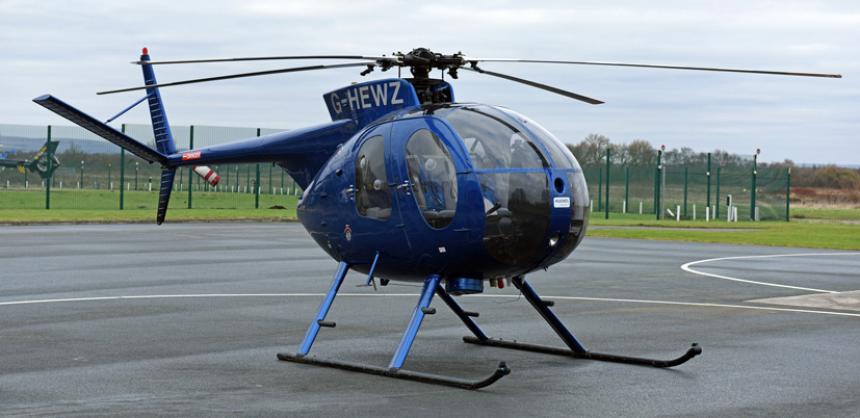
Almost as soon as the GlobalRanger had taken off, an equally enigmatic machine entered the circuit at Barton and prepared to land in the spot vacated by Bell 429. To many enthusiasts, the Hughes 369/500 series is the epitome of small helicopter design and has been gracing the world’s skies since the prototype aircraft first flew in 1963. The 369 is a civilian development of the famous OH-6 Cayuse light observation helicopter (nicknamed Loach) produced for the US Army, which proved to be one of the most successful helicopter designs. The aircraft saw service during the Vietnam War and set 23 helicopter world records when it entered service. Produced in large numbers, this particular example (G-HEWZ) was built in 1974 and despite its age, still looks as good as the day it made its first flight – an extremely stylish mode of transport.

The Hughes 369/500 series is a particularly distinctive helicopter design


Putting a helicopter back in the hangar is now a one-man job
Many of the gathered enthusiasts would have been hoping for an opportunity to be allowed inside the helicopter hangar and view the delights within, particularly as this will have been the first time most of us would have been afforded the privilege. Although not exactly crammed with aircraft, there were two which immediately caught my attention, including another former Hughes Helicopter design. This Schweizer 300CBi (G-CEBE) is a development of the Hughes 269 helicopter, which was later manufactured by both Sikorski and Schweizer Aircraft Corporation as a light utility and training machine. This family of helicopters has been in production for almost 50 years and is something of a rotary classic, being perhaps the most cost effective helicopter platform for both training and agricultural requirements.

The diminutive Schweizer 300CBi is a cost-effective way to fly


The classic Bell 206 JetRanger is arguably the most recognisable helicopter in the world
As far as classic helicopter designs are concerned, the Bell 206 JetRanger family of aircraft are very much at the head of this pack. With almost 8,500 aircraft already produced, this is the third most successful helicopter design in the history of flight, securing both military and civilian sales from customers all over the world. As one of the most instantly recognisable helicopters in the world, the JetRanger will be familiar to most aircraft enthusiasts and the sight of this classic at Barton was a real treat for attendees on the Photographers Day. This particular aircraft carried the registration G-JTBX and is owned and operated by a local businessman and aviation enthusiast.
The City Heliport is also home to a pair of aircraft which help to keep the people of the North West safe, acting as aviation ‘Angels on our shoulders’. With over 500 aircraft in service with emergency medical services all over the world, the Eurocopter EC-135 is becoming one of the most recognised aircraft in the world and one which many members of the public will see regularly. Providing fast and efficient medical transfer for patients requiring immediate medical assistance, these helicopters are usually the sign that a significant incident has occurred, as the highly professional crews race to the scene – if you are unfortunate to be involved, you will certainly be glad to see the Air Ambulance arriving. As these aircraft are an indication that help is always there should we ever need it, these EC-135s and their crews are always held in great affection, with communities raising thousands of pounds to help keep these vital services in operation. The aircraft that thankfully stayed on the ground at Barton was G-SPHU, which previously served with the Strathclyde Police and various Air Ambulance services around the country.


The Air Ambulance is a reassuring sight in the skies above the North West
One compound that we certainly did not have access to during our day was the Police Helicopter Unit, which is situated next to the City Heliport at Barton. For obvious reasons, this area is restricted and we were asked not to take photographs during our visit, which we were all more than happy to comply with. Fortunately, as we moved on to other locations around the airfield, the Police helicopter was scrambled and as members of the crew were acknowledging our group, I thought it would be ok to grab a few shots as it flew by. Once again using the robust and reliable Eurocopter EC135, this much more sinister looking black and yellow machine is positively bristling with cameras and detection equipment, designed to be an eye in the sky for the hard working police forces of the North West, in their effort to prevent crime and bring criminals to justice. G-LASU was previously with the Lancashire Police Air Support Unit based at Warton aerodrome, but now wears the livery of the National Police Air Service.


The Eurocopter EC135 is becoming one of the world’s most effective helicopters
The National Police Air Service is a cost effective and coordinated network of air policing assets, which ensure that the police service has the ability to quickly deploy aircraft to tackle crime and to protect the public. It also ensures that at any one time, regional forces may have access to multiple air assets at any one time, therefore increasing the effectiveness of the service. At the heart of this demanding service is the need to be effective in challenging economic times, whilst always delivering value for money for the tax payer. As well as performing the obvious tasks of tracking and locating suspects and vehicle pursuits, the NPAS helicopters also act as airborne command and control centres, serve as highly visible policing assets and also search for missing people when required. As the nature of policing continues to evolve, the work of the Police helicopter will surely become even more important in the future.
Our extremely enjoyable visit to Barton aerodrome encompassed a number of locations around the airfield and despite the rather dreary conditions on the day, the organisers are to be commended for arranging an excellent event. As the first of its kind, I am sure that I speak on behalf of everyone who attended in saying that it was a resounding success and surely the blueprint for many similar events in the future. It certainly allows a much clearer appreciation of the activities taking place at the airfield and speaking with fellow members helps to unlock some of the fascinating secrets behind the history of one of Britain’s most important early aerodromes. I will definitely be keeping an eye out for future Friends of Barton Aerodrome events.
Here is a final selection of images taken on the inaugural Friends of Barton Aerodrome Photographers Day.

Cessna F150, one of the general aviation movements during our visit

This airfield fire trainer was located on the far side of the airfield

A Barton classic – 1946 built Auster J-1 Autocrat G-AJEE

These barrage balloon anchors were used to protect the airfield during WWII

This Steen Skybolt is a US designed home-built aerobatic biplane

View across the airfield showing the historic control tower and late 1920s hangar at Barton

Another view of the hangar network at Manchester Barton
I hope you enjoyed this review of my trip around Barton Aerodrome and I hope it will inspire many of you to send in details and photographs of your own local airfield. It would be nice to think that in our 2017 review edition of Aerodrome, we could be featuring the most exotic, or interesting aircraft picture submitted in support of our ‘Project Aerodrome’ initiative – the challenge is on and it is time for Aerodrome readers to get involved. I would be grateful if you would send any photographs and initial contact details to me at aerodrome@airfix.com or aerodrome@corgi.co.uk where I very much look forward to hearing from you. It is exciting to think that our readers will be educating and informing fellow readers on some of the lesser known aviation venues around the world and revealing a host of fascinating aviation related stories in the process.
I am afraid that is all we have for you in this latest edition. As usual, if you would like to join in with all the latest social media discussions regarding Aerodrome and aviation matters in general, please head for either the Airfix Aerodrome Forum or our Corgi Aerodrome Forum and have your say. If you have any specific comments, questions or suggestions for future editions of Aerodrome, please do feel free to let us know by using either the Airfix Facebook or Corgi Facebook pages, our Airfix Twitter or Corgi Twitter accounts, using #aerodrome. If e-mail is more your style, then please use our usual addresses above.
We are always looking to appeal to aviation enthusiasts all around the world and continue to increase readership of our Aerodrome blog. We would be most grateful if you would mention us to anyone who may be interested in joining our numbers and direct them to the Community section of either the Airfix or Corgi websites, where they will be able to find all our previous blogs. You can also pick up new Aerodrome notifications on both the Corgi and Airfix Facebook pages.
As usual, thank you for taking the time to read our latest blog and I look forward to bringing you more aviation related content in the next edition of Aerodrome.
Michael
© Hornby Hobbies Ltd. All rights reserved

