As a confirmed aviation enthusiast, I have to admit that there is nothing quite like having an interesting project on your doorstep which will allow the opportunity for you to make regular visits to check on its progress. Unfortunately, since the days of my youth, the North West of England has seen a steady decline in such opportunities as aviation heritage continues to fall way down the list of local authority priorities with airfields and aviation sites continuing to close. These days, one of the closest aviation venues to me in Lancashire is the Yorkshire Air Museum at Elvington and, over the years, I have made the regular pilgrimage across the Pennines on many occasions. Recently, I had an unusual, early season opportunity to visit Elvington for a special event and as I never go anywhere without my camera, I thought that you might like to see what I got up to in this latest edition of Aerodrome.
I am sure that many Aerodrome readers will be just like me, in trying to get to as many Airshows as they possibly can, during the summer months. The opportunity to attend out of season events are few and far between these days, but when they do become available they can be particularly enjoyable and yield some unique and interesting photographs which would simply not be possible at other times of the year. A professionally organised aviation ‘night-shoot’ at Elvington had me quickly booking a ticket and preparing my camera gear, without giving the matter a second thought – this was just too good an opportunity to miss.
The Yorkshire Air Museum at Elvington is a delightful venue for anyone interested in aviation to pay a visit - I am probably doing it a disservice with this description because there are so many interesting exhibits and displays, that a family day out at Elvington will surely not disappoint any member of the group. Undoubtedly, the collection of preserved aircraft is the main reason why people travel to the museum and they really can boast a number of extremely high profile aircraft exhibits around the site. For this article, I am going to focus on just one of Elvington’s embarrassment of aviation riches, as it is an aircraft that I have admired many times over the years and is the life’s work of one very special man.

The chance to experience a professionally organised aviation night photo shoot is something to get any enthusiast's juices flowing – combine this with the rare opportunity to see some of Britain’s rarest aircraft on an excursion outside the safety of their hangars and you have an event that simply could not be missed. I decided to set off a little earlier than most people that would be attending, for a couple of specific reasons – firstly, as the event was taking place in March, the weather can still be relied on to be cold and wet. If the sun was going to put in an appearance, however fleeting this may be, I wanted to be in position to take advantage of this phenomenon. Secondly, even though the photo shoot event was not scheduled to begin until the early evening, aircraft would have to be positioned and prepared during the afternoon, which may just yield some fantastic photographic opportunities. For once, I was rewarded with good fortune and I enjoyed a very memorable day at Elvington.
The De Havilland Mosquito was one of the most important British aircraft of WWII and could be described as the RAF’s first true multi-role aircraft. Built using so called ‘non-strategic’ materials, the Mosquito utilised laminated wood construction, which was important in allowing it to be built and tested largely without Ministry interference. What De Havilland managed to produce was one of the fastest aircraft in the world at that time and one that would prove to be something of an aviation phenomenon. Flying sorties as a bomber, day and night fighter, pathfinder, maritime strike and reconnaissance aircraft, the Mosquito quickly became one of the most valuable assets available to the Royal Air Force, from its service introduction in 1941.
As a young man, I was absolutely besotted with the beautiful Mosquito T.III (RR299), which was operated by British Aerospace. I almost grew up with this aircraft on my shoulder, as it seemed to be a display item at almost every Airshow I attended, from the age of 14. In those memorable days, the average Airshow could boast much more interesting content than the shows we have today and I feel a little foolish in saying that I think we were all probably guilty of taking those days for granted – what we wouldn’t give for the opportunity to re-live those days now! Unfortunately, the British Aerospace Mosquito was tragically lost in an accident at Barton Aerodrome in July 1996, with the terrible loss of both airmen – since that fateful day, Britain has been without a flying Mosquito on the Airshow circuit, which is a situation that does not look like changing any time soon.
With few De Havilland Mosquitos remaining on display in the UK, Elvington’s rare example is of great interest to aviation enthusiasts throughout the world. Constructed as the only NF.11 variant still in existence, HJ711 really is one of the most important historic aircraft in Britain and is most definitely one of the main attractions to be found at the Yorkshire Air Museum. The aircraft itself stands testament to the vision and dedication of one man – Tony Agar. Tony has spent over 40 years trying to realise his dream of restoring a De Havilland Mosquito to complete display condition and having seen the fruits of his labours many times over the years, I have nothing but admiration for his dedication and resourcefulness. It is important to document that Tony has achieved all this without any financial backing at all and when you stand and admire this magnificent Mosquito, you are really left wondering how on earth he managed to achieve this magnificent feat.

Tony began his project to obtain and restore a Mosquito way back in 1971. You may think that this would start with the purchase of a substantial airframe section, with further components added in time – unfortunately, this would not be possible in this case and it would have to be done the hard way. Tony scoured the country for news of available Mosquito parts and would then try to secure them, in the most cost effective method possible. At this time, the components would be transported to Tony’s home in York and any restoration, or construction work would take place in the confines of his garage, or outside on his driveway. This was obviously not ideal, but Tony is no ordinary man and the more difficult things became, the more determined he was to succeed.
The adoption of the identity of De Havilland Mosquito NF.II (HJ711) occurred right at the start of this project. The aircraft is actually a composite rebuild, using parts from a number of Mosquito airframes, including RS715, PF498, VA878 and NT616, but as the cockpit section was secured from a dealer in Blackpool, information available at that time suggested that it was from Night fighter HJ711. This aircraft served with RAF No.141 and No.169 squadrons during WWII and indeed is credited with an aerial victory, whilst serving with No.169 squadron. On 30th January 1944, Mosquito HJ711 was flying from Little Snoring airfield, Norfolk, in the hands of Squadron Leader J.A.H Cooper, on a night intruder mission over Germany. Whilst patrolling west of Berlin, Cooper spotted a Messerschmitt Bf 110 nightfighter and managed to shoot it down – the first aerial victory for the squadron. Once discovering this information and making contact with the people from No.169 squadron, there really was only one identity for Tony’s Mosquito.
Perhaps the most significant development in the history of this Mosquito project occurred in 1986 – in this year, the entire restoration moved from the austerity of Tony’s garage, to the palatial surroundings of the Yorkshire Air Museum. This stimulated a period of greater activity and much higher profile for this Mosquito restoration – a fantastic liaison, which continues to this day. Enthusiasts continue to visit Elvington regularly, with the express intention of paying their respects to this rare and beautiful aircraft – I count myself as being amongst this number.
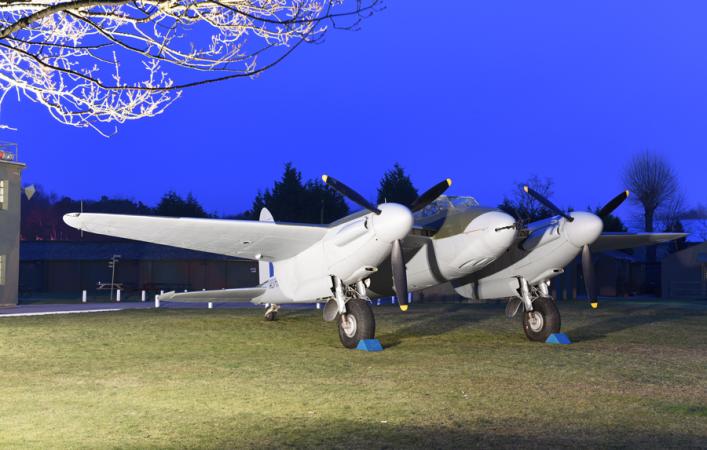
Mosquito HJ711 is an extremely rare aircraft indeed and as such, she hardly ever spends time outside the security of her hangar. When she does venture outside, it really is time for aviation enthusiasts to clear their diaries and quickly head to Yorkshire. I must say that I was a little surprised that the recent night-shoot was arranged so early in the year, as the weather can still be quite bad in March and as we can all fully understand, poor weather and historic aeroplanes simply do not mix. That being said, as I clapped eyes on the Mosquito for the first time in a couple of years, I have to say that she looked absolutely magnificent on the grass, just in front of Elvington’s restored control tower – what a sight! I just found myself hoping that the weather was going to be kind to this beautiful aeroplane, on her spring excursion.

As I loitered around the aircraft for what seemed like most of the afternoon, I was lucky enough to catch a quick word with Tony himself – he was also hovering around the Mosquito, but looking decidedly more stressed than I was myself. I could fully understand why he would be worried about having his aircraft outside the hangar, but I did thank him for allowing us to have the opportunity of seeing it in these unique surroundings. Although I am sure that he will be really happy about the interest and affection the public shows his Mosquito, he must worry every time she is dragged outside the protection of her hangar and when you consider the sheer physical effort he has invested in this project, you can hardly blame him. In these days of austerity, aviation history and museums in general need all the publicity they can get and a photographic event featuring one of the rarest WWII fighters in the world, is simply an opportunity too good for Elvington to pass up. There is, of course, another side to this story. Having the Mosquito outside for even just a short time, could quite literally put the project back months and result in significant remedial work being required, with all the associated expense. It is no wonder that Tony had a rather furrowed brow on the day.
Thankfully, I think the weather was kind to Mosquito HJ711 and I hope that Tony managed to get her safely back in the hangar unscathed. I am sure that everyone who managed to see her outside for those few days in March, will have very much enjoyed the opportunity to do so and would like to thank Tony for allowing us this experience – even though these occasions are few and far between, I certainly hope that I will be in attendance the next time it happens.
The future of De Havilland Mosquito NF.11 HJ711 looks like being a very interesting one. With two working Merlin engines now installed, it is hoped that this very rare aircraft will be able to taxi under its own power in the very near future, making it the only Mosquito capable of doing this in Europe. The significance of this development cannot be exaggerated and when it happens, this already famous aircraft is destined for even greater things - if it does happen, Tony Agar will surely be destined for national recognition of his stunning achievement and steadfast dedication.

I would like to end this latest edition of Aerodrome, by looking at the die-cast aviation collectors version of the famous Elvington Mosquito. The 1/72nd scale Mosquito tooling in the Aviation Archive range has to be considered as one of the most successful models in the entire range, with many thousands of models already lining the shelves of collectors, all over the world. AA32819 was released in late 2013 and presented the collector with an example of rare Mosquito NF.11 (HJ711), which is the aircraft on display at the Yorkshire Air Museum. If you have one of these beautiful models in your own collection, you can count yourself to be extremely fortunate, as they have been totally sold out for a great many months. If you are searching for one, your only remaining hope is to scour the secondary market, although you will be very lucky to find one now – these beauties rarely become available. I just hope that someone was good enough to buy one for Tony Agar!
Thank you very much for reading the latest edition of Aerodrome.
If you have any comments, questions or suggestions for future editions, please feel free to let us know on the Aerodrome Forum, or on Corgi Twitter using #corgiaerodrome.
Michael

